AMR vs AGV in 2026: which mobile robot fits your warehouse or factory?
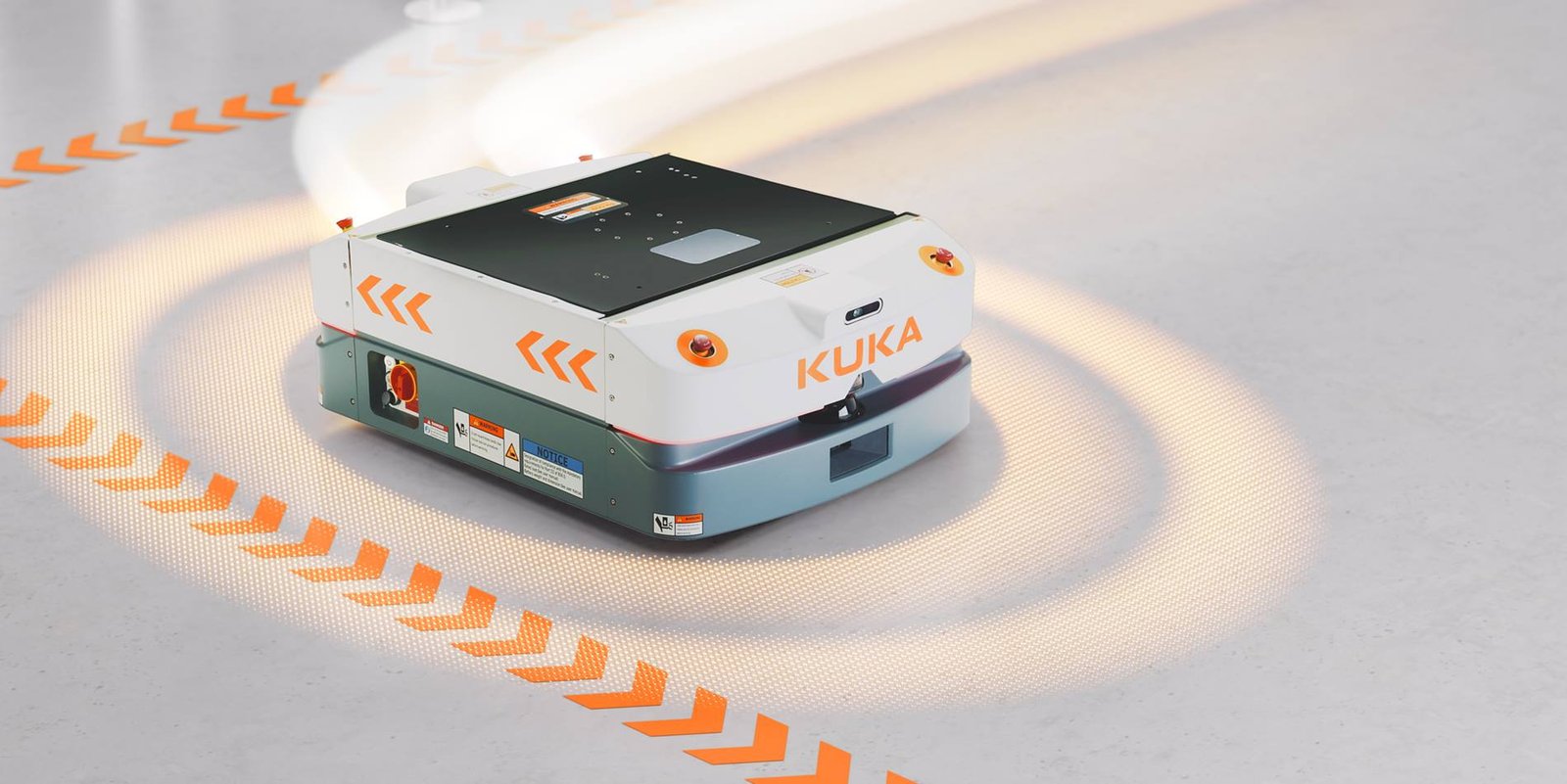
Featured image: KUKA Group — KMP 600-S diffDrive. Press material used in an editorial reporting context.
AMR or AGV? In 2026 the answer is less obvious than marketing material suggests. The simplest rule still works: AGVs are strongest where the process is stable, routes are predictable and deterministic flow matters; AMRs are strongest where layouts, human traffic and tasks change frequently. But the boundary between the categories is increasingly blurred. A vehicle marketed as an AGV can use SLAM, laser scanners and sophisticated fleet management, while an AMR may still be constrained by corridors, zones and traffic rules.
So the buying process should not start with “which acronym is better?”. It should start with: who plans the route, what happens when an obstacle appears, how much work a layout change creates, how the system connects to WMS/MES/ERP, and who owns safety responsibility for the complete application?
AMR vs AGV at a glance
| Criterion | AGV | AMR |
|---|---|---|
| Core motion logic | Follows a defined path / guidepath | Plans trajectories and avoids obstacles without relying on one predefined guidepath |
| Layout changes | Usually require more route or infrastructure reconfiguration | Usually easier through maps, zones and software configuration |
| Dynamic obstacles | Often prioritises safe stop and resume on the route | Can dynamically select an alternative trajectory when the application permits it |
| Flow predictability | Excellent in fixed repetitive processes | Excellent with good fleet management, but greater autonomy demands better orchestration |
| Natural environment | Stable corridors and repeatable A-to-B flows | Changing and shared environments |
| Integration | Can be simple in a closed fixed process | Often depends more heavily on mapping, APIs, fleet manager and task logic |
| Main trap | Cost of future changes | Overestimating “autonomy” without good traffic and integration design |
What do AGV and AMR actually mean?
ANSI/A3 R15.08 defines an AGV as a mobile platform following a predefined path indicated by markers or external guidance commands. An AMR is a mobile platform that can navigate using obstacle avoidance and trajectory planning rather than a predefined guidepath.
That distinction is more important than the sensor type. An AGV no longer has to mean a wire embedded in the floor or magnetic tape. KUKA's KMP 600-S diffDrive is a useful example: KUKA calls it an AGV, yet the system learns the environment using SLAM, localises the vehicle and selects the best route within a defined road network. LiDAR or SLAM alone therefore does not automatically turn a vehicle into an AMR.
Likewise, “AMR” does not mean unrestricted freedom to drive anywhere. In a well-designed facility, autonomy is bounded by safety zones, direction rules, priorities, restricted areas and fleet-manager constraints. In practice the decision architecture matters more than the label in the brochure.
Why the boundary is even blurrier in 2026
The clearest signal is VDA 5050 3.0, released in 2026. The interface connects mobile robots with a higher-level fleet control system and is intended to support mixed fleets from different manufacturers. Version 3.0 explicitly extends the model to robots with higher autonomy. It introduces free-navigation zones in which the vehicle can plan its own detailed route between waypoints while the master controller still defines movement rules and receives the planned path.
This confirms the direction of the market: instead of two clean boxes, mobile robotics is becoming a spectrum from highly deterministic guided systems to robots that locally plan motion. For a buyer the implication is simple: an RFQ should describe required behaviour rather than merely demand an “AMR”.
When is an AGV still the better choice?
An AGV is not “old technology that AMRs always replace”. In many facilities a more controlled architecture is an advantage. If material is expected to move between the same machines for ten years, the aisle is predictable and layout changes are rare, the extra freedom of an AMR may not create value proportional to its complexity.
- Highly stable mass production: fixed pickup/drop-off points, repeatable takt and few exceptions.
- Dedicated corridors: traffic can be physically or operationally separated from intense human movement.
- Deterministic flow: repeatability matters more than dynamic rerouting.
- Special payload carriers: heavy or unusual loads where the transport system is engineered as one integrated application.
- Very few lifecycle changes: future reconfiguration cost is low because the layout is genuinely stable.
In those cases a well-integrated AGV can be easier to validate, highly predictable and extremely productive. That does not mean “AGV = cheaper”. Cost depends on guidance infrastructure, intersections, safety, charging, integration and future facility changes.
When does an AMR have a clear advantage?
AMRs gain value when reality refuses to stay on one route. In warehouses, high-mix/low-volume production and facilities where lines or workstations are regularly reconfigured, mapping, localisation and alternative path planning can reduce the cost of change and shorten recommissioning.
- Dynamic layouts: racks, stations or delivery points move.
- Shared traffic: people, forklifts, pallet trucks and robots use the same corridors.
- Multiple mission types: the same robot receives different jobs based on queue and priority.
- Incremental scaling: the project starts with a few robots and grows with the process.
- Digital logistics integration: missions are issued by WMS, MES, ERP or line-call systems.
Heavy-duty AMRs also show that autonomy is not limited to lightweight tote carts. OTTO 1500 is designed for payloads up to 1,900 kg and combines LiDAR, 3D cameras and autonomous localisation. Autonomous forklifts occupy another part of the market, acquiring pallets from floor locations, stands or machines. Payload capacity alone should therefore never decide the AGV-versus-AMR question.
The key question: is your process stable or variable?
Before comparing quotations, count how often routes, stations, buffers and transport priorities changed during the last 24 months. If the answer is “almost never”, an AGV may be highly rational. If change is part of the operating model, AMR flexibility begins to have measurable business value.
This analysis matters more than an impressive demo run. A robot may elegantly drive around a person during a demonstration, but if 95% of its working life is one predictable A-to-B loop, you may be paying for a capability that does not solve the main constraint. Conversely, if a single box left in an aisle regularly stops material movement, a system that always waits for manual clearance can create hidden operating cost that never appears in the purchase price.
AMR vs AGV: seven buying criteria
1. Route complexity and frequency of change
Do not record only route length. Count nodes, intersections, one-way sections, poor-visibility locations, doors, lifts and zones that are periodically occupied. The more variability you have, the more value local AMR planning can potentially create.
2. Payload and transfer method
“1,000 kg payload” is not enough. Does the robot only carry a top module? Must it pick a pallet from the floor? Drive under a rack? Synchronise with a conveyor? Correct for a skewed pallet? In many projects the attachment and docking performance decide success more than headline navigation technology.
3. Human and vehicle traffic
A shared aisle containing pedestrians, manual pallet trucks and forklifts is fundamentally different from a controlled transport loop. Stopping before an obstacle is safe but may be operationally expensive. Dynamic avoidance, however, must also be constrained so that a robot does not create a new traffic conflict while trying to solve the first one.
4. Fleet management and congestion
With one robot, navigation gets the attention. With twenty, task allocation, intersection reservation, charging, priorities, deadlocks and fault recovery become more important. OTTO describes fleet-management logic in which robots exchange information and predict approaching intersections. In a larger fleet, software can influence throughput more than a small difference in vehicle top speed.
5. IT/OT integration
Check APIs, mission triggers, WMS/MES/ERP integration, offline behaviour, network requirements, event logs and user management. In multi-vendor projects, ask about VDA 5050 3.0, but do not assume a compatibility logo guarantees every function is interoperable. Verify the implemented feature set and test it with the selected master control.
6. Safety
You do not buy a “safe robot” independently of its application. Payload, speed, braking, visibility, zones, pedestrian crossings, transfers, manipulators and environmental changes all matter. ISO 3691-4:2023 covers safety requirements for driverless industrial trucks and explicitly lists both AGVs and AMRs as examples. In the US, ANSI/A3 R15.08 separates requirements for the IMR itself, system integration and use of the application; Part 3 was published in 2026 and places strong emphasis on risk assessment and management of change.
7. TCO rather than vehicle price
Compare not only robot CAPEX but project engineering, guidance infrastructure, integration, chargers, attachments, fleet-manager licences, mapping, safety validation, training, Wi-Fi, spare parts, service levels, software updates and the cost of future changes. Treat vendor claims of extremely short payback as marketing until your own process data produces the same result.
Safety and standards: what is current in 2026?
In Europe an important reference remains ISO 3691-4:2023. At the same time, work on a third edition is already underway in 2026: ISO/DIS 3691-4 is in the Draft International Standard process. A procurement specification should not treat that unpublished edition as if it were already the current international standard.
In the US, the current ANSI/A3 R15.08 series includes Part 1 for the industrial mobile robot, Part 2 for systems/integration and Part 3 for use of IMR applications, published in April 2026. A3 also notes that R15.08 and ISO 3691-4 originated from different assumptions and should not be treated as directly equivalent standards.
New EU projects also need to keep Regulation (EU) 2023/1230 on machinery in view; it applies from 20 January 2027. A project purchased in 2026 but commissioned or materially changed later should have explicit ownership of conformity and technical documentation.
VDA 5050 3.0: especially important for mixed fleets
If a facility wants to reduce lock-in to one supplier, VDA 5050 is one of the most important topics to discuss. Version 3.0 extends the interface toward freely navigating robots and introduces zones. A master controller can impose rules for an area while the robot plans the detailed path between waypoints and shares that path back to the higher-level system.
It does not eliminate all integration complexity. Vendors can support different actions, fields, error states and optional capabilities. An RFQ should therefore ask not just “VDA 5050?” but for the protocol version, implemented feature list, test scenario and proven operation with the selected master control.
Three practical selection scenarios
Scenario A: production line, one loop, 24/7
Five stations, fixed takt, almost no layout changes and controlled corridors. An AGV is a very strong candidate. Deterministic routing can be an advantage and the value of autonomous rerouting may be limited.
Scenario B: warehouse and high-variability production
Dozens of locations, WMS priorities, changing buffers, pedestrian traffic and regular layout changes. An AMR has a natural advantage, provided the fleet manager and integration are engineered properly.
Scenario C: heavy pallets between production and warehouse
Do not decide from the name. The market includes heavy AGVs, heavy AMRs and autonomous forklifts. Start with payload, pallet geometry, pickup tolerance, required takt, manual-forklift traffic and transfer method. Only then compare motion architecture. RoboMorrow will cover pallet-transport robots in a dedicated guide next.
10 questions to ask a supplier before signing
- Who plans the route: the robot, fleet manager or central master control?
- Exactly what happens when an obstacle appears, and when does the system select an alternative?
- How much work is required to change a layout, pickup point or traffic direction?
- How does the system integrate with our WMS/MES/ERP and which APIs are available?
- What happens after loss of Wi-Fi, localisation or fleet-manager connectivity?
- How are congestion, deadlocks and failures tested at the target fleet size?
- Which safety standards are covered by the manufacturer, and what remains the integrator/user responsibility?
- Does the solution support VDA 5050 3.0, and what is the actual implementation scope?
- What are the costs of licences, support, updates, batteries, attachments and fleet expansion after three to five years?
- Which acceptance KPIs will be contractual: missions/hour, cycle time, availability, blockages, manual interventions or transport cost?
RoboMorrow verdict
In 2026 it makes little sense to describe AMR as “newer and always better AGV”. AGVs remain excellent for fixed, repetitive and controlled flows. AMRs are stronger where process variability, shared traffic and frequent reconfiguration create genuine business value.
The bigger change is that the market is moving away from a simplistic AGV-versus-AMR debate toward software-managed, interoperable mobile robots selected for the right level of autonomy. VDA 5050 3.0 illustrates that direction well. A good procurement specification should therefore define the process, exception behaviour, integration, safety and TCO first — and the acronym on the vehicle second.
Sources
- A3 — AGV/AMR definitions and R15.08 versus ISO 3691-4
- A3 — current ANSI/A3 R15.08 series, including 2026 Part 3
- ISO — ISO 3691-4:2023
- ISO — third-edition ISO/DIS 3691-4 project
- VDA — VDA 5050 Version 3.0
- KUKA — KMP 600-S diffDrive and KUKA.NavigationSolution
- OTTO by Rockwell Automation — AMRs and fleet management
- Mobile Industrial Robots — AGV/AMR comparison (manufacturer source)
- EUR-Lex — Regulation (EU) 2023/1230