Gatik raises $200M as driverless freight moves beyond pilots
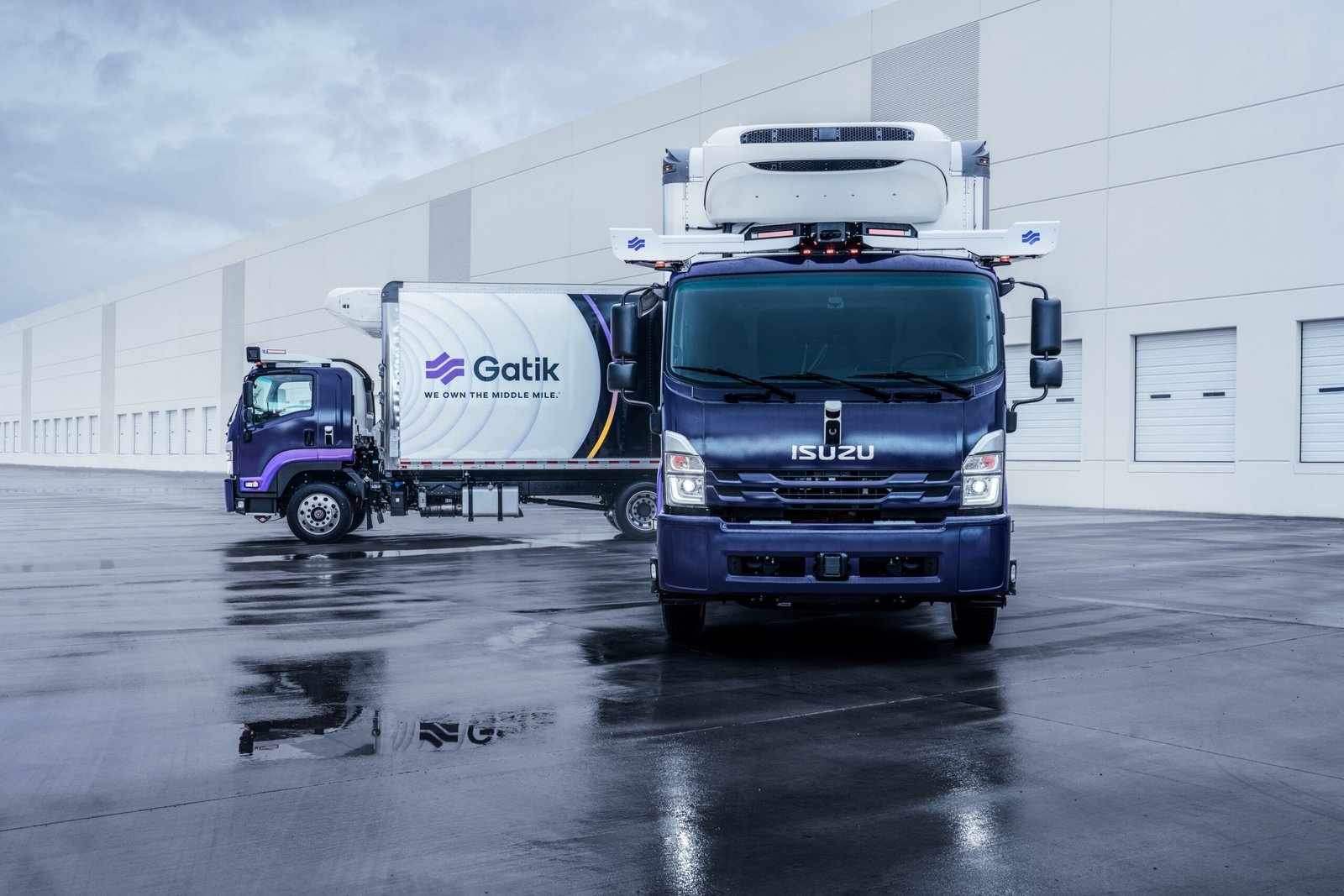
Gatik is a reminder that physical automation is much broader than humanoids. Its autonomous trucks move goods every day on repeated routes between distribution centers and stores, and the new financing is intended to scale a model already operating inside major supply chains.
The financing is large, but contracted business matters more
The Series D is led by Qatar Investment Authority and Koch Disruptive Technologies, with Millennium Management, ARK Invest and Intact Private Capital also participating. Gatik did not disclose its valuation. Reuters independently confirms the round, investor group and expansion plan.
Gatik reports more than $600 million in contracted revenue, 85,000 fully driverless orders and 99% on-time delivery. Those metrics are company-reported rather than an independent audit. Even so, the contracted business differentiates Gatik from many autonomy projects that still operate primarily as technology pilots.
Middle-mile freight is less flashy but economically logical
Gatik focuses on repeated routes between distribution centers and stores. That is a more controllable environment than general-purpose robotaxis: routes are known, pickup and drop-off points are predictable, and enterprise customers can redesign processes around an autonomous fleet.
The company operates in Texas, Arizona and Arkansas as well as Canada. Reuters names PepsiCo and Loblaw among major customers. Gatik says it already has dozens of driverless trucks and is targeting more than 100 by the end of 2026.
Capital goes into fleet, infrastructure and people
The new $200 million is intended for commercial expansion, fleet growth, infrastructure, technology and hiring. That is the full physical-automation stack: software alone is not enough without depots, service, remote support, maintenance procedures and vehicles ready for sustained operation.
Gatik’s earlier work with Isuzu is aimed at production-ready SAE Level 4 trucks. The next bottleneck after autonomy software is industrializing the vehicle itself — redundant braking, steering, power and sensor integration must be engineered as a production system rather than a prototype.
What is independently confirmed
Reuters confirms the financing amount, lead investors, operating geographies, customers and the target of more than 100 driverless trucks by year-end. TechCrunch adds detail on the PepsiCo deployment. What remains missing is an independent public audit of route-level profitability, intervention cost or total cost of ownership versus human-driven fleets.
RoboMorrow therefore does not claim autonomous freight has already won on economics. It is fair to say Gatik has one of the more tangible commercial evidence sets in mobile robotics: live routes, named customers, contracted revenue and capital to scale.
What it means for Poland and Europe
Europe has the same problem Gatik targets: driver shortages and expensive, repetitive freight flows between warehouses, distribution centers and stores. Technically, those fixed regional routes are attractive autonomy candidates, especially at night and in high-frequency logistics.
The barriers are regulation, homologation, liability and integration with local operators. Gatik has not announced Poland or a specific EU market. The model is still worth watching as a reminder that useful robotics can win large contracts without a humanoid form factor.
Sources and methodology
Primary source: Gatik, Aug. 25, 2026. Independent confirmation: Reuters and TechCrunch. Contracted revenue, 85,000 orders and 99% on-time delivery are company-reported metrics.
Why middle-mile freight may monetize faster than robotaxis
Gatik focuses on repeatable routes between distribution centers, warehouses and stores. That is a narrower problem than taking a passenger to any destination in a city. Routes can be selected for geometry, weather and infrastructure, while a business customer can calculate delivery cost, delay and vehicle utilization precisely. Autonomy can therefore be deployed where the economics work without first solving the entire problem of driving everywhere.
That does not mean the business model is fully proven. Contracted revenue is not the same as recognized revenue, and an order count does not reveal margin, remote-support cost, maintenance or insurance. Customers and investors will ultimately need metrics such as cost per mile, intervention frequency and fleet availability. Gatik does not publicly disclose a complete set of those operating economics today.
A European version makes sense — but regulation is harder
The model fits European transport between logistics hubs and stores, particularly where driver shortages and cost pressure are increasing. Closed or semi-constrained corridors and highly repeatable routes may be the easiest starting point. Different homologation rules, liability regimes, national regulation and denser road environments mean U.S. scale cannot simply be copied across the Atlantic. The larger signal from Gatik’s round is that investors are now funding physical autonomy tied to contracted workflows, not only a promise of a future platform.
The key advantage: a customer pays for a specific freight workflow
Robotics can easily confuse technology interest with commercial demand. Gatik has a simpler test: a truck either moves goods between network nodes every day or it does not. Multi-year agreements with large customers are therefore a stronger signal than test mileage without business context. Contract value still has to be distinguished from cash actually earned, because realization depends on scaling the fleet on time and maintaining service levels.
That is why the target of more than 100 driverless vehicles by the end of 2026 will be important. Moving from dozens to hundreds often exposes issues that small pilots hide: spare parts, field-team training, dispatch operations, insurance and exception handling. This is the point at which autonomous freight becomes a transport operation rather than primarily a technology project.