Chery’s AiMOGA Eyes IPO, Targets 10,000 Robot Deliveries in 2027
AiMOGA Robotics, the robotics company controlled by Chery Automobile, wants to scale rapidly and is considering a stock-market listing. Its head Zhang Guibing told Reuters that the business is discussing several possible listing venues. At the same time, management has set a target of 10,000 global robot deliveries in 2027, up from more than 3,000 delivered so far.
The important signal is not simply that another Chinese robotics company is using the word “IPO”. AiMOGA is trying to combine robotics with the operating infrastructure of a large automaker. Chery is China's largest vehicle exporter, and according to corporate data cited by Reuters it owns almost 77% of AiMOGA. If this model works, the company's advantage may come not only from the robot itself but also from manufacturing, logistics, distribution and service.
The IPO is an intention, not yet a formally launched process
Zhang told Reuters that AiMOGA is making preparations and discussing several possible listing locations. A future IPO could provide capital for technology investment while improving governance and transparency. He did not disclose an exchange, timetable, deal size or expected valuation.
The most important caveat was added in Reuters' corrected 21 August version: AiMOGA said it has not taken any “substantive steps” toward an IPO. That means it would be misleading to describe the listing as decided or already advanced. What is confirmed today is management's intention and discussions over possible venues.
More than 3,000 deliveries, including 2,000 overseas
Reuters says AiMOGA has already delivered more than 3,000 robots globally, including around 2,000 outside China, and operates across more than 60 countries and regions. CnEVPost separately reported the 2,000th overseas-delivery milestone at the end of July, when Chery held a shipment ceremony in Wuhu.
Those numbers need careful interpretation. AiMOGA sells several robot formats: bipedal humanoids, service robots, public-service systems and quadrupeds. Three thousand deliveries do not mean 3,000 humanoids doing regular productive work. The number covers the wider robotics business, while public data does not provide a complete model mix, revenue split or utilization after installation.
The 10,000-unit target for 2027 is a management goal, not an audited forecast. That distinction matters in a market where definitions are still unstable: public H1 2026 humanoid shipment trackers differ by almost a factor of two, depending on product scope and what counts as a shipment.
110 police and traffic robots: real deployment, but not a conventional biped
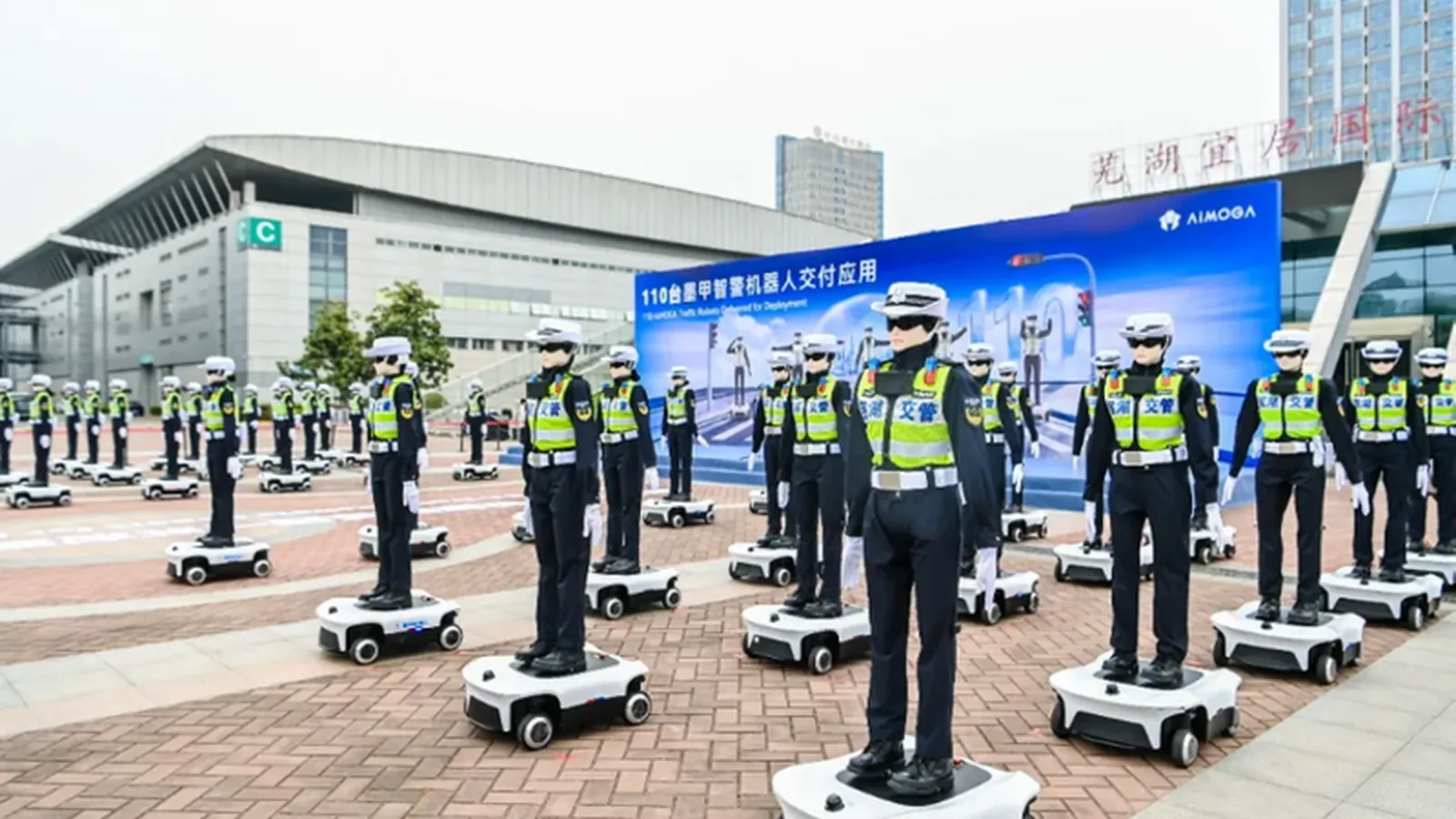
One of AiMOGA's clearest real-world programs involves robots used for traffic management, crowd guidance and public-safety awareness. Reuters reports 110 units deployed across several Chinese cities. In AiMOGA's own materials, the Intelligent Police R001 is presented as a system for standardized traffic gestures, monitoring and public prompts at intersections.
The “humanoid police robot” label should not obscure the hardware form. AiMOGA material shows R001 with an anthropomorphic upper body mounted on a wheeled mobile base. It is therefore not a bipedal robot walking a beat like a person. That matters when comparing it with classic humanoids, even if the wheeled architecture may be entirely sensible for repetitive intersection work.
AiMOGA's most important advantage may come from Chery
AiMOGA was incubated by Chery in January 2025. CnEVPost reports that it draws on the group’s research and development, manufacturing, supply-chain, logistics and distribution capabilities. This is where the story becomes bigger than another robotics startup: an automaker can attempt to reuse an existing global operating machine to scale a new hardware category.
Automotive capabilities such as sensing, control, autonomous systems, power electronics, serial manufacturing and service overlap with several requirements in robotics. That does not guarantee that a car company will build a better humanoid. It does mean it may be better positioned to solve the problems that often appear after a pilot: spare parts, manufacturing consistency, multi-country support, repairs and local-partner training.
Middle East and Southeast Asia are priority markets
Zhang highlighted the Middle East and Southeast Asia in his Reuters interview. The rationale is that harsh working conditions, including extreme heat and heavy rainfall, can make some public-service roles more difficult and may increase the value of automation. AiMOGA says its initial overseas push will be led primarily by service robots and companion robots.
This remains strategy rather than a disclosed contract book. There is no public breakdown of the planned 10,000 deliveries by region, customer or robot type. It is also unclear how much human supervision current deployments require or how service economics work outside the Chery network.
Why this matters for Europe
For Europe, the distribution model matters more than the IPO headline. If AiMOGA can use Chery's channels, robots may enter new markets through infrastructure originally built for cars: local entities, dealers, spare-parts warehouses and service operations. That could shorten the route from demonstration to genuine commercial presence.
Europe also imposes demanding requirements around machinery safety, cybersecurity, data protection and AI accountability. Distribution alone is not enough. Integrators will need certification, SDK and diagnostic access, spare-parts commitments, service-level agreements and a clear definition of what the system can do autonomously. For the broader software bottleneck behind useful robotics, see our analysis of Unitree and robotics' “ChatGPT moment”.
RoboMorrow assessment
The most important story is not a future stock ticker but the possibility of scaling robots through automotive infrastructure. AiMOGA already has meaningful shipment volume and visible public-service deployments, but evaluating the quality of the business still requires data on product mix, revenue, margins, autonomy and fleet operating cost. The 10,000-delivery target will be a useful test of whether an automaker-backed robotics company can turn global operational reach into sustainable robotics scale.
Sources and verification: Reuters — corrected 21 August 2026 report and interview with Zhang Guibing · CnEVPost — 2,000 overseas deliveries, global footprint and Chery infrastructure · AiMOGA / PR Newswire — official Intelligent Police R001 description. RoboMorrow verification: 21 August 2026.