Unitree bets on world models as CEO defines robotics’ “ChatGPT moment”
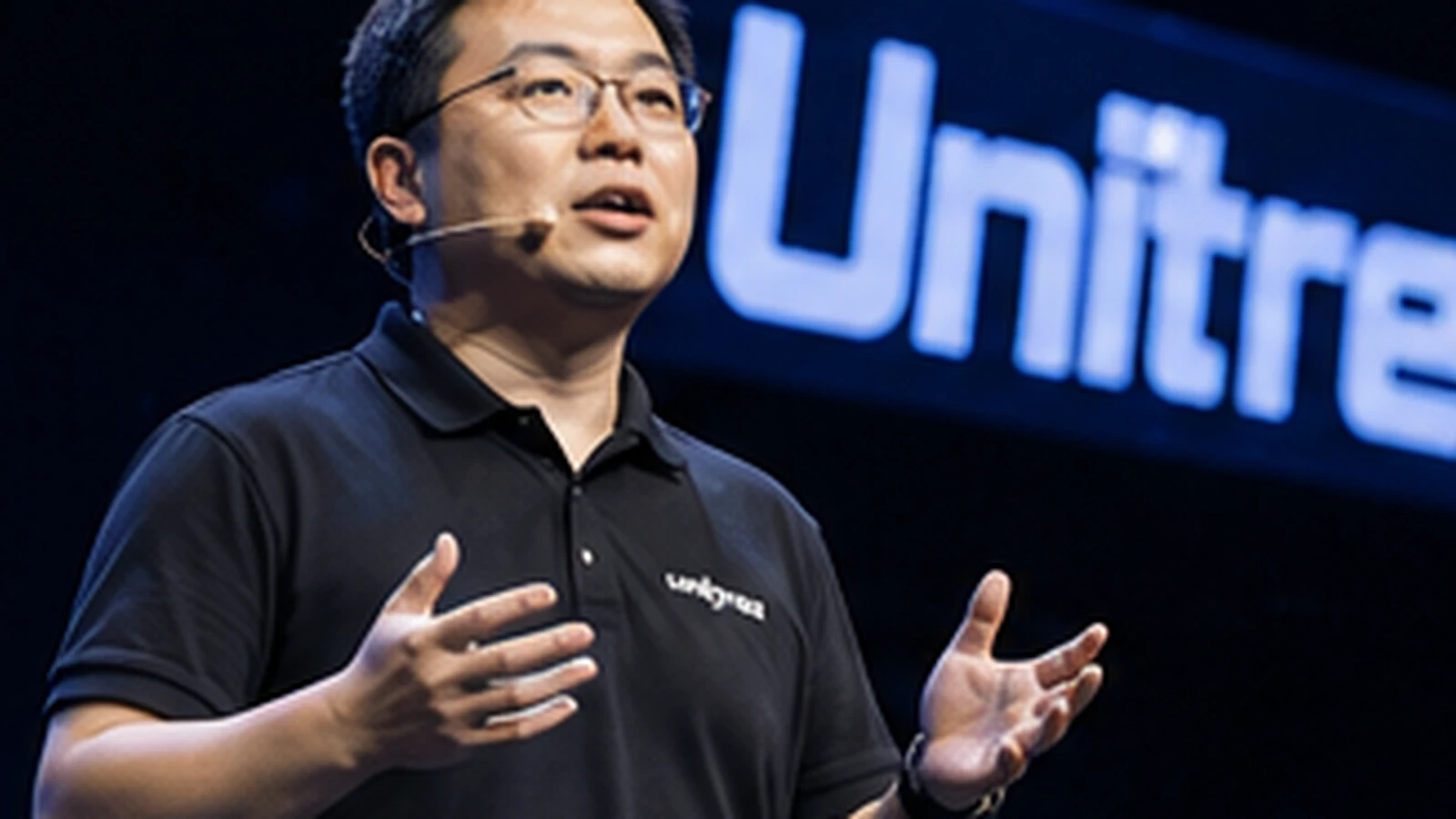
Unitree founder and CEO Wang Xingxing is making a clear distinction between impressive mechanics and useful intelligence. At the World Robot Conference he described a robotics “ChatGPT moment” as the point at which a robot could enter an unfamiliar home and complete roughly 80% of tasks from simple voice or text instructions.
In the same remarks, reported by Reuters on 20 August, Wang said world models are Unitree’s largest current investment in both capital and manpower. He also acknowledged that the company is lagging in real-world application of Physical AI models. That is more informative than another choreographed humanoid demo because it identifies software generalization as the bottleneck.
What Unitree means by a breakthrough
The 80% threshold is not an agreed industry benchmark. It is useful because it reveals how the CEO of a major robot maker defines a qualitative change: the robot should not need every room prepared or every task separately trained. It should enter a new environment, understand a natural instruction and compose an action sequence on its own.
Wang said a major software leap could come within two to three years in an optimistic scenario, or five to ten years in a more cautious one. The width of that range matters. It is a reminder that the industry still faces substantial technical uncertainty.
Why world models are central to Physical AI
A robot following broad instructions has to predict consequences in the physical world. If it moves a chair, does that create a path? If it grasps a cup too high, will the cup tilt? If a person enters its trajectory, what safe alternative should it choose? A world model aims to provide a representation of environment dynamics that can support planning.
In a real system that representation must work with perception, a language or VLA layer, motion control and deterministic safety mechanisms. A strong predictive model does not fix gearbox backlash, poor friction, an unreliable grasp or bad depth data. Hardware and intelligence therefore remain tightly coupled.
Unitree says hardware is ahead of software
Reuters reports Wang saying humanoids are not yet capable enough for mass deployment and that the AI models behind decision-making and interaction remain the industry’s biggest bottleneck. Unitree’s IPO prospectus also shows that universities and research institutions represent a large part of its customer base. That is an important counterweight to videos of dancing or fighting robots.
Motion capability is not task autonomy
Dynamic motion is valuable evidence about actuators, control and mechanical design. It is not evidence that a robot can autonomously complete a productive workflow. Industrial buyers should care more about process success rate, mean time between interventions, minutes of teleoperation per operating hour, recovery time after failure and integration cost.
Those are the metrics RoboMorrow treats as more meaningful than stage demonstrations. That is why Wang’s comments are notable: a company that gained global recognition through spectacular motion demonstrations is itself identifying general-purpose software as the main market constraint.
What would “80% of household tasks” actually mean?
The figure should not be read as “the robot works correctly 80% of the time.” Wang is describing a hypothetical share of different everyday tasks that a general system could complete in an unfamiliar home from a natural instruction. A serious benchmark would still need to define the task distribution, success criteria, safety requirements, execution time and permitted human assistance.
Without that methodology, 80% is a strategic threshold rather than a measured KPI. It is nevertheless a useful question for the sector: can a robot generalize across new rooms, objects and requests, or is it reproducing jobs prepared during deployment?
What this means for Europe
A shift in value from mechanics toward models has two implications for Europe. First, component and platform makers cannot assume that excellent hardware alone creates a durable advantage. Second, there is room for European integration, safety, simulation and industrial-data companies that can turn a general model into a validated process.
For Polish and European integrators, the first useful application does not need to be a robot that cleans an entire home. A more plausible near-term route is a bounded factory or warehouse workflow where a world model helps handle variation while task limits and safety remain explicit. If Unitree is right, this software layer is where a large part of the next competitive battle will happen.
How to measure world-model progress instead of demo quality
A fair test of the claimed generalization should begin in an environment the robot did not see during deployment preparation. It should not receive a hand-written exception map or a separate program for every object. The evaluation should break performance into instruction understanding, planning, manipulation and recovery, because the same final failure can have very different causes.
Useful metrics include the share of tasks completed without assistance, interventions per operating hour, execution time relative to a person or conventional automation, collisions and safety-zone violations, energy use and performance after the layout changes. Teleoperation should also be separated explicitly from autonomy: remote correction may be a sensible product feature, but it is still an operating cost.
This protects against a recurring problem in humanoid coverage: a polished completion of one prepared sequence can look like general intelligence. A world model becomes commercially important when it raises reliability across unseen task variants, not merely when it improves the best demonstration.
Sources and verification
This article is based on: Reuters — Unitree CEO, RoboMorrow — Unitree G1. Manufacturer and analyst figures are identified as claims or estimates rather than audited facts. RoboMorrow verification: 20 August 2026.