Hesai passes 10,000 robot actuators as lidar supplier expands into Physical AI infrastructure
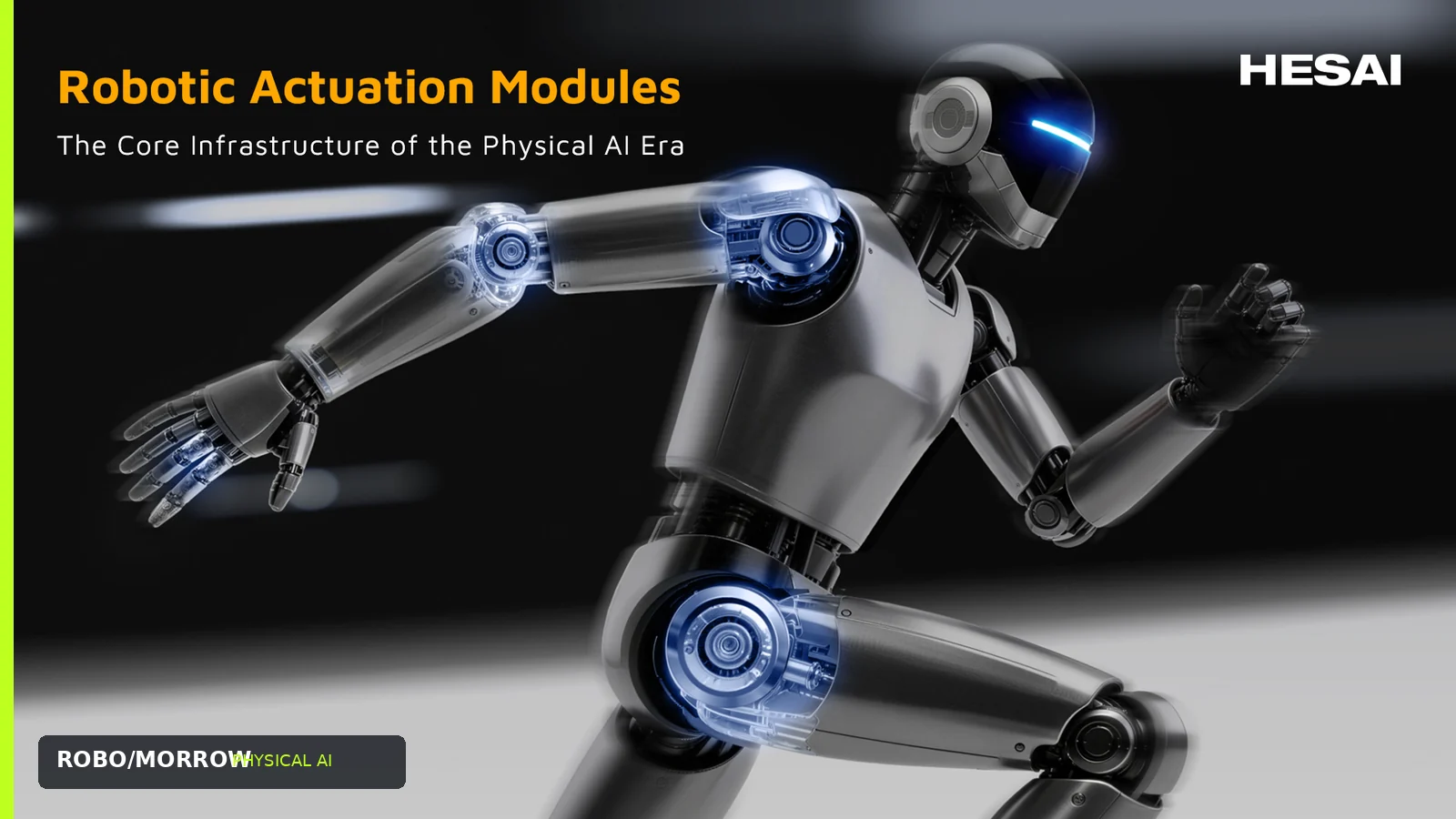
Hesai is no longer positioning itself as only a lidar company. In its second-quarter 2026 results, the supplier disclosed that its robotic actuation module production line is fully operational and had delivered more than 10,000 units by the end of June. The business started generating revenue in the quarter, Hesai is supplying modules to Sharpa, and the company says it is expanding from actuators for dexterous hands toward joints for full-body applications.
The 10,000-unit figure does not mean Hesai has become the dominant humanoid actuator supplier. There is no public split by customer, module type or end application. It matters because it moves the story from a technology preview toward series production of one of the most difficult and expensive building blocks inside an advanced robot.
The broader direction is even more interesting. Hesai is building what it describes as three layers of Physical AI infrastructure: lidar to help machines see, the Kosmo platform to help digitize and understand physical spaces, and robotic actuation modules to let machines act. That three-layer description is the company's positioning, but each layer now has a concrete product and, according to Hesai, early commercial traction.
Hesai in Q2 2026: the robotics numbers that matter
| Area | Hesai data | How to read it |
|---|---|---|
| Robotic actuation modules | more than 10,000 units delivered by the end of Q2 | meaningful production scale, but no public customer or model breakdown |
| Robotics lidar | 142,371 units in Q2, up 193.4% year over year | Hesai already has high-volume manufacturing experience in robotics components |
| Embodied AI customers | more than 50 companies, including Unitree, Robbyant, Galbot, Galaxea and Dexmal | a company-reported figure showing a broad integration funnel |
| Kosmo | initial prototypes delivered in July; orders including Galbot | the spatial-data platform is moving beyond a presentation-only stage |
| Strategic Growth Initiatives | 2026 revenue guidance raised from RMB100m to RMB200–300m | management expects faster monetization, but this remains forward-looking |
Why 10,000 actuators can matter more than another spectacular humanoid demo
The humanoid market is dominated visually by videos: fast running, jumping, carrying boxes or manipulating objects. Those demonstrations can show real progress, but they do not answer whether the hardware can be manufactured cheaply, consistently and in large quantities. Actuators are a useful illustration of the gap between a demo and industrialization.
A humanoid joint needs torque, speed, precision, controlled compliance or stiffness depending on the task, sensible mass, manageable energy use and durability over a huge number of cycles. Behind those requirements sit the gearbox, encoder, motor control, thermal design, wiring, mechanical tolerances and quality assurance. A single robot contains many of these assemblies, so a small difference in cost, mass or failure rate multiplies across the machine.
That is why a supplier capable of making a critical component in the thousands can influence the market more than a company with a single impressive prototype. It does not prove that Hesai has the best actuator. It changes the category of evidence: instead of “we intend to build this”, Hesai is reporting a functioning production line and more than 10,000 delivered modules.
The theme connects with RoboMorrow's earlier coverage of humanoid production and commercialization. As the industry grows, the important question is increasingly not only what a robot can do once, but whether its supply chain can repeat the result across thousands of machines with predictable cost and quality.
What Hesai actually claims about its actuators
Hesai says it redesigned the modules from first principles across materials science, mechanical structure and system integration. Compared with what the company describes as leading products currently available, the new modules are claimed to deliver about three times both torque density and power density in a package that is 37% smaller, while transmission efficiency exceeds 95%.
Those are substantial claims, but the earnings release does not provide a complete comparative test methodology. We do not have the list of competing modules, operating points, temperatures, voltages, load cycles or the exact boundary used to calculate system volume. Without that information, it would be misleading to call the Hesai design “three times better” than the market. What can be said is that the company is optimizing around three constraints that are central to humanoid design: high force, compact packaging and efficiency.
Hesai also highlights true backdrivability, meaning an external force can move the output rather than the transmission behaving like a rigid one-way mechanism. In robots that interact with people, this can support force control, compliant behavior and safer motion. Backdrivability on its own, however, is not a safety certification and does not replace the safety architecture of the complete robot.
From dexterous hands to full-body joints
The most demanding phase is still ahead. Hesai says shipments are underway for dexterous-hand applications, while full-body joints are expected to ramp next. Management expects robotic actuation module shipments to reach a six-digit level in 2027.
That is a target, not a contracted result. Moving from small hand actuators to shoulder, hip or knee joints changes the load case, thermal requirements and durability profile. If Hesai can translate its manufacturing experience into a broad family of joints, it could become a supplier across multiple robot manufacturers instead of depending on the success of a single platform.
This is the attractive part of the business model. It is still difficult to predict which humanoid brands will reach high volume. A component supplier can potentially sell to several winners at once. Technology markets often produce this pattern: the company supplying a critical enabling component can build considerable value even when the most visible device brands change.
UPDATE 29 Aug: Sharpa moves from a planned trial into a real Shanghai DQ
This is a more meaningful test than a typical trade-show demo. Sharpa's official customer story says North is intended to work behind the counter in an operating kitchen using the existing DQ equipment, ingredients and process without retrofitting the workcell for the robot. Sharpa describes each order as a 50–60-step end-to-end manipulation sequence; the DQ/CFB announcement and Chinese reporting specify the workflow as 55 steps, from handling the cup and metal ring through dispensing ice cream, adding toppings, blending, performing the signature upside-down Blizzard flip and handing over the finished product.

The technically interesting part is contact-rich manipulation of a deformable paper cup. Sharpa says grip and motion are adjusted through force and tactile feedback, while the robot must maintain task state when successive topping scoops look almost identical to the camera. The company describes a layered architecture: a lightweight latent world model for next-state prediction, CraftNet as its vision/touch/language/action model, and a fast “System 0” layer for real-time tactile grasp control.
Chinese reports published on 28 August say the robot is expected to operate during the store's daily opening hours, roughly 10:00–22:00, without continuous manual operation. Xinhua Finance/China Financial Information Network also describes a second robot assigned to greeting customers. These are deployment details and company-reported operating claims; we do not yet have an independent multi-day reliability dataset.
Video from the real store: Chinese outlet Jiemian Vnews published video from the Shanghai DQ showing the robot performing successive stages of the preparation process. It is an external video report, not a RoboMorrow hands-on test.
What is still not proven
We still do not know the task success rate, number of human interventions, average order cycle time, uptime, MTBF or the economics of a full shift. “Fully autonomous”, “zero-retrofit” and “full shift” are primarily Sharpa and deployment-partner claims. Nor should autonomy of the Blizzard workflow be generalized to the entire restaurant: restocking, cleaning, maintenance, safety supervision and exception handling may still require people.
For the original subject of this article — Hesai components — the deployment matters because it moves Sharpa's actuators from a demonstration into repetitive work in an environment designed for humans. If hard data on completed orders and intervention rates appears after several weeks, it will be a much stronger benchmark than opening day itself.
Update sources: Sharpa — North at Work; CFB/DQ via PR Newswire Asia; Xinhua Finance / China Financial Information Network; Economic Observer.
Kosmo: the second part of the strategy is spatial data
Hesai is not diversifying only into mechanics. Kosmo is a spatial-intelligence platform combining an AI spatial camera, algorithms, 3D assets and cloud services. Its job is to turn physical environments into high-fidelity, editable 3D models that can then be used for robot training, simulation and other spatial applications.
At WAIC 2026, the company described a pipeline using lidar, high-resolution imaging and 3D Gaussian Splatting reconstruction. For robotics, the value is not the rendering technique by itself. The potential advantage is a faster way to capture factories, warehouses, campuses and other real places as digital training environments. A more faithful representation can help teams build scenarios and probe edge cases before a robot is deployed on site.
Q2 reporting adds an early commercial signal. Hesai says initial Kosmo prototypes were delivered in July, orders have been secured from humanoid robotics companies including Galbot, and the company is engaging with more than 200 prospective partners. Initial revenue is expected in the third quarter. Pricing and order volumes have not been disclosed.
Lidar remains the manufacturing engine behind the new strategy
Hesai's biggest advantage may be that it is not starting from zero. In Q2 alone, it shipped 142,371 robotics lidars, up 193.4% from a year earlier. Including ADAS products, total quarterly lidar shipments reached 628,275 units.
The company says it now works with more than 50 embodied-AI companies on lidar, naming Unitree, Robbyant, Galbot, Galaxea and Dexmal among them. That customer network can become a natural distribution channel for new products. A robotics team that already knows a supplier's qualification process, hardware and support has a lower barrier to discussing another component than a completely new buyer.
That does not mean every lidar customer will buy Hesai actuators or Kosmo. Robotics companies often deliberately mix suppliers to reduce technical and commercial dependency. The three-layer portfolio is therefore a sales opportunity, not evidence that Hesai will control the entire stack.
The financial signal: Physical AI is being built as a separate business
Hesai reported Q2 revenue of RMB860.8 million and net income of RMB70.6 million. For this story, the more relevant metric is the segment the company calls Strategic Growth Initiatives. It contributed revenue for the first time in Q2, and management raised full-year 2026 SGI revenue guidance from RMB100 million to RMB200–300 million.
The company also expects SGI to reach roughly US$100 million in revenue in 2027 and to break even in the same year. These are management forecasts and may not be achieved. They do show that actuators and Kosmo are being treated as businesses to monetize, not simply research projects attached to the core lidar operation.
That may be more important than the 10,000-unit headline. A supplier with an established high-volume business, factories and large customer relationships can fund new component programs differently from a startup that depends on the next financing round.
What this changes in the humanoid supply chain
If humanoids move from thousands to tens or hundreds of thousands of units, the industry will need enormous volumes of actuators, sensors, gearboxes, encoders, motor controllers and batteries. At that point, a robot maker's advantage will not come from the AI model alone. It will also depend on access to components with repeatable specifications, acceptable cost and short enough lead times.
Hesai is trying to occupy that enabling layer. It is not launching its own complete humanoid; it wants to supply technology used across multiple platforms. In the optimistic scenario, that creates scale regardless of whether the market leader is Unitree, Galbot, Sharpa or another manufacturer. In the pessimistic scenario, robot makers develop critical joints in-house or choose other specialized suppliers.
There is not enough public evidence to know which outcome is more likely. What is clear is that Hesai has crossed an important threshold: actuators have started contributing revenue, the production line is operating, and cumulative module volume has moved beyond a small prototype run.
What we still do not know
The missing data are the numbers an integrator would care about more than the headline “10,000”. Hesai has not disclosed actuator pricing, average selling price, the full product family, volume split between dexterous hands and other applications, field failure rates or lifetime under a defined load profile. It has not said how many modules go to each customer.
There is no public independent benchmark confirming the claimed 3× torque and power density advantage. Nor is there a like-for-like public dataset comparing energy consumption, temperatures, acoustic noise, backlash and durability against competing modules in an identical duty cycle.
The six-digit 2027 shipment level is also forward-looking. In robotics hardware, scaling from tens of thousands to hundreds of thousands of parts can expose quality, yield, material-supply and service problems that are less visible at earlier volumes.
What it means for Poland and the EU
For Europe, the most important issue is not a Chinese production milestone by itself but the increasing concentration of important Physical AI supply-chain capabilities in Asia. If lower-cost, sufficiently capable actuators become available in large volumes, European integrators could build their own platforms faster. At the same time, dependence on external suppliers would increase in an area that directly affects robot availability and safety.
For an EU deployment, an actuator is not a safety certificate for the complete robot. The integrator still needs to assess the full machine, force and speed limits, stopping functions, fault behavior, cybersecurity and operation around people. High power density is useful for mechanical design, but it also makes correct risk control more important.
RoboMorrow has not found a public European price or confirmed European availability schedule for Hesai's new robotic actuation modules. For now, this is primarily a supply-chain and market-direction signal rather than a component that a Polish integrator can already compare through a normal local quotation process.
RoboMorrow assessment
The key development is not simply that Hesai is “entering humanoids”, but that it is beginning to scale components needed by many robot manufacturers. More than 10,000 modules is not yet mass-market volume, but it is already a level where manufacturing, quality control, cost and real customers matter more than a laboratory prototype.
Hesai also has an unusual advantage: its lidar business already operates at significant volume and gives it access to dozens of robotics teams. If Kosmo can create useful spatial data and the actuator modules retain their performance as production grows, the company could build a meaningful position across perception, world representation and motion execution.
The next 12–18 months should make the strategy easier to judge. The key indicators will be the volume of full-body joints, the number of independent actuator customers, repeatability of the Sharpa deployment, and whether the projected RMB200–300 million of 2026 SGI revenue is actually delivered. Only then will it be possible to tell whether Hesai is building a durable second growth engine or simply capitalizing on the current Physical AI cycle.
Sources
- Hesai Group — Q2 2026 results: actuators, Kosmo, lidar shipments and financial data
- Hesai — 2026 Technology Open Day and Physical AI strategy
- Hesai — Kosmo and robotics lidar at WAIC 2026
Featured image: official Hesai robotic actuation modules artwork; RoboMorrow editorial layout adaptation. Technical figures presented by the manufacturer are not a RoboMorrow independent test.