A robot is not enough. Value is shifting to data, AI and fleet operations
Verification date: 10 August 2026.
Thesis
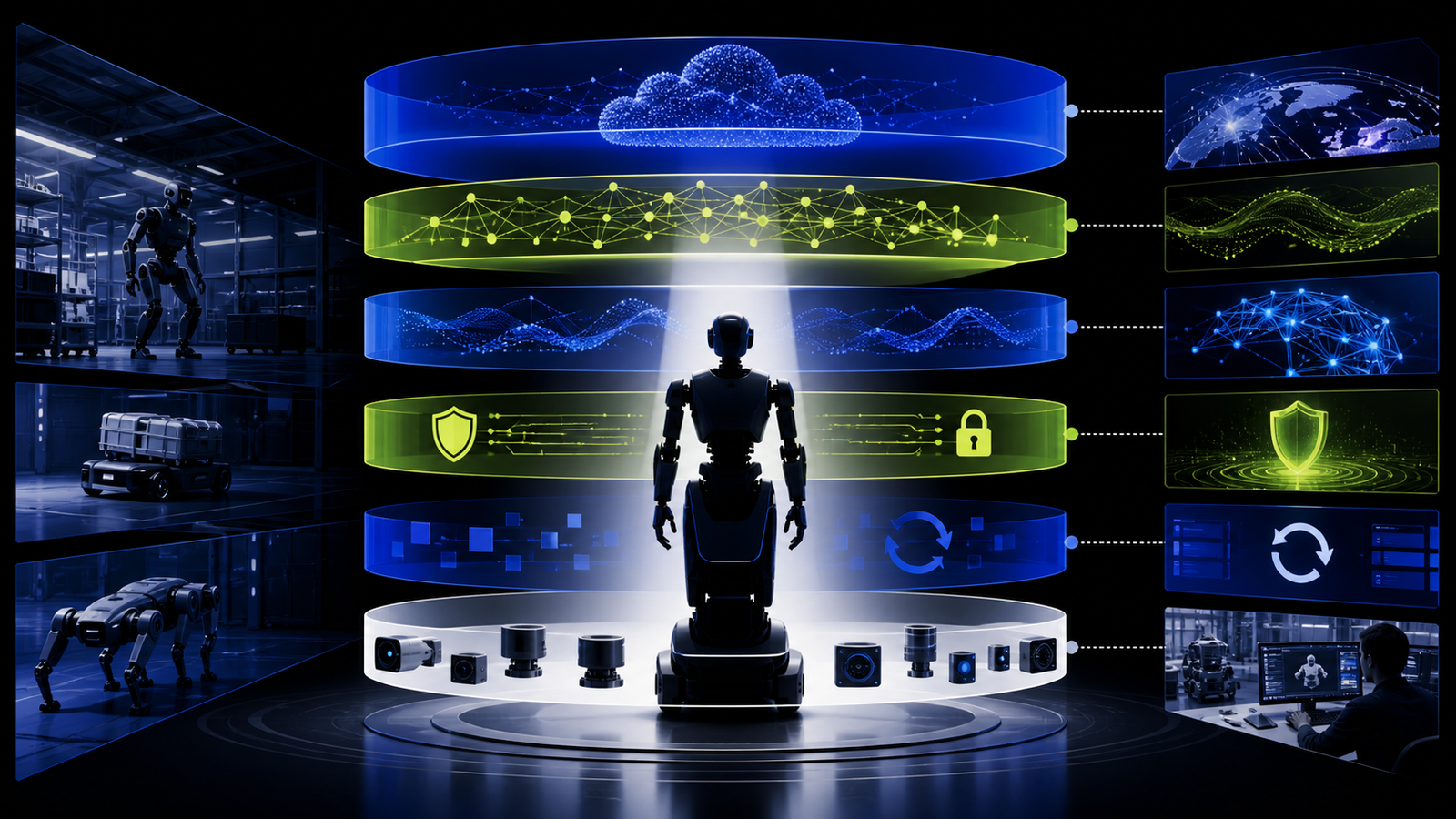
The market likes to compare robots by payload, speed, range and impressive videos. Those measures are necessary but insufficient. Real deployment outcomes depend on a full stack: mechanics, sensors, data, models, fleet software, safety, updates and service. Three developments in 2026 illustrate the shift. DeepSeek's capital around Unitree brings models closer to hardware; Orbbec is trying to accelerate data production before the robot is ready; Brain Corp builds an advantage on a large fleet and millions of operating hours.
This does not make hardware less important. Weak mechanics or unsuitable sensors constrain every model. What changes is where long-term differentiation and recurring revenue are created.
Seven layers of value
1. Mechanics and energy. Actuators, transmissions, batteries, durability and serviceability define the physical limits of the job.
2. Perception. Cameras, depth, LiDAR, IMUs and calibration determine whether the system sees space reliably.
3. Data. Demonstrations, failures and edge cases must be recorded, cleaned, labelled and used lawfully.
4. Models and control. A model must turn a goal into safe action while respecting the constraints of the machine.
5. Fleet operations. Updates, telemetry, task planning, remote diagnostics and access control turn a device into an operational service.
6. Safety and compliance. Functional safeguards, cybersecurity, risk documentation and clear responsibility are required.
7. Service and economics. Parts, response time, training and downtime can matter more than purchase price.
Unitree and DeepSeek: capital is not integration
The reported RMB 140.8 million DeepSeek investment in Unitree's strategic IPO tranche signals that AI models and robot hardware are moving closer financially. We do not know what code, data or product will result. Without a shared architecture, test results and a deployment agreement, this is potential rather than a functioning full stack.
The lesson is important: the brand of a language model does not guarantee that a robot can work safely. Embodied AI requires temporal data, geometry, contact, forces, latency and defined behaviour when confidence is lost. These elements must be tested on specific hardware.
Orbbec: data before the robot
Robot-Free Data Collection addresses sequencing. Rather than building many expensive robots first, EGO, UMI and WristCam kits let people record demonstrations. This may shorten collection time and allow models and hardware to develop in parallel.
The risk lies in transfer. A human hand differs from a manipulator in kinematics, range, sensing and speed. A dataset becomes valuable only when it is synchronized, calibrated and usable on the target robot. Manufacturer specifications start the evaluation; they do not complete it.
BrainOS: an operational advantage
Brain Corp's reported 50,000-plus robots and 25 million hours show a third layer: learning from operations. A large fleet can provide failures and edge cases that are expensive to generate in a lab. A platform can also standardise updates, permissions and integration with customer systems.
Fleet size must be separated from fleet quality. Hours without information on interventions, mission success, downtime and service cost do not form a full benchmark. Advantage should be measured by the customer's outcome: availability, cost per task, safety and response time.
What Europe changes
In the EU, the stack must also be legally deployable. The AI Act may impose duties depending on the function and risk of the system. The Cyber Resilience Act raises the importance of secure updates, vulnerability handling and responsibility for products with digital elements. The Machinery Regulation directly affects machine safety. A buyer should receive not only a device and app but documentation, an update policy, data-processing terms and an incident procedure.
Poland
Polish companies often need the most predictable solution rather than the most advanced robot. A request for proposal should separate device price from integration, subscription, connectivity, parts, training and downtime. Buyers should require metrics for missions without intervention, technical availability, mean time to repair, minimum update period and data location.
This creates an opportunity for local integrators that combine hardware from several manufacturers with European hosting, service, security audits and deployment processes tailored to warehouses, hotels, shops or factories.
Pre-purchase checklist
Before buying, ask who owns the data; whether it can be exported; how long support lasts; what happens if the cloud is discontinued; which functions need teleoperation; how autonomy is measured; what the vulnerability process is; whether parts are available in the EU; and who owns process integration. Missing answers are business risk even when the demonstration looks excellent.
What remains unknown
The market lacks a common standard for reporting autonomy, interventions and cost per task. Comparable fleet-reliability data and clear principles for valuing data are missing. It is also unclear whether hardware makers, model providers, cloud operators, integrators or owners of the largest operating datasets will retain the strongest position.
RoboMorrow assessment
The most credible robotics product is not simply the “best robot” but the best-completed system. Hardware opens the door; data, updates, safety and service determine whether the deployment survives its first months. RoboMorrow must therefore pair specifications with autonomy, interventions, data policy, EU availability and ownership cost.
Sources
- BrainOS platform — manufacturer / fleet platform
- Orbbec at ROSCon JP 2026 — manufacturer / data collection
- EU AI Act overview — European Commission
- EU Cyber Resilience Act — European Commission
- EU Machinery Regulation — EU law