AgiBot overtakes Unitree as Chinese vendors account for over 97% of humanoid shipments
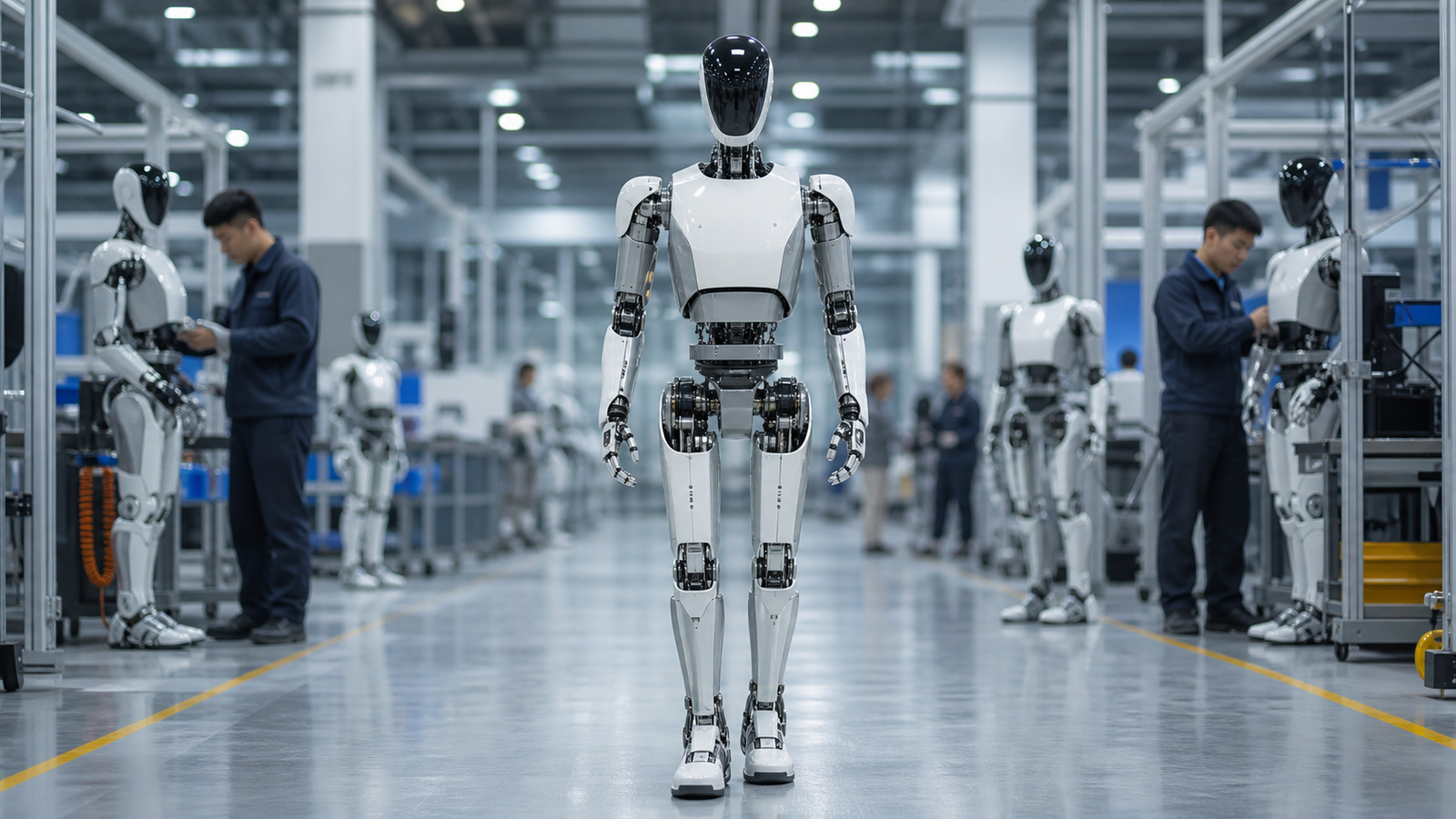
AgiBot overtook Unitree in humanoid robot shipments during the first half of 2026. According to Smart Analytics Global, approximately 19,100 humanoid robots were shipped worldwide during the period, up 272% year over year.
AgiBot is estimated to have shipped about 8,400 robots, reaching a 44% global share. Unitree ranked second with roughly 5,900 units and a share of about 31%.
Chinese vendors account for more than 97%
The most striking figure in the report is the share held by Chinese manufacturers. Smart Analytics Global estimates that Chinese vendors accounted for more than 97% of global humanoid robot shipments in the first half of 2026.
The figure highlights the manufacturing advantage being built around China's access to motors, gearboxes, batteries, electronics, sensors and a broad production ecosystem.
AgiBot's result also represents extremely rapid growth. SAG reports shipment growth of around 562% year over year for AgiBot, compared with approximately 170% for Unitree.
A shipped robot is not automatically an autonomous worker
The numbers need careful interpretation. A humanoid shipment does not automatically mean a robot is already performing long, fully autonomous factory or household shifts. The market includes machines of different sizes, configurations and purposes, while some deployments still focus on research, education, demonstrations or pilots.
Software capability is equally important. Hardware production is scaling faster than reliable manipulation, task generalisation, safety and the ability to operate for long periods without human intervention.
Industrial and commercial use is growing
According to SAG, more than 70% of H1 2026 shipments went to industrial and commercial applications. That is an important signal because it points to a shift away from laboratories and demonstrations toward manufacturing, logistics, warehousing, services and other business environments.
It does not mean every deployment is already economically justified. In many cases the market is still collecting the data needed to answer the key question: can a humanoid perform a specific task more cheaply, safely and reliably than existing forms of automation?
What does it mean for Poland and Europe?
For Europe, Chinese vendor dominance matters commercially and strategically. AgiBot is expanding in Europe, and Smart Analytics Global has previously identified Western Europe as one of the company's highest-priority overseas markets.
If production scale continues to rise, European companies may gain access to increasingly affordable humanoid platforms. At the same time, safety, cybersecurity, data location, service, spare parts and compliance with EU regulation will become more important.
What is confirmed — and what remains unknown?
The SAG data confirms approximately 19,100 global H1 2026 shipments, about 8,400 AgiBot units and a 44% share, around 5,900 Unitree units and a 31% share, and more than 97% of shipments coming from Chinese vendors.
These are estimates from a market-research company rather than an audit of each manufacturer. There is also no single universal industry definition of a humanoid robot, so methodology should always be checked when comparing figures from different research firms.
Teleoperation is not measured by these shipment statistics. They do not show what proportion of tasks is fully autonomous or how often remote human assistance is required. The report also does not introduce new prices or specific availability dates for AgiBot models in Poland.