Best robotic pool cleaners 2026: ranking, comparison and buying guide
BUYING IN YOUR MARKET
Availability in your country
Sales, delivery and support can differ by country and exact model. Choose your market to see the evidence we have checked.
Beatbot AquaSense 2 Ultra
United States
Official US listing — checkout confirmation required
- Price
- US$2,299 displayed on the standalone product page; promotions may change
- Delivery
- Manufacturer advertises dispatch within 24 hours and 4–5 days transit; your address and checkout must confirm eligibility
- Warranty and service
- A three-year full-replacement warranty is advertised; verify seller and territorial terms
This evidence covers AquaSense 2 Ultra, not AquaSense 2 Pro. A product listing does not confirm stock or delivery for every address.
Evidence checked: · Not a live stock feed
Official US AquaSense 2 Ultra listing ↗Germany
Local store offer — check checkout availability
- Seller / sales channel
- Beatbot Germany
- Price
- See the local offer for the current price and exact bundle
- Delivery
- Confirm stock and the delivery date for your address with the seller
- Warranty and service
- Confirm written warranty terms, parts and service coverage for your address
Beatbot Germany lists this exact model for this market. A listing is evidence of a buying route, not a delivery commitment.
Evidence checked: · Not a live stock feed
Beatbot Germany: check local offer ↗Beatbot EU — supported destinations
Regional store lists this model — delivery country supported
- Seller / sales channel
- Beatbot EU
- Price
- See the linked offer for the current price, configuration and taxes
- Delivery
- Seller lists this country as a delivery destination; confirm postcode, model stock and dispatch at checkout
- Warranty and service
- Confirm warranty territory, local service and return shipping with the seller
Delivery countries: Austria, Belgium, Bulgaria, Croatia, Czechia, Denmark, Estonia, Finland, France, Greece, Hungary, Italy, Latvia, Lithuania, Luxembourg, Netherlands, Poland, Portugal, Romania, Slovakia, Slovenia, Spain, Sweden
Exact model listing and the store’s delivery policy are linked separately. Supported delivery is not proof of current stock or local service.
Evidence checked: · Not a live stock feed
Beatbot EU: model offer ↗Supported delivery countries ↗No verified local offer in this dataset
No country-specific offer for this exact model has been established in our current sources. This is a gap in our research, not a statement that the robot cannot be bought here. Use the manufacturer’s sales contact to request a supplier serving your address; confirm configuration, imports, warranty and service.
- Price
- No verified local price in this dataset
- Delivery
- No confirmed date for your address
- Warranty and service
- Local coverage not verified
Dreame Z1 Pro
Germany
Local store offer — check checkout availability
- Seller / sales channel
- DREAME Stores Deutschland
- Price
- See the local offer for the current price and exact bundle
- Delivery
- Confirm stock and the delivery date for your address with the seller
- Warranty and service
- Confirm written warranty terms, parts and service coverage for your address
DREAME Stores Deutschland lists this exact model for this market. A listing is evidence of a buying route, not a delivery commitment.
Evidence checked: · Not a live stock feed
DREAME Stores Deutschland: check local offer ↗No verified local offer in this dataset
No country-specific offer for this exact model has been established in our current sources. This is a gap in our research, not a statement that the robot cannot be bought here. Use the manufacturer’s sales contact to request a supplier serving your address; confirm configuration, imports, warranty and service.
- Price
- No verified local price in this dataset
- Delivery
- No confirmed date for your address
- Warranty and service
- Local coverage not verified
Mammotion SPINO E1
Germany
Local store offer — check checkout availability
- Seller / sales channel
- Mammotion Germany
- Price
- See the local offer for the current price and exact bundle
- Delivery
- Confirm stock and the delivery date for your address with the seller
- Warranty and service
- Confirm written warranty terms, parts and service coverage for your address
Mammotion Germany lists this exact model for this market. A listing is evidence of a buying route, not a delivery commitment.
Evidence checked: · Not a live stock feed
Mammotion Germany: check local offer ↗No verified local offer in this dataset
No country-specific offer for this exact model has been established in our current sources. This is a gap in our research, not a statement that the robot cannot be bought here. Use the manufacturer’s sales contact to request a supplier serving your address; confirm configuration, imports, warranty and service.
- Price
- No verified local price in this dataset
- Delivery
- No confirmed date for your address
- Warranty and service
- Local coverage not verified
ECOVACS ULTRAMARINE P1
United States
Official US product listing
- Price
- Current checkout price not captured in this verification; earlier USD prices are not a current quote.
- Delivery
- Confirm stock and delivery for your ZIP code.
- Warranty and service
- Confirm warranty eligibility, local repair arrangements and coverage for your address
The exact P1 has a US manufacturer sales page. This confirms the listing, not shipment to every address.
Evidence checked: · Not a live stock feed
ECOVACS US — ULTRAMARINE P1 ↗No verified local offer in this dataset
No country-specific offer for this exact model has been established in our current sources. This is a gap in our research, not a statement that the robot cannot be bought here. Use the manufacturer’s sales contact to request a supplier serving your address; confirm configuration, imports, warranty and service.
- Price
- No verified local price in this dataset
- Delivery
- No confirmed date for your address
- Warranty and service
- Local coverage not verified
“Listed” confirms a product page or sales route, not stock, delivery to every address or local service. “Pre-order” is not immediate availability. Unverified means we lack evidence; it does not mean unavailable. Prices belong to the named market and currency. Confirm the exact version, tax, shipping and support before ordering.
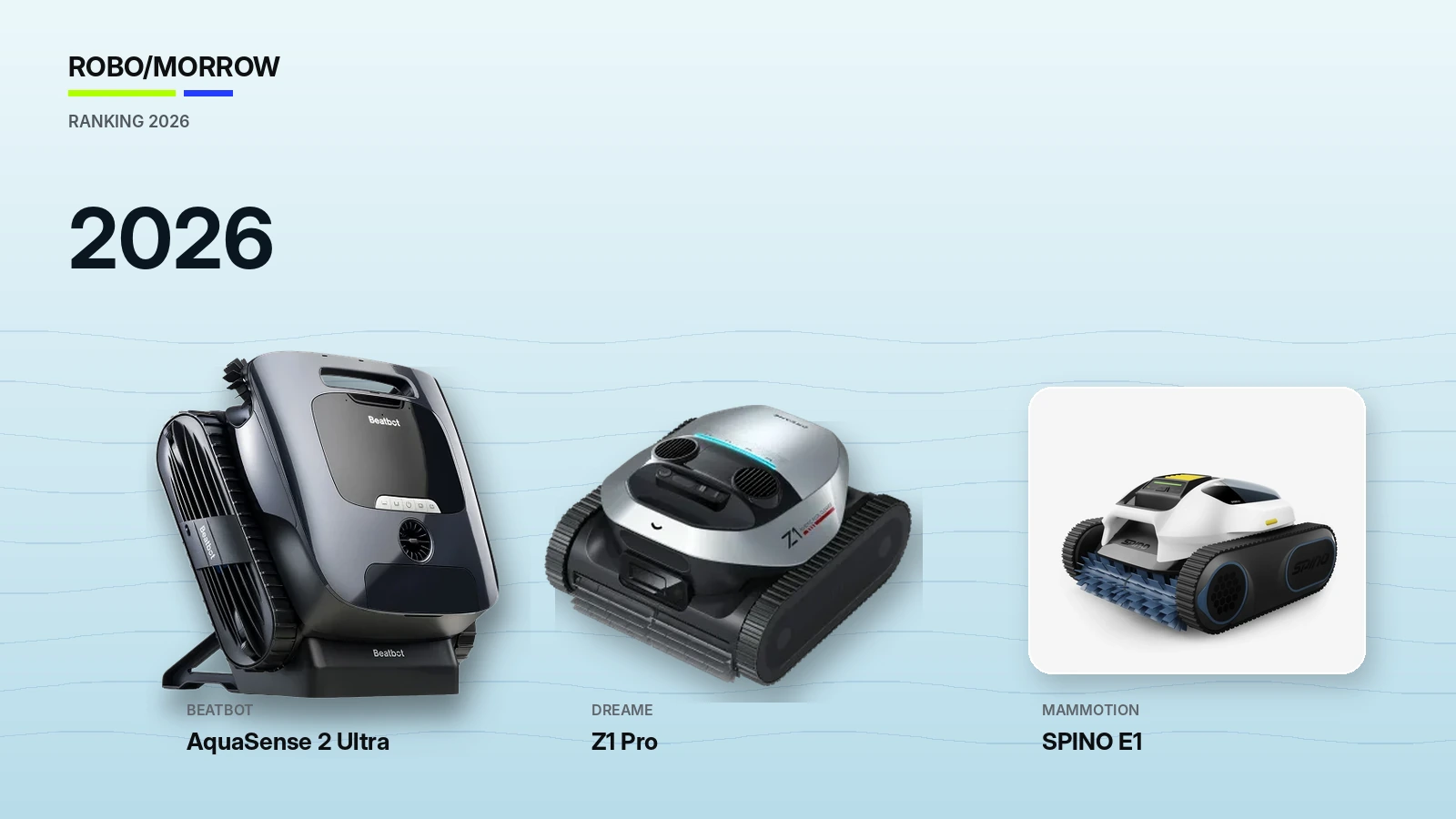
Short answer: Beatbot AquaSense 2 Ultra is the most elaborate and expensive robot in this group, covering several pool zones and tasks beyond basic floor vacuuming. Dreame Z1 Pro stands out through PoolSense navigation and an unusual LiFi remote that works underwater. Mammotion SPINO E1 is a far cheaper entry point covering floor, walls and waterline. ECOVACS ULTRAMARINE P1 is simpler but strategically important as a product from a major consumer-robotics brand, with a strong emphasis on filtration and route planning.
With pool robots, a feature list can be misleading. One owner mainly needs fine sand removed from the floor, another struggles with waterline deposits, and a third has leaves floating on the surface every day. This ranking therefore separates use cases rather than assigning one universal score.
Best pool-cleaning robots 2026 — comparison table
| Model | Cleaning zones | Manufacturer runtime | Quoted coverage | Main advantage |
|---|---|---|---|---|
| Beatbot AquaSense 2 Ultra | floor, walls, waterline, surface + water clarification | up to 5 h floor; 4.5 h walls+waterline; 10 h surface | up to roughly 360 m² in manufacturer material | most complete system and advanced sensing |
| Dreame Z1 Pro | floor, walls, waterline | over 180 min in the stated mode | up to roughly 201 m² | PoolSense + LiFi remote for underwater control |
| Mammotion SPINO E1 | floor, walls, waterline | up to 210 min | up to 150 m² | strong feature-to-price proposition |
| ECOVACS ULTRAMARINE P1 | floor, walls and mode-dependent scenarios | up to 3 h in Eco | up to 180 m² floor coverage according to ECOVACS | 4,800 GPH, SmartNavi and dual-layer filtration |
This is not a performance-test table. Brands quote specifications using their own procedures and actual coverage depends on mode and pool geometry.
1. Beatbot AquaSense 2 Ultra — the most complete if budget is secondary
AquaSense 2 Ultra attempts to replace several pieces of pool-maintenance equipment with one robot. Beatbot presents it as a 5-in-1 system covering floor, walls, waterline, surface and water clarification. This matters to owners whose main problem is not simply sand on the floor. If leaves, insects and pollen constantly land on the pool, active surface cleaning can be a real advantage over robots that remain fully submerged.
Beatbot quotes up to 10 hours of surface cleaning, up to 5 hours on the floor and about 4.5 hours for walls plus waterline. The robot uses extensive sensing and HybridSense mapping. AI functions are designed to improve debris detection and planning, but without a common test we cannot quantify how much better this is than simpler navigation in a specific pool.
The largest barrier is price. The EU shop showed around €2,699 on the verification date. At that level, ask whether you genuinely need surface cleaning and the full feature set or whether a robot costing several hundred euros solves 90% of the actual problem.
Best for: large or complex pools, heavy surface debris, high budget and a desire to automate several maintenance tasks. Less suitable for: a small simple pool where the main issue is sediment on the floor.
See the Beatbot AquaSense 2 Ultra profile →
2. Dreame Z1 Pro — best when you want underwater manual control
Dreame Z1 Pro is interesting not only because of its quoted 8,000 GPH, but because of how the owner can interact with it. Dreame includes a handheld LiFi remote that can assign tasks, steer the cleaner and call it back underwater. This addresses a real limitation of normal mobile-app connectivity: Wi‑Fi and Bluetooth are not convenient channels for a device submerged in water.
Z1 Pro uses PoolSense, combining technologies including ultrasound and 3D structured light according to Dreame. Quoted coverage is up to 2,160 ft², around 201 m², and the company states more than 180 minutes of operation in the relevant mode. Automatic poolside parking also matters because lifting a heavy wet robot from the centre of a deep pool is one of the least pleasant parts of ownership.
Dreame also publishes specific water-chemistry limits for Z1 Pro, including salinity up to 5,000 ppm, chlorine up to 4 ppm and pH 7.0–7.8. This is the kind of detail buyers should actively search for. A pool robot operates in a chemically aggressive environment and a saltwater pool is not automatically compatible with every model.
Best for: owners of larger pools who want advanced navigation and the ability to direct the cleaner to a specific area. Limitation: remote control and apps are extras; filtration and real debris handling still matter most.
See the Dreame Z1 Pro profile →
3. Mammotion SPINO E1 — the strongest entry-price proposition here
SPINO E1 shows how quickly this category is becoming cheaper. Mammotion EU showed €499 versus €799 regular price on 17 August, although the product was marked sold out. The manufacturer claims 5,800 GPH, up to 210 minutes of runtime and pools up to 150 m². It is designed to clean floor, walls and waterline in one cycle.
Compared with Beatbot, the feature list is much simpler. That can be a virtue. If you do not need active surface skimming or an extensive AI layer, the more important questions are whether the robot covers your floor, climbs your walls and is easy to retrieve.
Mammotion uses SmartArc path planning and automatic waterline parking. Availability is the key caveat. A good promotional price is less meaningful if stock is persistently unavailable or consumables are difficult to source locally.
Best for: buyers looking for a first cordless cleaner for a medium-size pool without spending several thousand euros. Less suitable for: users who specifically need surface cleaning and the broadest automation.
See the Mammotion SPINO E1 profile →
4. ECOVACS ULTRAMARINE P1 — simpler hardware from an experienced robot brand
ULTRAMARINE P1 is interesting strategically as well as technically: ECOVACS is moving from floor and window robots into pools. Official material lists 4,800 GPH flow, SmartNavi, up to three hours in Eco mode and floor coverage up to 180 m². Sales material also highlights dual-layer filtration, with some regional pages describing very fine-particle capture.
It is not the most feature-heavy model here, but a simpler product from a large robotics brand can appeal to users prioritising a familiar ecosystem and straightforward maintenance. European availability should be checked carefully because P1 is more heavily promoted in some markets than others.
See the ECOVACS ULTRAMARINE P1 profile →
First identify what actually makes your pool dirty
A robot that is good with leaves is not automatically the best for fine dust. Large leaves need flow and a basket that does not clog quickly. Fine sand and pollen demand effective small-particle filtration. Algae and slippery deposits put more emphasis on brushes and wall contact. The waterline is another task again: the robot must maintain position and spend enough time moving laterally along the edge.
Before comparing products, spend a week observing what you manually remove. A pool under trees has very different priorities from an indoor pool dominated by fine dust.
Floor, walls, waterline and surface are four different jobs
Floor cleaning is the easiest and is supported by most robots. Wall cleaning requires grip and compatible geometry; not every robot handles every floor-to-wall radius. Waterline cleaning requires stable movement near the surface. Surface cleaning is a separate category and only some advanced machines actively collect floating debris.
If leaves floating on top are your biggest problem, do not buy a robot simply because it climbs walls well. That does not solve the main task.
Filtration: microns, flow and basket volume
A micron rating matters but does not describe the whole system. A very fine filter can clog quickly in a pool with lots of large debris. A high flow number can look impressive on paper while telling you little about how much sand remains captured after an hour.
Ergonomics matter too. The basket should come out without spilling wet leaves and the filter should rinse easily with a hose. If the robot runs daily, filter cleaning convenience becomes as important as navigation.
Navigation and “AI”: where is the real value?
Advanced sensing can reduce repeated paths and help avoid drains, steps or unusual geometry. We do not assume that an AI label automatically produces cleaner water. In a basic rectangular pool, a reliable systematic route may be enough. In a complex pool with ledges, steps and a spa zone, advanced mapping has more potential value.
Cordless robots: convenience comes with a battery
No power cable is a major usability win and removes tangling. In return you have a battery, charging time and long-term degradation. For a large pool, select runtime with headroom rather than assuming the manufacturer's maximum is always achieved at full power while climbing walls.
Also check parking behaviour. A robot that approaches the edge at the end of a cycle is far easier to retrieve than one that stops unpredictably in the deepest section.
Salt water, chlorine, pH and temperature
This is one of the most overlooked buying checks. Water chemistry affects seals, metals and plastics. Z1 Pro publishes specific supported ranges. For every other model, read the manual before buying. Operating outside a stated range can create both performance and warranty problems.
At the end of a season, rinse, dry and store the robot as instructed. We would not leave a cleaner permanently in the water unless the manufacturer explicitly designed it for that use.
Steps, drains and irregular geometry
This is where specifications cannot give a complete answer. The same robot may excel in a rectangular pool with a gentle wall radius but struggle with wide steps, ledges or sharp transitions. If the manufacturer publishes minimum depth, angle or radius constraints, treat them as important.
We do not award “100% coverage” points in this ranking because such a claim would require repeatable tests across several pool geometries.
Real cost of ownership
After purchase come filters, brushes, clarification consumables where applicable and eventually a battery. On a €2,700 machine, multi-year parts availability should be a buying condition. On a budget robot, battery replacement can become a substantial percentage of the product's original value.
Check local service as well. Pool cleaners work underwater and a sealing failure has more serious consequences than on a normal floor robot. Shipping a heavy wet-environment device to service in another country can become a real cost.
Which robot for which pool?
- Large pool under trees: AquaSense 2 Ultra has a functional advantage through surface cleaning; decide whether this is worth the premium.
- Irregular pool and a need to correct the route manually: Z1 Pro is uniquely interesting because of LiFi control.
- Medium simple pool and limited budget: SPINO E1 looks rational when in stock.
- Priority on filtration and simplicity: ULTRAMARINE P1 is worth checking.
- Occasional seasonal use: ask whether a premium robot makes economic sense against a cheaper cleaner or seasonal service.
FAQ — robotic pool cleaners
Does a pool robot replace the pool's filtration system?
No. It collects debris and scrubs surfaces but does not replace circulation, the main filter, pH control or sanitation.
Can I leave the robot in the water all the time?
Only if the manual explicitly allows it. For battery, seal and material longevity, follow the manufacturer's retrieval and rinsing procedure.
Will it clean steps?
There is no universal guarantee. It depends on step width, height, angle and turning space. This is one of the features best confirmed in documentation or a real-world test of a similar pool.
Does GPH tell me which cleaner works best?
No. It is a quoted flow rate, not a final cleaning score. Filtration, brushes, route planning, geometry and debris type matter as much.
Is an expensive robot always worthwhile?
No. Surface cleaning, advanced navigation and extra automation are valuable only if they solve your problem. A simpler pool may be better served by a cheaper robot.
RoboMorrow verdict
Beatbot AquaSense 2 Ultra is the most complete choice for a demanding user who wants several pool zones automated and accepts the price. Dreame Z1 Pro stands out through its control method and navigation. Mammotion SPINO E1 is the most interesting price entry point, while ECOVACS ULTRAMARINE P1 makes sense for buyers who prefer simpler hardware from a large brand.
Do not buy any of them without checking pool geometry, water chemistry, coverage, parking behaviour and local service. Current product status is tracked in the RoboMorrow Robot Database.
Official sources
Where to buy models from this article
We show only exact verified Amazon product pages. Before purchase, confirm the variant, seller, warranty and box contents.
Exact Amazon links. Where a verified RoboMorrow marketplace tracking ID is active, the link is an affiliate link and we may earn from qualifying purchases. Price and availability can change after you click.
Before buying: variants, offers and further comparisons
- Record pool length and depth, surface material, step shape and the main types of debris.
- Separate floor, wall, waterline and surface cleaning. Check which tasks the exact listed model covers.
- Confirm retrieval arrangements, replacement filters and battery service. A US offer does not establish European availability or warranty coverage.
Check availability on Amazon
As an Amazon Associate, RoboMorrow earns from qualifying purchases. Check the seller, bundle, delivery and availability on the store page.
- ECOVACS ULTRAMARINE P1 · Amazon — international availability — check availability
- Beatbot AquaSense 2 Ultra · Amazon — international availability — check availability
Amazon may redirect you to a local store. If the identical product is unavailable, you may see search results. Check the model, bundle, power supply, delivery and warranty before buying.