Humanoid vision and motion share one loop: ~90% kick success reported
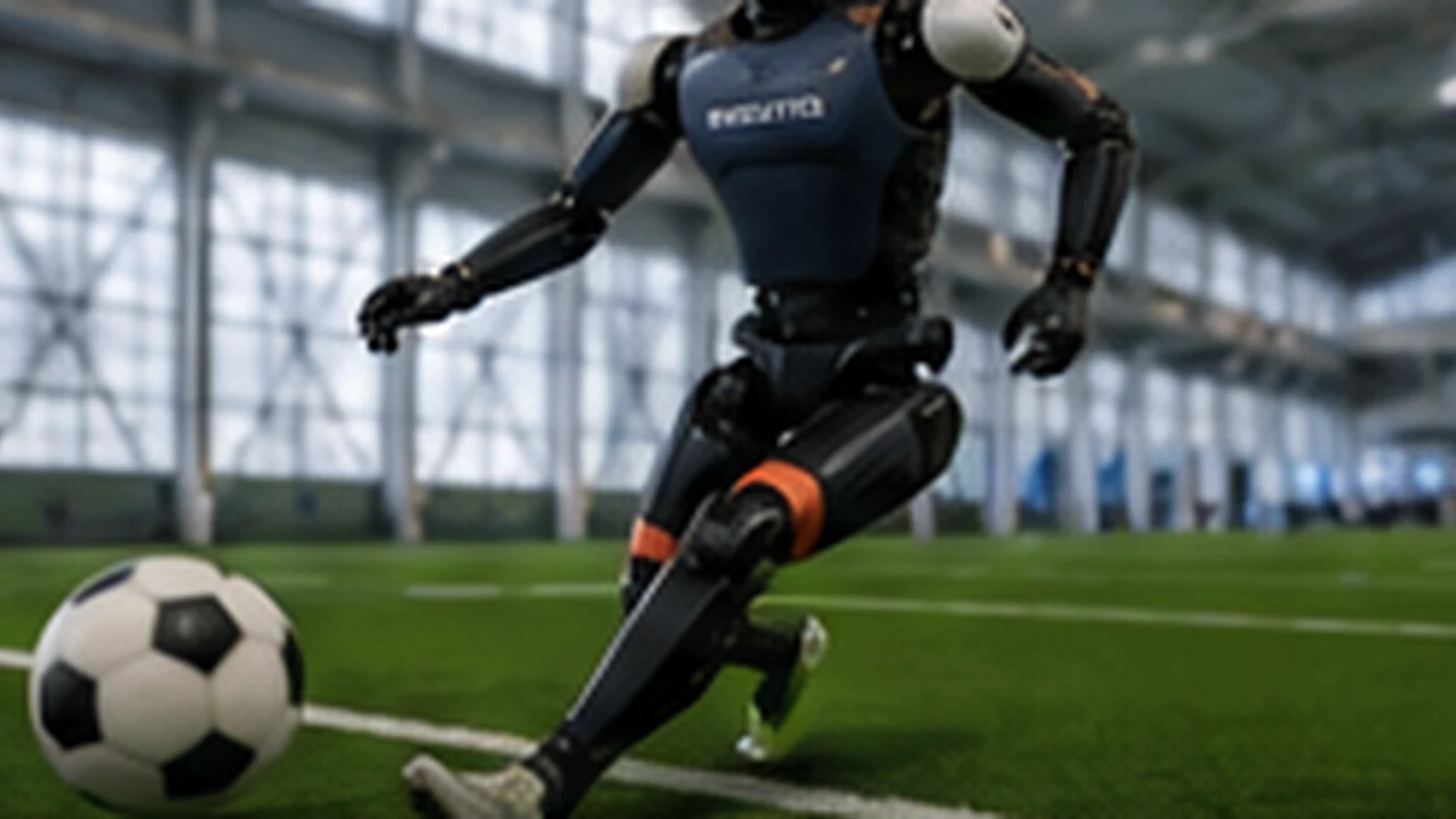
A new Science Robotics publication uses the Booster T1 platform to couple visual perception and motion control in one reinforcement-learning controller. Booster Robotics released the accompanying announcement at 20:58 EDT on August 20, already 02:58 CEST on August 21. The important result is not simply that a humanoid can play football, but that it has to react to a dynamic world without a perfect view of the situation.
The ball moves quickly, can be occluded, camera images contain latency and blur, and the robot must maintain balance while estimating trajectory and preparing motion. That perception-action loop is directly relevant to robots expected to work in logistics, manufacturing and human environments.
One loop instead of a chain of isolated modules
A conventional pipeline separates vision, state estimation, planning and execution. Every stage can add latency and an error from one module propagates to the next. The researchers optimize perception and control under a shared learning objective so the robot does not have to wait for a perfect world model before beginning its reaction.
The system uses a history of 50 frames, roughly one second of observations. An encoder compresses them into a 64-dimensional latent state and a decoder reconstructs the ball position. The design aims to preserve motion information even when the object is temporarily hidden from view.
Measured results, but for a specific benchmark
According to the results presented with the publication, the approach reduced ball-position estimation error by 46% and reduced time-to-kick by 64%. Reported kicking success in front-field positions was about 90%. This is not a general reliability score for the humanoid; it is a result for a defined task and test setting.
The sim-to-real result may be more important. Policies were trained entirely in simulation and then deployed on physical robots without real-world fine-tuning or manual post-transfer adjustment. If the approach generalizes to other task classes, it could reduce the expensive process of collecting and tuning data directly on hardware.
Why football matters beyond the pitch
A factory robot also works with imperfect observations. A person can occlude a part, an object can shift on a conveyor and lighting can change exposure. The machine still has to react without stopping the process. A football benchmark forces fast decisions under a similar kind of uncertainty, although it obviously does not measure assembly precision, functional safety or multi-hour industrial reliability.
It is important to separate the scientific work from the manufacturer narrative. The method and experiments are described in the research publication, while adoption figures for Booster platforms at RoboCup and the World Humanoid Robot Games come from Booster Robotics. The company says 38 teams used its platforms in the RoboCup Humanoid League and 56 teams used them in August football events. That is ecosystem context, not an independent quality benchmark.
What remains unknown
We do not yet know how the method scales to dexterous manipulation, heavy-contact work or tasks lasting tens of minutes. We also do not know how it behaves after sensor failures or when transferred to a different hardware platform. The work is still valuable because it reports measurable progress on reacting to a changing world in real time rather than executing prepared choreography.
The practical takeaway is simple: a useful humanoid cannot merely “see” first and “act” second. It needs to learn to see through action and act through perception. Closing that loop may ultimately matter more to commercial deployment than another speed or jumping record.