Boston Dynamics connects Spot with Gemini to react to events inside industrial facilities
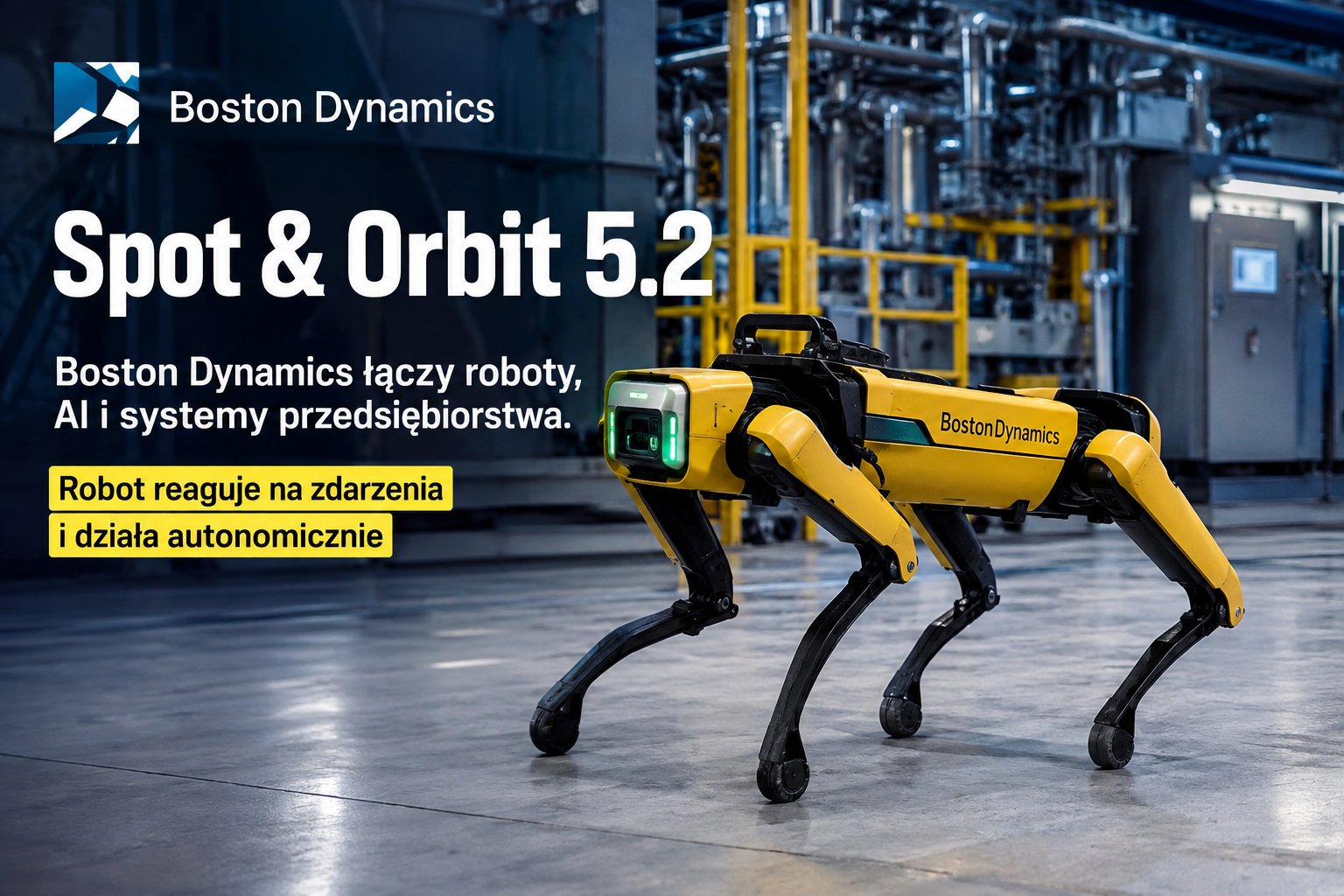
Boston Dynamics is previewing Spot & Orbit 5.2, an update designed to connect Spot, facility sensors, enterprise systems and AI models into a single workflow. The most important change is not that the robot will walk better. It is that an event detected by an industrial system can trigger a physical action by the robot.
The company is presenting the release in a webinar titled “From AI Insights to Autonomous Action.” According to Boston Dynamics, an input from a PLC or another third-party sensor can trigger an appropriate process and deploy Spot exactly where an additional inspection is needed. That moves Spot beyond scheduled robotic rounds and toward a closed loop: detect a problem → decide what to do → perform a physical inspection → write the resulting data back into enterprise systems.
From scheduled rounds to event-driven response
The traditional autonomous inspection model is relatively simple: at a defined time, a robot launches a mission, follows a saved route, collects images, thermal or acoustic data and sends the results for analysis. Spot and Orbit already support mission scheduling, remote robot operation, APIs, webhooks and enterprise-system integrations.
Spot & Orbit 5.2 is intended to extend that model with real-time, event-driven workflows. Instead of waiting for the next routine round, the system can react to a signal from a PLC or another sensor. A possible scenario is straightforward: production monitoring detects an unusual value, Orbit launches a prepared workflow, and Spot travels to the relevant asset to collect additional visual or sensor data.
This is still not “general autonomy” in which a robot independently understands an entire factory and decides what work to perform. Automation happens inside defined integrations, permissions and workflows. For companies, however, that can be more useful than a spectacular demonstration of general intelligence because a specific process can be identified, timed and compared with the cost of downtime it is intended to prevent.
Gemini moves beyond single-image inspection
The second major element of 5.2 is an expansion of AI Visual Inspection with Google Gemini-powered video analysis. Boston Dynamics gives examples of dynamic failures that may be difficult to capture in a single still image, including slipping belts and fluid leaks from operating equipment.
The Gemini integration did not start with 5.2. Boston Dynamics previously announced a partnership with Google Cloud and Google DeepMind to integrate Gemini and Gemini Robotics ER 1.6 into Orbit AIVI-Learning. The system is used for applications including safety inspections, asset monitoring, gauge reading, sight-glass level estimation, pallet counting and standing-liquid detection.
The important step in the new release is moving from recognizing a state in a still image to analysing behaviour over time. For maintenance teams, that can matter because many failures are inherently dynamic: vibration, slipping, intermittent leaking or irregular movement may be easier to identify in a video sequence than in a single frame.
AI can trigger action in the physical world
The most interesting part of the update goes beyond Spot itself. In many companies, AI still stops at the screen: it detects an anomaly, creates an alert or produces a recommendation, but a person has to bridge the final gap between information and action in the physical world.
Boston Dynamics is trying to close that gap. The architecture can look like this: a sensor detects a change → a system interprets the event → a workflow deploys Spot → the robot travels to the asset → it performs an inspection → the result returns to Orbit or another enterprise system. The company is also previewing no-code work-order automation and direct API integrations with facility systems.
This is a practical example of physical AI. An AI model does not need to control every step of a robot directly for its decision to result in physical action. In an industrial environment, a safer and easier-to-deploy architecture may be one in which AI selects an appropriate pre-defined workflow while the robot executes it using a proven autonomy stack.
Orbit is becoming an operational layer for the facility
Boston Dynamics is developing Orbit as more than a fleet-management application for Spot. The current platform aggregates inspection data, schedules missions, handles alerts, APIs and webhooks, and integrates with systems of record. Enterprise users can also manage activity across multiple sites and robot fleets. Boston Dynamics says Orbit currently spans Spot and Stretch and is intended to support Atlas in the future.
Version 5.2 is also set to introduce asset-centric dashboards. Instead of focusing primarily on which mission the robot completed, users will get a view centred on a specific asset — a motor, pump, conveyor or another piece of equipment — and its condition over time. For maintenance teams, that is an important shift: the robot becomes one data source describing the machine rather than the main object of the user interface.
What is confirmed — and what is still unknown
Boston Dynamics officially confirms the planned scope: connecting sensors, enterprise systems and AI; event-triggered workflows; API integrations; work-order automation; Gemini-powered video inspection; and new dashboards organised around facility assets.
At the same time, this is currently a Spot & Orbit 5.2 preview and manufacturer material. The webinar page does not provide independent performance data for the new video inspections, false-positive or false-negative rates, or pricing for the update. It also does not publish a complete rollout schedule for every feature or specify whether all capabilities will be included in every Orbit package.
Teleoperation: Spot can still be operated remotely, and Orbit lists remote robot operation among its current capabilities. The 5.2 announcement is primarily about automatically triggering defined missions and workflows from events. It should therefore not be presented as full, general robot autonomy.
Why Poland and the EU should watch
The most obvious use cases are large manufacturing plants, energy infrastructure, logistics centres and extensive technical facilities. In these environments a single unplanned failure can cost far more than the inspection itself, while some checkpoints are hazardous, hot, noisy or difficult for people to inspect frequently.
For a small business, Spot remains a high-end solution. The more important signal may be the architecture itself: sensor → AI → autonomous robot → business system. If that model proves effective in expensive industrial deployments, similar approaches can eventually move into lower-cost service, cleaning and logistics robots.
RoboMorrow assessment
Spot & Orbit 5.2 is interesting not because Spot is simply receiving another AI feature, but because Boston Dynamics is trying to connect a digital decision to a physical action. That is less spectacular than a humanoid learning a new trick, but it is much closer to a process for which a company can build a measurable business case.
The key questions are now practical: how reliably does the system detect dynamic anomalies, how often does it require human intervention, how difficult is integration with existing maintenance systems, and what does a complete deployment cost? Real-world deployments will determine whether 5.2 actually reduces the time between detecting a problem and taking action.