China targets 100 key humanoid robot standards by 2028
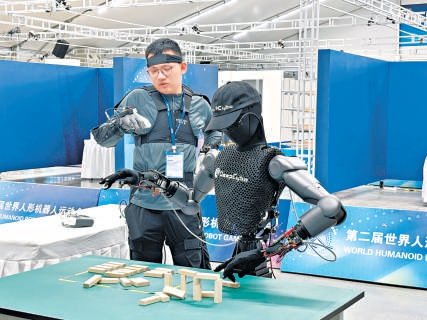
The humanoid race is entering a phase where standards may matter as much as new robots. China wants common capability tests, interfaces, safety rules, identification and industrial-use requirements. This is a consultation draft, not a set of 100 standards already in force.
The 100 standards go far beyond safety
The draft targets at least 100 key standards by 2028 across capability testing and evaluation, key technologies, platforms and systems, application scenarios and safety governance. More than 200 companies are expected to participate in promotion and implementation. That is an unusually broad program for a still-young humanoid industry.
The framework extends beyond mechanical safety. It covers common foundations and interfaces, brain and compute, limbs and components, complete robots, applications, safety and ethics. Xinhua reports that more than 100 humanoid standards are already under development or preliminary study globally, but the field still lacks a coherent common architecture.
Capability levels and unique robot identification are especially important
The draft includes a humanoid capability-level system as well as unique identification, coding and recognition mechanisms. That may sound administrative, but it matters for fleet management, service, version tracking and potentially incident accountability.
Capability classes could also reduce today’s benchmark chaos. One manufacturer shows a cup grasp, another reports 98% success, but results are difficult to compare without shared protocols. A standard can force disclosure of environment, trial count, conditions and autonomy mode.
Industrial environments and safety governance
The framework is intended to define requirements for structured and semi-structured industrial environments, including manipulation capability and environmental adaptability. That suggests China wants to move from demonstrations toward industrial procurement, where customers need common acceptance criteria.
A separate block covers safety, ethics and social-impact assessment. We do not yet know which future standards will become mandatory versus recommended. The current document is a consultation draft open from Aug. 25 to Sept. 23, not 100 standards already in force.
Why standards can accelerate scale
Electronics, automotive and industrial automation all show that common interfaces and test methods can accelerate markets more than individual products. Suppliers can build against shared requirements, manufacturers can compare components and customers receive less arbitrary procurement criteria.
The effect may be particularly strong in humanoids because the supply chain is still forming. If hundreds of companies converge on similar definitions for joints, interfaces, identity and benchmarks, integration cost can fall.
Europe: the AI Act is not the same as industrial standardization
The EU is building rules around product safety, liability and AI, but that is a different layer from constructing a complete standard architecture for one emerging industrial category. Europe also works through CEN/CENELEC, ISO and IEC, yet the speed of humanoid development means early practical test methods can shape the market’s language.
The key question is whether Chinese standards remain domestic or later migrate into ISO/IEC work and export contracts. For Polish integrators and buyers this matters directly: imported robots may arrive with benchmark claims based on the Chinese framework while EU conformity follows a separate path.
Sources and methodology
Primary source: MIIT consultation, Aug. 25–Sept. 23, 2026. The 100-standard and 200-company targets are also reported by Xinhua. The featured image is an authentic Beijing Government humanoid photo used illustratively.
Standards can become the invisible infrastructure of a market
In a mature industry, every manufacturer should not have to redefine connectors, test procedures or safety-level descriptions from scratch. Shared standards lower integration costs and let component suppliers design for a larger market. That matters especially for humanoids because the stack spans many suppliers: actuators, reducers, hands, force sensors, cameras, batteries, compute, middleware and AI models. If some interfaces stabilize, barriers to entry for new robot makers can fall.
Benchmark standardization may be just as important. Companies currently publish impressive videos of running, manipulation and factory work, but results are difficult to compare because rules, teleoperation levels and definitions of success differ. Capability classes and common test methods could force greater comparability. Much depends on whether the eventual standards are rigorous and widely adopted or become a box-ticking exercise.
Europe should watch industrial interfaces, not only AI regulation
Europe has deep expertise in machinery safety and standardization, so China’s initiative does not automatically create a technological advantage. It does show that Beijing views humanoids as an emerging industry that needs shared technical infrastructure. European manufacturers will need to stay active in ISO and IEC processes and defend interoperability so that global markets are not shaped solely around one national supply chain. For now the MIIT document remains a consultation draft, so its real impact can only be judged when concrete standards are published and adopted.
Standardization could also accelerate enterprise purchasing
Buying a humanoid is difficult for large companies today because two robots with similar marketing descriptions can expose very different interfaces, safety procedures and performance reporting. A shared language for specifications and tests can simplify RFPs, procurement and risk assessment. This matters especially for fleets, where an integrator wants to know whether a component or platform supplier can be changed without rebuilding the entire system.
A standard does not guarantee quality, however. A poorly designed rule can lock in weak requirements or favor technologies used by current leaders. The significance of China’s plan will depend on the content of the individual documents, certification methods and whether test results become public and comparable. The number “100” is a policy target for standardization, not a standalone measure of industry maturity.