Delta debuts an Embodied AI dual-arm robot platform for flexible automation
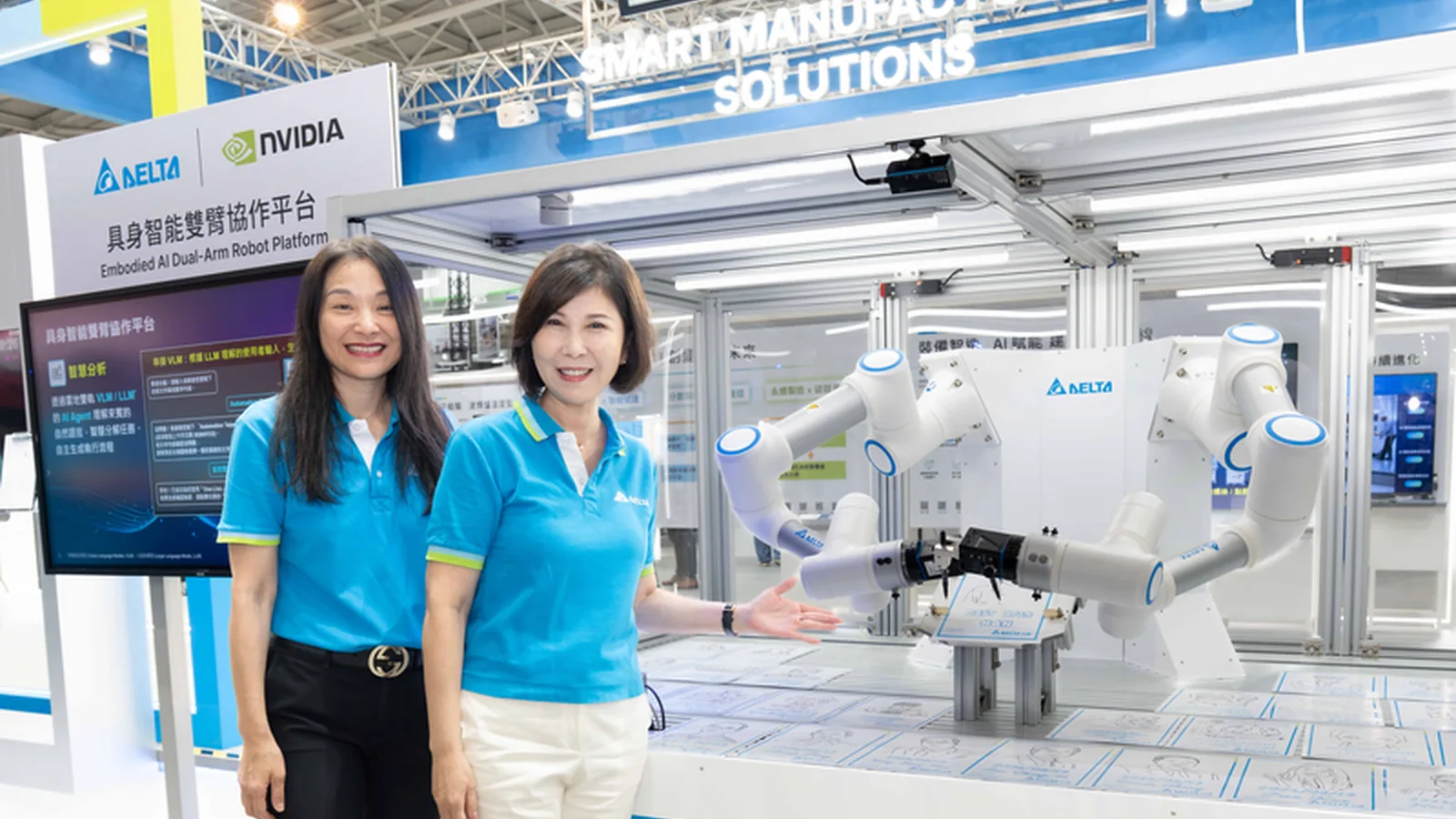
Delta Electronics has unveiled its own Embodied AI Dual-Arm Robot Platform at Automation Taipei 2026. The direction is notable because Delta is not trying to replicate a full humanoid. Instead, it is combining a two-arm manipulation system with AI and digital-manufacturing tools, aiming at production tasks that are more variable than the jobs normally handled by a rigidly programmed robotic cell.
Delta’s official August 19 announcement confirms the platform’s public debut at Automation Taipei 2026. The company presents it as part of a broader “AI-empowered digitization” strategy that also includes production-line digital twins. That distinction matters: this is a platform launch and a technology demonstration, not yet an independently benchmarked product with a public price, detailed productivity data and a long list of disclosed customer deployments.
Embodied AI without a full humanoid body
A dual-arm layout can be valuable in manufacturing when a task was originally designed for a person but does not require legs. Two arms can hold a component with one side while manipulating it with the other, transfer parts between grippers and execute sequences that depend on coordinated bimanual motion. In many factories, that architecture may also be easier to integrate and safeguard than a full-size humanoid walking around the production floor.
Delta is positioning the new platform around the transition from conventional robot programming toward systems where perception and AI models influence how a task is executed. This is the same broader trend described as Physical AI or embodied AI in humanoid robotics: the model does not merely interpret information but becomes part of a machine that acts in the physical world.

The key question: can AI reduce reprogramming cost?
The most important promise of embodied AI in manufacturing is not a spectacular demo. It is the possibility of reducing the engineering effort required when a line switches to a new product or variant. In traditional automation, a new part may require new trajectories, grip points, safety logic and process programming. If perception-driven systems can tolerate more variation, automation may become more economical in high-mix, lower-volume manufacturing.
Delta has not yet published a benchmark that allows that benefit to be quantified. Public information does not provide a production cycle time, complex-manipulation success rate, gripper specification, payload figure or hours of unattended operation for the new platform. A trade-show presentation therefore should not be interpreted as proof that the system can already replace conventional industrial robots across arbitrary processes.
The digital twin is the other half of the strategy
In the same announcement, Delta highlights an AI-enhanced Production Line Digital Twin. That is a logical counterpart to an embodied robot platform. An accurate virtual representation of a line can be used to test changes, analyse production flow and prepare parts of a robot workflow before deploying them to physical equipment. The practical value depends on data quality, factory-system integration and how closely the digital environment matches the real production floor.
Delta has an advantage here because it already operates across industrial automation, drives, power electronics and control systems. Embodied AI can therefore become another layer on top of an existing industrial stack rather than a completely new hardware business starting from scratch.

What is confirmed and what remains a company claim
- Confirmed: Delta publicly unveiled the Embodied AI Dual-Arm Robot Platform at Automation Taipei 2026.
- Confirmed: the company presented it alongside production-line digital-twin technology.
- Company positioning: embodied AI is intended to make future industrial processes more flexible and autonomous.
- Unknown: broad commercial availability, price and detailed production-performance metrics.
- Unknown: whether external customers are already running this exact dual-arm configuration in serial production.
Why it matters for Europe
European factories often compete through flexibility rather than only through enormous production volumes. Shorter runs, multiple variants, rapid changeovers and high labour costs are common. Those conditions are exactly where a more adaptable robot could offer an advantage over automation engineered around one tightly defined repetitive process.
For manufacturers in Poland and the wider EU, the decisive question will not be whether the system can perform an impressive demonstration. It will be whether an integrator can teach it a new operation quickly, validate safety and show a credible return on investment. If embodied AI genuinely reduces integration and reprogramming effort, dual-arm platforms may reach factories sooner than fully mobile humanoids.
Why two arms matter for Physical AI
Many real manufacturing tasks are inherently bimanual. A worker may hold a housing while routing a cable, stabilize a part while fastening it or rotate a component to reach another surface. A single-arm robot can require extra fixtures, positioning tables or a process redesigned specifically around automation. A dual-arm platform can potentially reproduce more of the natural work sequence without rebuilding the entire station around the machine.
This is where embodied AI may matter more than it does in a simple pick-and-place demo. The more a task depends on the current pose of a part and on reacting to small variations, the harder it becomes to describe every possible situation with conventional programming. At the same time, reliability becomes more important: an AI model may improve adaptation, but an industrial system still has to remain inside defined safety limits and deliver predictable cycle times.
RoboMorrow view
This is a meaningful technology signal, but not yet proof of a manufacturing breakthrough. Delta has genuine industrial scale and integration experience, which makes its embodied-AI move worth following. The next data points that matter are customer deployments, productivity, reliability and commissioning time. Those will show whether “AI-native” robotics actually changes the economics of flexible automation.
Source: Delta Electronics — official Automation Taipei 2026 announcement.