GEN-1.5 learns from a demonstration: physical prompting instead of programming?
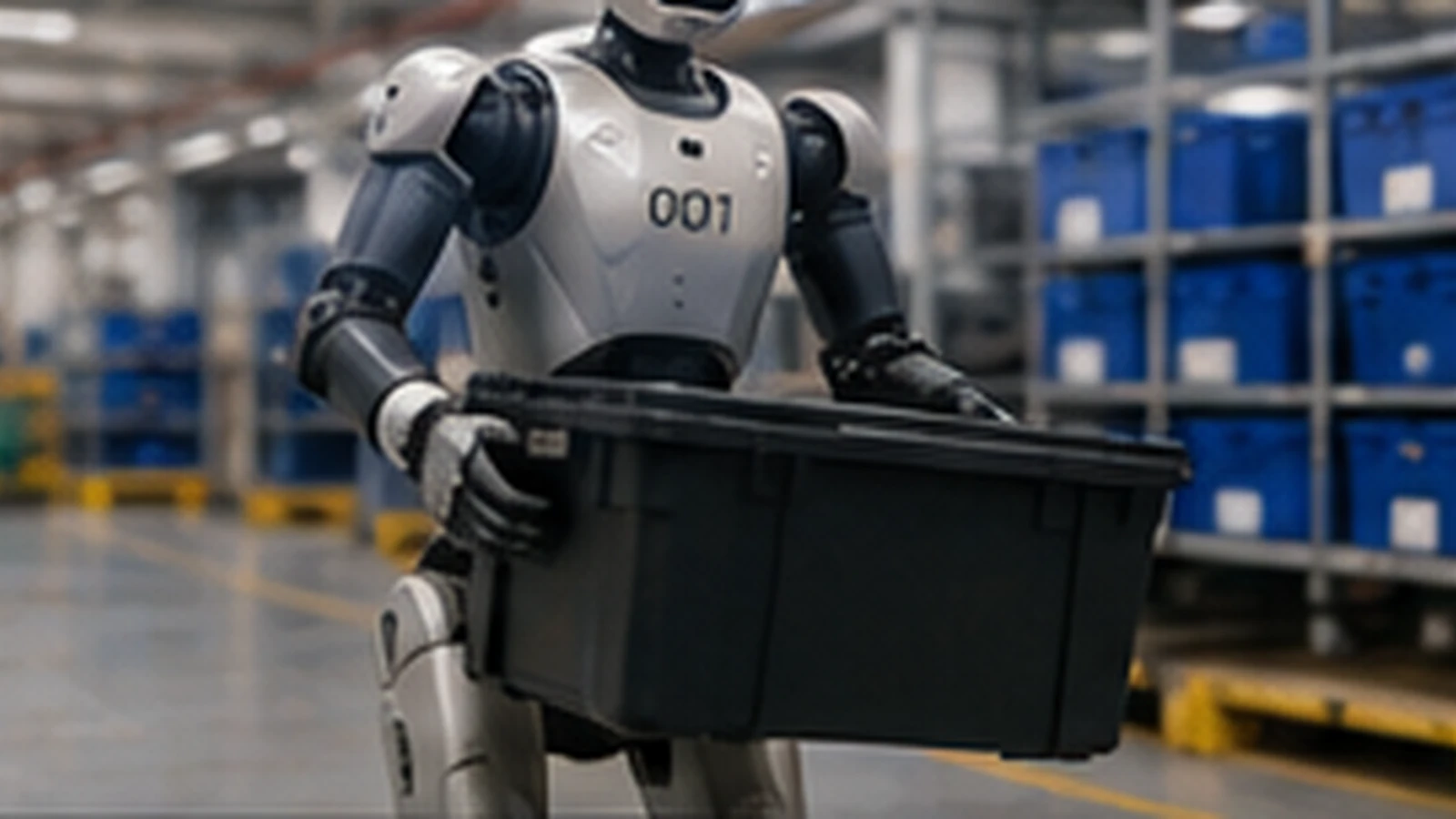
Generalist AI has introduced GEN-1.5, a robotics model designed so that a new physical behavior can be specified by a short demonstration rather than by conventional programming or lengthy task-specific fine-tuning. The company describes the capability as one-shot learning: show the system what to do, then let the robot infer the intent and apply it to the situation in front of it.
The claim is significant, but the evidence needs to be separated into layers. The launch and the one-shot framing come from Generalist. WIRED visited the company and reported seeing robots adapt after short instructional videos and improvise when conditions changed. What does not yet exist is an independent laboratory replication of the GEN-1.5 benchmark. WIRED reports current success at roughly 59%, which is far from production-grade reliability.
Why physical prompting could matter more than another hardware upgrade
In conventional automation, the cost does not end with buying an arm or gripper. Integrators still have to describe the sequence, prepare the cell, program motions, handle exceptions and repeat some of that work when the product changes. If a meaningful share of this integration can be replaced by demonstrating the job, the economics of high-mix, low-volume automation change more than they do from a modest increase in payload or degrees of freedom.
The interesting part is not copying a trajectory. A demonstration-driven system becomes useful only when it identifies what should remain invariant and what can change: object position, available tool, grasp side, or a small execution error. Those are the kinds of behaviors WIRED described during its visit to Generalist, including alternative strategies when the original setup was unavailable.
What Generalist actually demonstrated
Generalist calls GEN-1.5 a one-shot learner and says new tasks can be acquired from a demonstration in a few seconds. That is a manufacturer statement, not an industry-standard benchmark. Public examples focus on object manipulation and adaptation when the scene or available tool changes.
WIRED observed tasks guided by short instructional videos, work with different objects and improvisation when the original tool or arrangement was not available. In one reported example, the system repurposed a dustpan. Such examples are more informative than a perfectly replayed motion because they suggest the model is representing the goal at a level broader than a memorized trajectory.
A 59% success rate is both impressive and insufficient
An early model that can transfer a demonstration into a new situation without a separately written task program may be technologically important even at moderate success rates. From a factory perspective, however, 59% is unusable. A production process cannot require human intervention in roughly four out of ten attempts.
The figure should therefore be read as evidence about the direction of capability, not as proof of deployment readiness. Real applications will care about failure modes, safe abort behavior, recovery time, transfer between cells, performance after hours of operation and the amount of human supervision required—not merely a mean success rate on short tasks.
GEN-1.5 follows Generalist’s broader bet on scaling physical data
Generalist has built its strategy around scaling data from physical interaction. In April it described GEN-1 as achieving very high performance on selected simple tasks after adaptation and emphasized a large physical-data corpus. In July the company showed one model spanning many different end effectors. GEN-1.5 shifts the emphasis from “train the model on this task” toward “give the task as context.”
The analogy with language models is tempting: users increasingly prompt a general model with instructions and examples instead of training a dedicated model for every request. But physical AI has a harder reliability problem. A bad text answer is inconvenient; a bad action can drop an object, collide with equipment or stop a line. Data collection and evaluation are also more expensive.
What remains unknown
- Generalist has not publicly disclosed the full architecture, parameter count or inference cost of GEN-1.5
- there is no independent replication of the roughly 59% result on the same task set
- it is unclear how performance scales from short manipulations to multi-minute jobs
- there are no public MTBF, safety or maintenance figures for production deployments
- availability, pricing and access for external integrators have not been established
None of these gaps invalidates the demonstration. They define the correct editorial label: a notable research and engineering result, not a finished general-purpose worker.
What it could mean for Europe
For European manufacturing, the most important part may not be humanoid form at all. It is integration time. Poland, Czechia, Germany and northern Italy contain thousands of plants with short runs, frequent SKU changes and tasks that have historically been too expensive to automate. Demonstration-based task specification could lower the setup cost for that long tail of processes.
The condition is a move from impressive adaptation to predictable operation. Integrators will need validated skills, version control, deterministic safety layers, clear data handling and responsibility for failed actions. If those pieces mature, physical prompting could become a normal integration tool. Without them, it remains a compelling lab capability.
How GEN-1.5 should be independently tested
The next important step is not another collection of impressive demonstrations but a blind evaluation whose exact tasks were not known to the model developers. Such a benchmark should separate genuine learning from a demonstration from behaviors already represented in pretraining. Objects, positions, lighting, available tools and action order should vary, while the report should include task-by-task variance rather than only an average success rate.
Failure handling matters just as much. Robotics evaluation needs to record whether the system detects its own mistake, stops safely, recovers without assistance, how many human interventions are required and whether changed conditions produce new failure modes. Those measurements would make physical prompting comparable with conventional programming, teleoperation and task-specific learning on more equal terms.
Integrators will also care about transfer between cells. If the same demonstration works only on one table with one camera setup and one object set, the integration benefit is limited. If a skill survives a move to another station and needs only a short validation step, one-shot learning begins to change the real cost structure of automation.
Sources and verification
This article is based on: Generalist AI — GEN-1.5, WIRED — on-site report, Generalist AI — GEN-1. Manufacturer and analyst figures are identified as claims or estimates rather than audited facts. RoboMorrow verification: 20 August 2026.