LG and NVIDIA are developing a bipedal humanoid for a planned 2027 public unveiling
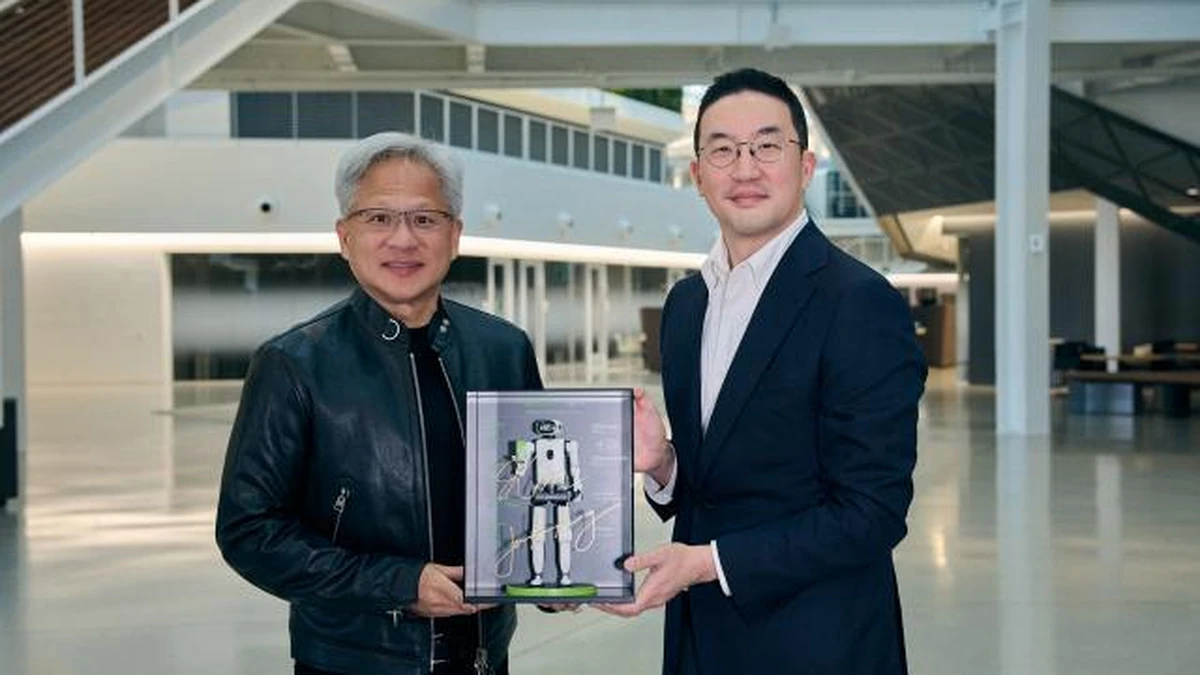
LG and NVIDIA are expanding their robotics partnership with a new bipedal humanoid. The Korean group says it is developing a robot that will use NVIDIA Jetson Thor, the Isaac GR00T foundation-model stack and NVIDIA Halos for Robotics. A public unveiling of the full-size machine is planned for the first quarter of 2027.
The announcement is significant, but it is important to separate a confirmed development program from a finished product. LG has not disclosed the robot's name, detailed specifications, price, mass-production date or sales schedule. The image accompanying the announcement shows LG's Kwang Mo Koo and NVIDIA's Jensen Huang with a miniature model or representation of a humanoid — it is not a demonstration of an operating full-size robot.
A bipedal humanoid built around Jetson Thor and Isaac GR00T
According to LG's official announcement, the robot will use NVIDIA Jetson Thor for onboard compute, advanced reasoning and control. Its robotics AI stack will be developed using NVIDIA Isaac GR00T, NVIDIA's open family of foundation models designed for humanoid robots.
LG also names NVIDIA Halos for Robotics. NVIDIA describes Halos as a full-stack safety system for physical AI that spans hardware, system software and applications. Its inclusion in LG's plan does not mean the future humanoid is already certified or that its complete safety architecture has been disclosed. Implementation details remain unknown.
The project is intended to combine capabilities from several LG companies. LG Electronics will contribute actuator technologies, LG Innotek will provide sensing capabilities and LG Energy Solution will contribute battery technologies. That is one of the most important elements of the announcement: LG is not entering robotics only as a software integrator. The group already has expertise in motors and actuators, optics, electronics, batteries, manufacturing and consumer products.
This is not the same robot as CLOiD
The new bipedal humanoid should not be confused with LG CLOiD, which LG has previously presented as a home-oriented assistant on a mobile base. In the latest announcement, LG explicitly describes CLOiD as a wheel-based robot and says it plans to deploy it on an LG Electronics washing-machine production line in Tennessee before the end of 2026 for validation in a real manufacturing environment.
The deployment is intended to generate operational experience beyond a trade-show demonstration. LG says it will use the validation results to refine robot performance and utility, with the longer-term possibility of extending deployments across manufacturing sites, commercial spaces and homes.
A robot data factory and LG's own foundation model
The NVIDIA partnership goes beyond the hardware of a future humanoid. LG plans to build a robot data factory powered by LG CNS PhysicalWorks. The infrastructure is intended to support continuous data collection, synthetic-data generation, training and verification for robotics.
Data gathered from real-world validation is also expected to strengthen LG's in-house Robot Foundation Model. The company is therefore not replacing its own AI stack with NVIDIA's model. Its stated strategy is to actively use Isaac GR00T while continuing to develop proprietary model capabilities.
This matters strategically because the humanoid race increasingly depends on more than mechanical design. Access to real-world task data, simulation, training infrastructure and the ability to transfer new skills onto physical machines can become as important as the robot body itself.
A broader LG–NVIDIA agreement
The memorandum signed on August 13 at NVIDIA's headquarters in Santa Clara covers three areas: robotics, AI factories and future mobility. The companies also plan to operate a joint technical and business task force focused on R&D, site validation and commercialization.
The relationship did not begin with this announcement. NVIDIA had already said that LG Electronics was adopting its robotics frameworks and GR00T models and that the companies planned to jointly develop reference robots. The new announcement goes further by attaching a specific bipedal humanoid program and a target window for public unveiling.
What is confirmed
LG officially confirms development of a new bipedal humanoid, the planned use of Jetson Thor, Isaac GR00T and Halos for Robotics, the combination of technology from LG Electronics, LG Innotek and LG Energy Solution, and a target public unveiling in the first quarter of 2027. South Korea's Yonhap News Agency independently reported the core announcement.
LG also confirms that its wheel-based CLOiD robot is scheduled for validation on a Tennessee washing-machine production line in 2026 and that the partnership includes infrastructure for collecting, generating, training and verifying robotics data.
What is still unknown
LG has not disclosed the humanoid's name, dimensions, weight, number of degrees of freedom, payload, speed, runtime or battery charging and swapping strategy. The company has also not stated the initial autonomy level, first commercial tasks or whether the robot will initially target factories, logistics, homes or several segments.
Price: not disclosed. Availability: not disclosed. A public unveiling in Q1 2027 is not the same as a sales launch. LG has not announced availability in Poland or the European Union.
Teleoperation: the official announcement does not describe teleoperation as part of the announced system or demonstration. That does not prove that future development will never use remote supervision or operator-generated data; it simply has not been disclosed at this stage.
Why Poland and the EU should watch
For Europe, the key signal is that another large industrial and consumer-technology group is entering the humanoid race with substantial in-house component and manufacturing capabilities. If LG moves from prototype to a series-produced product, it could have advantages over startups in batteries, sensing, quality control, component procurement, global service and production scaling.
There is currently no basis for assuming a specific European rollout. For Polish companies, the shorter-term lesson is perhaps more relevant: LG intends to validate robots inside its own manufacturing operations first. That approach can reduce development risk because the company has factories where it can gather data, improve the system and build a measurable business case before broad commercialization.
RoboMorrow assessment
This is an important announcement, but it is not a product launch yet. The most meaningful part is not the miniature model shown in the press image, but the combination of LG's resources and NVIDIA's stack: actuators, sensors, batteries, Jetson Thor, GR00T, safety technology, factory data and LG's own robot foundation model.
Q1 2027 will be the first major test of the program. Only then should we expect to evaluate the robot's mechanics, actual autonomy, target tasks and path toward commercial deployment. Until then, the project is best described as a confirmed humanoid development program by a major technology group, not a robot that customers can already buy or order.