Lidl puts a cabless Level 4 truck into daily logistics in Germany
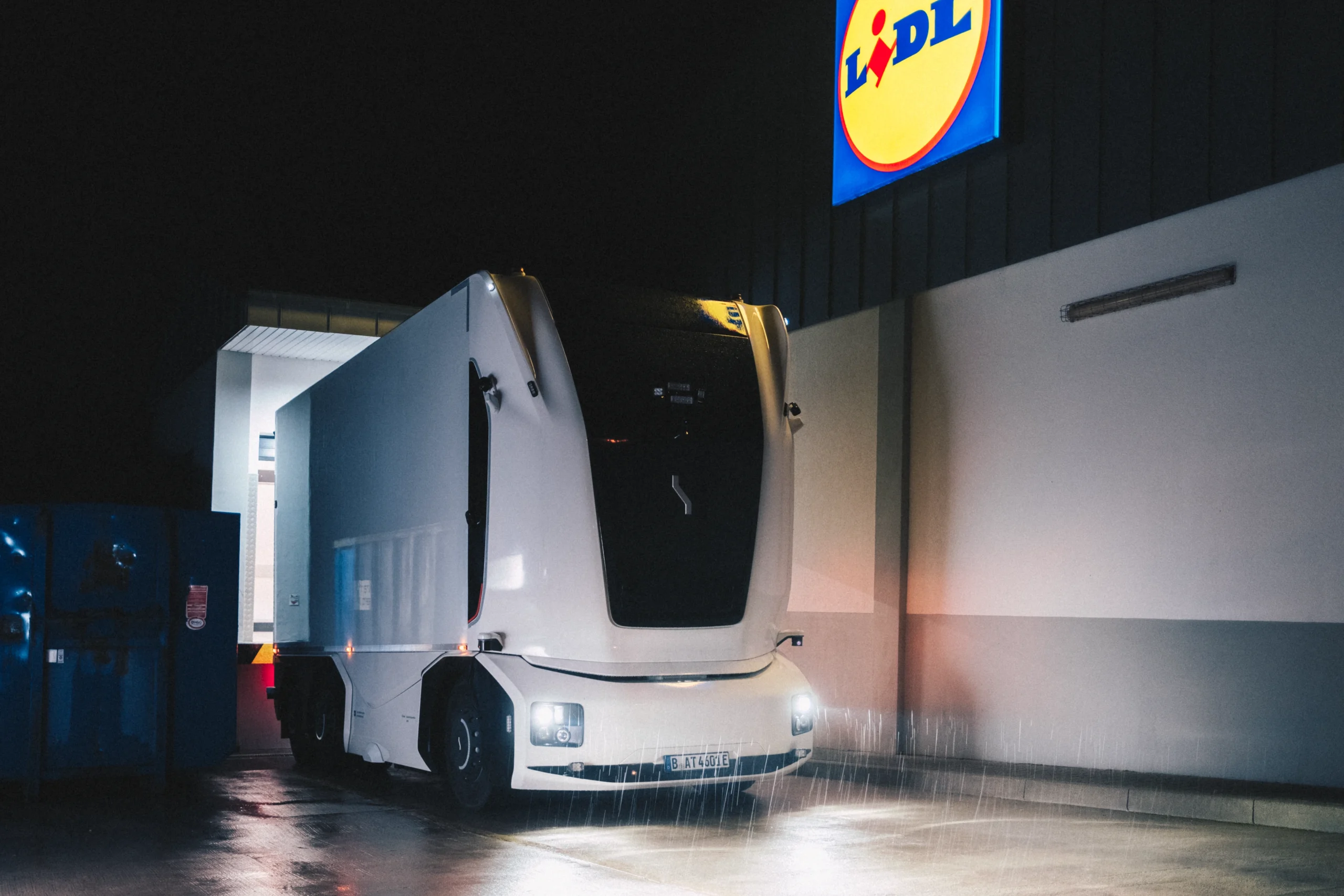
Lidl and Einride have put a cabless, battery-electric SAE Level 4 truck into operation in Germany, moving goods between a distribution center and a retail store. The important detail is that there is no driver or safety operator inside the vehicle. The operation runs under a permit from Germany’s Federal Motor Transport Authority, KBA, which Reuters describes as the first authorization of its kind in the country.
What has actually started
- The Einride vehicle operates on a public road in Germany, not only on private property.
- The system is SAE Level 4 within a defined operational domain.
- The truck has no cab and runs daily logistics without a driver or safety operator onboard.
- It moves goods between a Lidl distribution center and a store.
- KBA issued the permit after a safety-validation process for real-road conditions.
- The partners plan to expand the initial route into a multi-stop milk-run network.
- Further deployments in other Schwarz Group businesses are under discussion.
Why this is stronger than another prototype story
Autonomous trucking is crowded with announcements, demonstrations and tests that still keep a human ready to take control. What makes this deployment notable is the combination of four factors: public roads, no onboard human, real freight for a major retailer and formal regulatory authorization. It remains a limited deployment, but the discussion shifts from “can the truck drive?” to “how does a driverless system perform inside a daily logistics network?”
A pilot that is also doing real work
Language matters. Schwarz Group calls the project a pilot and a real-world test of autonomous store delivery. Reuters describes the vehicle as being in regular service and daily logistics. Those statements can both be true: a program can remain a pilot while carrying real goods every day. RoboMorrow is not describing this as a nationwide German fleet rollout because the number of vehicles and total transport volume have not been disclosed.
KBA matters as much as the vehicle
European road autonomy does not scale through better AI alone. It needs a legal operational design domain, safety validation, a clear operator model and permission to run on specific infrastructure. Germany’s KBA approved this operation after a safety-validation process for real-world road conditions. That creates a useful procedural precedent, but it does not automatically authorize the same system in another EU member state.
What Einride and Lidl plan next
The initial route is intended to grow into a multi-stop milk run. That will be a more demanding operational test than a simple A-to-B lane because it adds stops, timing constraints, more interactions and more opportunities for edge cases. Einride and Lidl are also discussing additional deployments elsewhere in Schwarz Group. There is currently no confirmed rollout in Poland and no public timeline for a much larger fleet.
The business case is not yet public
The companies point to driver shortages and supply-chain reliability as key motivations. A cabless design may also change vehicle architecture and asset utilization, but there is not enough public data to calculate the economics of this deployment. We do not know the cost of the vehicle, infrastructure, remote supervision, insurance, service or interventions. RoboMorrow therefore does not claim the system is already cheaper than a conventional truck with a driver.
Level 4 does not mean “autonomous everywhere”
SAE Level 4 means the driving system can operate without a human driver inside a defined set of conditions. It does not mean universal autonomy on every road, in every city and in all weather. The important questions are the width of the approved ODD, how often operations pause and how frequently remote support is needed. Einride describes remote oversight as part of its autonomous platform, but it has not published an intervention rate for the Lidl route.
Why Poland and the EU should watch
Poland is a major European road-freight and logistics market, so technology that reduces dependence on driver availability has clear economic relevance. Schwarz Group also operates at significant scale in Poland. None of that means the German project is automatically coming to Poland soon. Local road rules, approval processes, infrastructure and liability arrangements will need a separate path.
What we still do not know
- the number of vehicles in operation and trips per day;
- the exact route length and full operational design domain;
- intervention rate, uptime and MTBF;
- operating cost versus a driver-operated truck;
- remote-supervision rules and response times;
- the timing of the planned milk-run expansion;
- whether Schwarz Group will deploy the system in Poland or other EU countries.
RoboMorrow editorial assessment
This is one of the more important European road-autonomy cases of 2026. Not because a cabless truck exists — those have been demonstrated before — but because the system has passed a regulatory path and is doing daily logistics for a real customer on a public road with nobody onboard. The next stage should be judged by operational data, not by a bigger mileage headline.
Sources and methodology
Schwarz Group — autonomous store delivery · Reuters — Einride/Lidl deployment, 15 Sep 2026 · Einride — autonomous platform context. RoboMorrow verification: 15 September 2026.