NEURA Robotics acquires ACTIVE Shuttle from Bosch Rexroth to expand its European Physical AI ecosystem
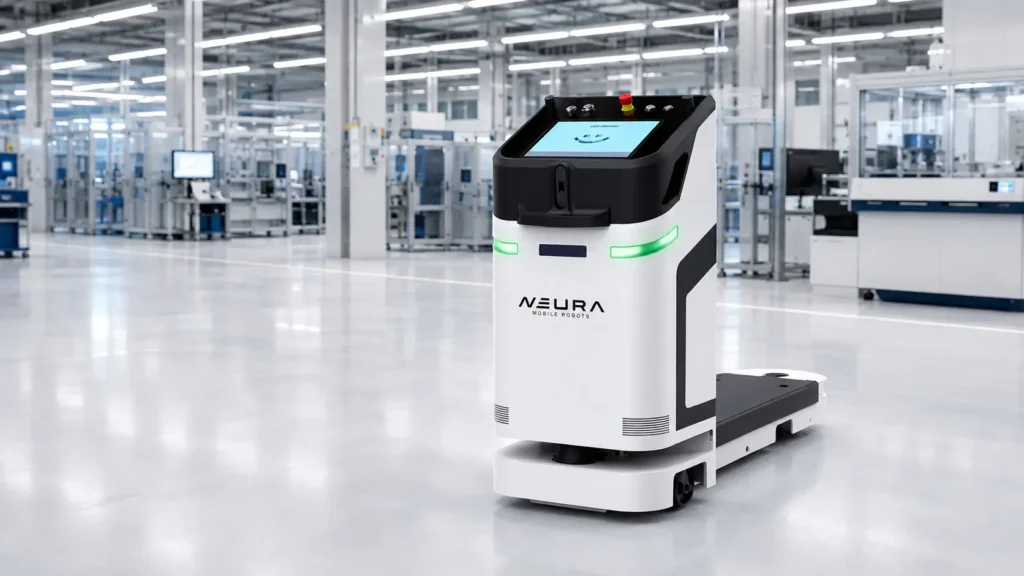
NEURA Robotics is acquiring the ACTIVE Shuttle platform from Bosch Rexroth — an autonomous transport system used in manufacturing and intralogistics. The transaction is set to take effect on October 1, 2026 and covers both the platform's hardware and software, while NEURA Mobile Robots is also set to continue supporting existing customers.
This is not a humanoid acquisition or a flashy new AI demonstration. For the Physical AI market, however, it may be more important because NEURA is bringing a system that already operates in real industrial environments into its own ecosystem. The company intends to combine proven intralogistics technology with its AI stack, mobile robots, industrial robots and, eventually, humanoids.
What exactly NEURA is acquiring
According to NEURA's official announcement, NEURA Mobile Robots will take over the hardware and software of ACTIVE Shuttle and continue providing service to existing customers. Bosch Rexroth and NEURA prepared the handover together, with the announcement emphasising continuity in service, support and future development for installed systems.
ACTIVE Shuttle is used for automated material transport in manufacturing and logistics, including supplying assembly workstations and moving small load carriers. NEURA describes the platform as a field-proven solution already deployed across numerous industrial companies.
Another important detail is what remains connected to the existing Bosch Rexroth technology stack. ACTIVE Fleet Manager and ROKIT navigation software remain part of the solution. Bosch Rexroth currently describes ACTIVE Fleet Manager as a flexible order-management platform that can coordinate mixed vehicle fleets through the VDA 5050 interface, while ROKIT provides localisation and navigation technologies for mobile robots.
What changes for existing customers
For companies already using ACTIVE Shuttle, the most important part of the announcement is less spectacular than the Physical AI strategy: NEURA says service, support and continued development will carry on. The official release stresses that Bosch Rexroth and NEURA Mobile Robots prepared the handover together to reduce disruption for existing users. That matters because changing ownership of an intralogistics platform affects not only the vehicle, but also software, spare parts, integrations and the operational support surrounding an entire fleet.
From an established AGV to a Physical AI ecosystem
NEURA is not promising an immediate transformation of ACTIVE Shuttle. The company talks about a step-by-step integration into its Physical AI ecosystem, adding AI capabilities and interfaces to technologies across the wider NEURA Group. In the longer term, navigation and fleet-management technologies are also intended to become available as software and hardware tools through the Neuraverse platform.
The strategy is broader than a single transport robot. NEURA wants to build a shared technology layer for multiple robot classes: mobile platforms, industrial robots, collaborative robots and humanoids. Instead of developing perception, navigation, skill learning and machine coordination entirely separately for every device, the company aims to connect them through common infrastructure.
This reflects a wider shift in robotics. Physical AI is increasingly less about one robot performing an impressive demonstration and more about the full stack around it: robots, navigation, data, fleet management, AI models, enterprise integrations and tools for deploying new skills.
Why ACTIVE Fleet Manager and ROKIT matter
In intralogistics, the autonomous vehicle itself is only one part of the system. A larger facility must assign jobs, coordinate multiple robots, react to route changes, connect transport with production and communicate with other software. Fleet-management and navigation technologies may therefore be as valuable to NEURA as the ACTIVE Shuttle hardware itself.
If these tools are eventually integrated with Neuraverse and other NEURA robots, the company could gain a common coordination layer across multiple machine types. For now, however, this is a roadmap described by the manufacturer, not a publicly verified deployment in which humanoids and ACTIVE Shuttle systems already operate under one shared control layer.
What is confirmed
The acquisition was officially announced by NEURA Robotics on August 13, 2026. The company confirms the October 1 effective date, the transfer of hardware and software, continued customer service, the retention of ACTIVE Fleet Manager and ROKIT within the solution, and a plan for gradual integration with NEURA's AI technologies.
The announcement has also been reported by independent industry publications including Tech.eu and Germany's Logistik Heute. Their coverage confirms the core elements of the deal, although it largely relies on NEURA's announcement. At the time of RoboMorrow's verification, we did not find a separate Bosch Rexroth release disclosing additional transaction terms.
What is still unknown
The transaction value has not been disclosed. NEURA has also not published the number of active ACTIVE Shuttle installations, the volume covered by the agreement or a detailed rollout schedule for new AI capabilities. It is also unclear when ACTIVE Fleet Manager and ROKIT technologies will become available through Neuraverse for broader NEURA applications.
There is currently no public information showing whether the acquisition will change system pricing, service terms or deployment costs for new customers. No transaction-related public price list has been published.
Teleoperation: it is not central to this announcement. ACTIVE Shuttle is an autonomous intralogistics platform, while the deal focuses on technology ownership, fleet management, navigation and future Physical AI integration. The announcement should not be interpreted as a demonstration of general-purpose autonomy.
Why Poland and the EU should watch
The acquisition is notable for the European robotics market because it combines technology developed within a major German industrial automation supplier with a fast-growing European Physical AI company. NEURA Mobile Robots also operates beyond Germany: the official announcement lists sites in Milan, Prague and Buckingham.
For Poland, the most immediate relevance is likely to be intralogistics. Manufacturing plants and logistics centres across Central Europe are natural markets for AGVs and AMRs, while VDA 5050 compatibility and the ability to coordinate heterogeneous fleets are becoming more important as deployments scale.
The longer-term direction is even more interesting. If NEURA actually builds a shared infrastructure spanning mobile, industrial and humanoid robots, Europe could gain a platform that connects different robot types through a common AI and orchestration layer. ACTIVE Shuttle gives NEURA an established industrial entry point for that strategy.
RoboMorrow assessment
This is not primarily a story about another robot. It is a story about assembling the technology stack around robots. That is what makes the acquisition interesting. NEURA does not need to recreate every part of intralogistics from scratch: it is taking over a proven platform, software and service relationships and intends to connect them with its Physical AI ecosystem.
The real test will come after October 1. Will the integration remain mainly an ownership change, or will it quickly produce new capabilities, shared orchestration across robot types and real Neuraverse deployments? Only then will it be possible to judge whether NEURA is building a coherent European robotics ecosystem or simply expanding its portfolio of platforms.