Noitom releases HiPHI: 617.5 hours of motion data for humanoid learning
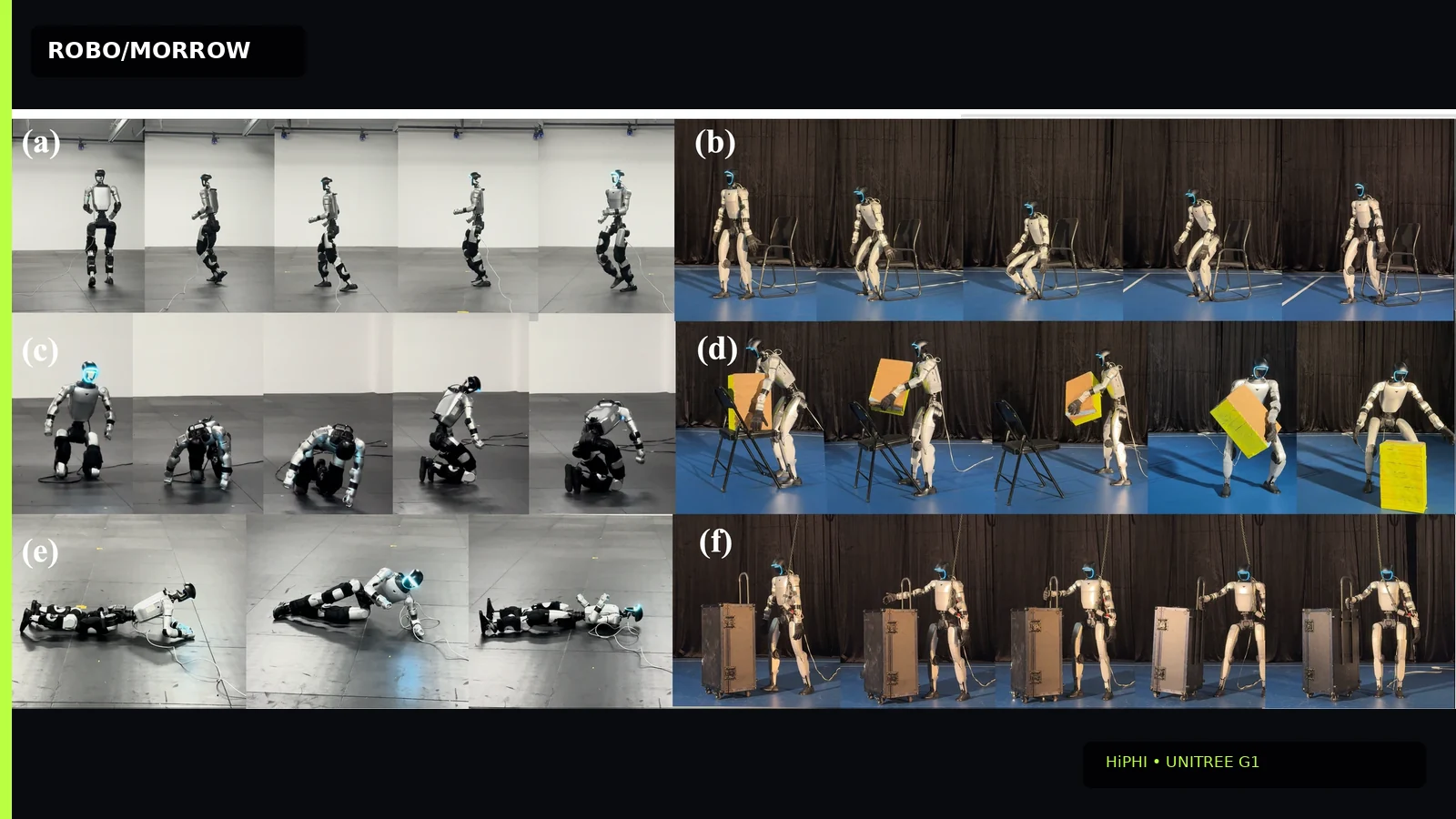
Noitom Robotics has released HiPHI, a large human-motion dataset designed specifically for humanoid learning and Physical AI. The release contains 617.5 hours of motion, 200.1 million frames, data from 132 performers and 245.7 hours of human-object interaction. The most interesting part is not the raw hour count, but the fact that human motion, object trajectories and object geometry are synchronized, while the authors also demonstrate policies trained with HiPHI on a physical Unitree G1 humanoid.
This addresses a real bottleneck in robotics. Humanoids need better hardware and larger AI models, but they also need motion data precise enough to be reproduced by a machine. Internet video offers enormous diversity but normally lacks exact body and object states. Traditional motion capture is much more precise, but expensive and usually smaller. HiPHI attempts to combine broader scale with physically measured motion.
HiPHI by the numbers: 617.5 hours, but 308.7 hours of original capture
| Metric | HiPHI | Why it matters |
|---|---|---|
| Total release | 617.5 h | includes original sequences and mirrored counterparts |
| Original capture | 308.7 h | the underlying recorded material before mirroring |
| Whole-body motion | 371.8 h / 120.5M frames | locomotion, posture and whole-body motion |
| Human-Object Interaction | 245.7 h / 79.6M frames | human and object states recorded together |
| Total | 200.1M frames | 90 Hz optical motion capture |
| Performers | 132 | greater anthropometric and movement-style variety |
| Semantics | 22 Frames, 214 Frame–LU labels | structured expansion of the motion space |
| HOI objects | 40 objects, 12 categories | real geometry and trajectories instead of pantomime alone |
| Repository size | about 215 GB | full dataset is large, while metadata can be downloaded separately |
The distinction between 617.5 and 308.7 hours matters. Every original sequence has a mirrored counterpart in the release. That increases left-right examples and can be useful for training, but it does not mean performers spent more than 600 hours inside the motion-capture volume. RoboMorrow therefore treats 617.5 hours as the size of the published corpus after augmentation and 308.7 hours as the scale of original capture.
What is actually inside the dataset
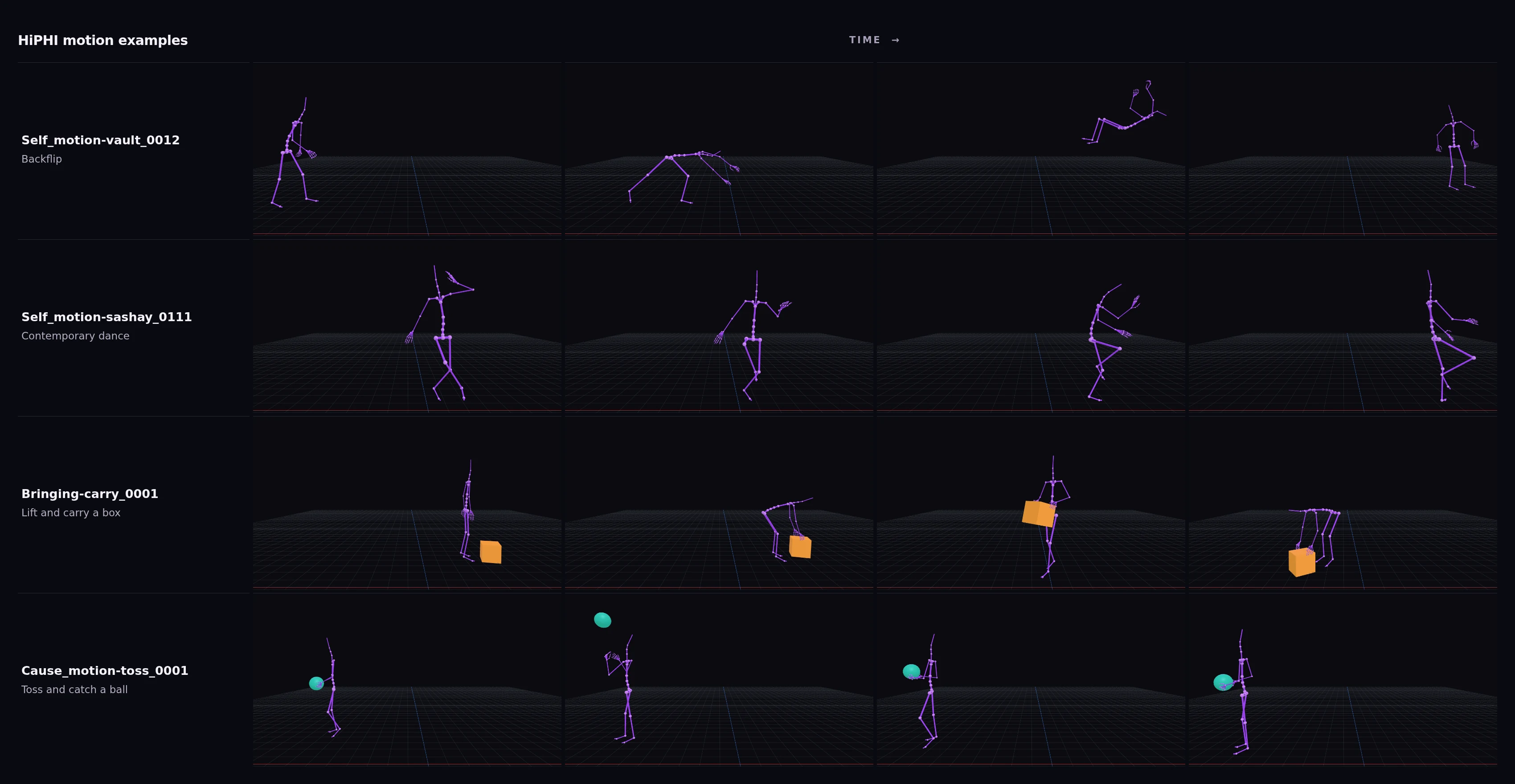
HiPHI uses optical motion capture at 90 Hz and stores human motion in a standardized 55-joint BVH hierarchy. Human-object interaction sequences add synchronized object trajectories and 3D OBJ meshes. A learning system can therefore recover not only where the hands and torso were, but where the manipulated object was at the same moment.
That distinction is practical. A person miming “lift a box” can generate plausible kinematics while omitting the mass, inertia, contact and geometric constraints of the real object. In physical manipulation, those factors change the center of mass, leg strategy, movement speed and arm trajectory. That makes the 245.7-hour HOI subset potentially more valuable for humanoid control than a much larger collection of visually impressive but ungrounded motion clips.
The interaction subset covers 40 real objects from 12 categories. Project documentation also lists an object-mass range of 0.45 to 6.25 kg. The authors evaluate geometric consistency and report 98.1% non-conflict and 95.7% near-surface grounding. Those are author-reported benchmark metrics, not independently audited performance figures.
FrameNet instead of an ever-growing list of “walk, sit, wave” scripts
One of HiPHI's more interesting design decisions is how the data collection itself is planned. Rather than building a longer and longer list of manually described activities, Noitom uses FrameNet as a semantic scaffold. A Frame represents an event type, while a lexical unit identifies a particular word sense that evokes it. Each Frame–LU pair becomes a motion seed that can be expanded across direction, speed, amplitude, posture, body-part involvement and object/contact conditions.
Why can that be better than a normal activity list? Two semantically different activities can produce almost identical kinematics. Meanwhile, a simple activity such as walking can represent many genuinely different motions once direction, speed, stride, turning pattern and torso posture change. For robot learning, named activity count is therefore less useful than actual motion-space coverage.
HiPHI contains 22 Frames and 214 Frame–LU labels. The project reports that 154 labels include at least 10 performers. This attempts to reduce the risk of a model learning one person's movement style instead of a more general pattern.
The most important test: transfer to a physical Unitree G1
The dataset does not stop at plots. The authors deploy policies trained with HiPHI on a physical Unitree G1. Demonstrated examples include running, sitting, crawling, dynamic whole-body movements, carrying a box and pulling a suitcase. That is stronger evidence of practical value than a simulation-only result.
It should not, however, be turned into the claim that HiPHI “gives the G1 autonomy”. This is a motion-tracking and imitation-learning benchmark. The robot is reproducing movement under a learned control policy; it is not thereby proving that it can understand arbitrary instructions, plan open-ended tasks in unfamiliar environments and recover from every exception. Real-hardware transfer shows that the data can contribute to physical robot control. It does not demonstrate general intelligence or a finished autonomous product.
This distinction matters especially for humanoids. A strong motion controller is foundational, but higher layers still have to perceive the scene, choose goals, plan actions, manipulate objects and handle unexpected events. HiPHI addresses an important layer of the stack, not the entire autonomy problem.
What HiPHI does not solve
HiPHI is not a complete world model for a humanoid. Motion capture can describe human kinematics with high precision and, in the HOI subset, track the object as well. It does not replace force and tactile sensing, onboard camera data, the encoders of a specific robot, or task-level supervision. By itself it does not teach a robot how to recognize an unknown object, interpret an open-ended instruction, decide whether a task succeeded or stop safely when conditions change.
A second limitation is the embodiment gap. Humans and humanoids differ in proportions, link masses, joint ranges, actuator speed, feet, hands and torque limits. Human motion has to be retargeted, while the control system must determine whether the robot can physically reproduce it without falling or exceeding hardware limits. Even a high-quality motion dataset therefore does not eliminate simulation, reinforcement learning, dynamic control, safety filters or real-hardware validation.
Does more HiPHI data keep helping?
The authors also evaluate scaling behavior. Increasing the amount of unmirrored training data from 3 to 300 hours reduces average MPJPE across four evaluated motion benchmarks: AMASS, BONES-SEED, Motion-X++ and LaFAN1. In the reported setup, larger amounts of HiPHI continued to improve tracking rather than saturating after only a few hours.
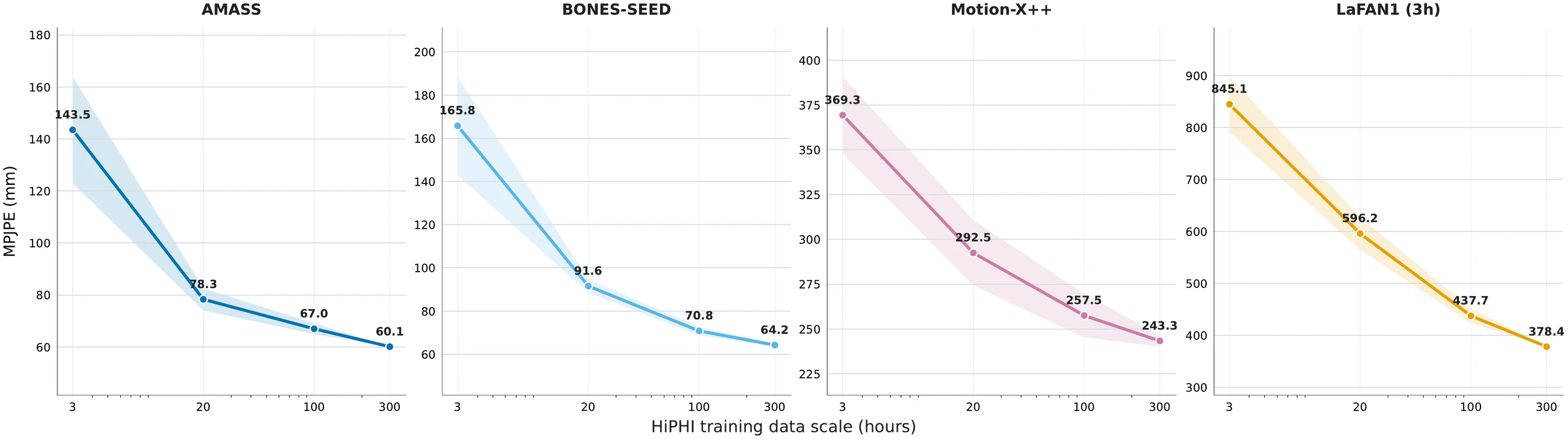
This is one of the stronger parts of the paper, but it still deserves caution. The team that built the dataset also designed the benchmark and performed the evaluation. The methods and results are public and can be reproduced, but at publication time RoboMorrow has not found an independent replication confirming the same advantage under a separate training pipeline.
“Public” does not mean unrestricted anonymous download
Noitom describes HiPHI as a public release and hosts it on Hugging Face. That is accurate, but practical access is not simply an anonymous download button. The Hugging Face page asks users to sign in, complete a questionnaire and accept the ModalityNet Open Research License. The license covers non-commercial scientific research, education and evaluation. Commercial use requires a separate license.
It is therefore more accurate to call HiPHI a publicly released research dataset rather than unrestricted open data. For universities and R&D teams, this still lowers a substantial barrier because high-precision optical motion capture and object tracking are expensive to build internally. A startup building a commercial product, however, should review licensing terms before including the data in a production training pipeline.
The repository is about 215 GB and is divided into 32 tar.zst archives. Metadata can be downloaded separately, which is useful for teams that want to inspect structure and annotations before transferring hundreds of gigabytes of BVH files and object meshes.
What can be independently checked, and what remains an author claim
The dataset's existence, license, repository structure, frame count, duration split, data formats, metadata, arXiv paper and G1 deployment material can all be inspected directly. The project also exposes example motions and detailed documentation.
Statements such as “broadest motion-space coverage”, “best body-motion quality metrics” or fastest convergence should be treated differently. They are supported by the authors' tables and experiments, but they come from the HiPHI team itself. That does not make them false. It means independent reproduction is still required before treating them as settled external benchmarks.
The same applies to Noitom's statement that its infrastructure produces more than 100,000 hours of data per year for commercial partners. That figure is part of the company's release. If sustained, it would be strategically significant, but there is no public audit of the full commercial data-production volume.
Why this matters for the humanoid market
Humanoid coverage often focuses on robot prices, degrees of freedom, walking speed and spectacular demonstrations. The more the market matures, the more value is likely to move into data. A team that can collect, structure and retarget high-quality movement quickly may shorten the path from a new skill to a deployable control policy.
HiPHI is also interesting because it is not tied exclusively to one robot. BVH motion still has to be retargeted and validated for a specific embodiment, but the source representation is more portable than a dataset collected only through teleoperation of a single hardware platform. That can make it useful to teams working on humanoids other than the G1.
Human data also create an unavoidable embodiment gap. Humans and robots have different segment masses, joint limits, feet, hands, actuators and torque envelopes. Even high-precision motion capture does not remove the need for retargeting, simulation, dynamic control and safety filtering. A large dataset cannot eliminate those engineering problems.
What it means for Poland and Europe
For European laboratories, universities and startups, a publicly released dataset of this class can reduce the cost of entering humanoid research. Building a large optical-capture facility, recording hundreds of hours of movement and tracking physical object interactions is beyond the budget of many smaller teams.
European users also need to care about provenance and licensing. HiPHI has explicit terms, anonymized performer IDs and detailed metadata documentation. That does not automatically answer every legal question for a particular commercial application, but it is a stronger starting point than a dataset assembled from poorly documented large-scale video scraping.
For commercial companies, the key missing information is economic: what does a commercial license cost and what rights are granted for models trained using the data? Noitom routes commercial use through separate ModalityNet licensing, and public pricing is not available.
RoboMorrow assessment
HiPHI matters more than a typical “new dataset” announcement because it combines meaningful scale, high-precision motion capture, real-object interaction and a physical humanoid deployment. Its value is not the 617.5-hour headline alone. The stronger story is the structured motion-space design, synchronized object state and the fact that documentation and benchmark artifacts can be inspected by outside teams.
The 617.5-hour figure must also be read correctly. Roughly half of the release comes from mirrored augmentation, while original capture totals 308.7 hours. That does not reduce the dataset's usefulness, but it prevents the misleading impression that more than 600 hours of unique studio sessions were recorded.
The next test will be adoption. If independent teams use HiPHI and reproduce its reported advantages under different training frameworks, it could become an important public reference for humanoid motion tracking and imitation learning. As of today, it is already concrete and verifiable enough to be treated as real Physical AI infrastructure rather than a marketing-only announcement.
Sources
- HiPHI — official project and benchmark page
- Ji et al., HiPHI: A Large-Scale Benchmark for High-Precision Human Motion and Object-Interaction, arXiv:2608.16222
- HiPHI on Hugging Face — dataset, documentation and access terms
- Official HiPHI GitHub repository
- Noitom Robotics — public HiPHI release announcement
Featured image: official HiPHI material showing policies transferred to a physical Unitree G1; source Noitom Robotics. RoboMorrow did not physically test the G1 for this article. Charts and dataset examples are taken from the official HiPHI documentation.