NVIDIA Jetson Orin Nano 2 brings 78 TOPS and 2x inference to compact robots
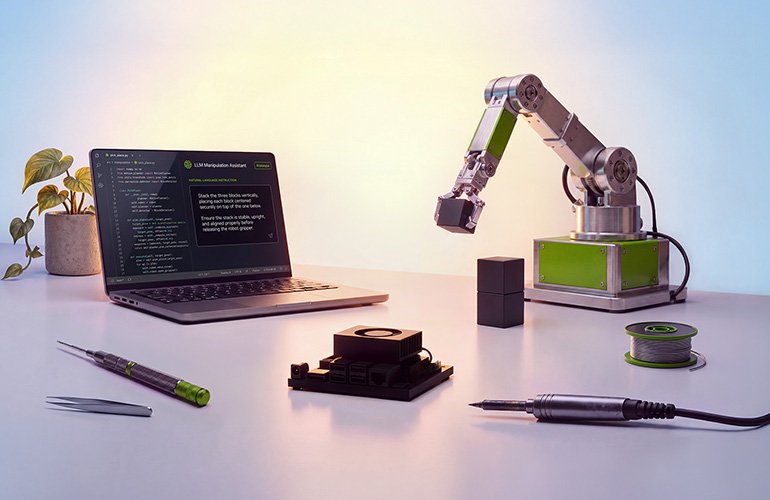
NVIDIA is refreshing one of the most important compute building blocks for compact robots. Jetson Orin Nano 2 is not a flashy robot on stage; it is a platform that can sit inside future home, inspection, industrial and drone systems. The key combination is more AI performance under a tighter energy budget.
78 TOPS for compact robots
Jetson Orin Nano 2 combines 8GB of memory, an 8-core Arm CPU and 78 TOPS of AI compute. NVIDIA claims twice the inference performance of Jetson Orin Nano Super through improved Tensor Cores and higher memory bandwidth while keeping the compact form factor. That should make migration easier for existing designs.
The more interesting metric for mobile machines is power. In 15-watt mode, NVIDIA says Nano 2 uses 40% less power to deliver the same performance as its predecessor. In a battery-powered robot, every watt spent on compute competes with motors, sensors and runtime.
Local models instead of permanent cloud dependence
NVIDIA positions the platform for local language and vision-language models including Cosmos, Nemotron, Gemma 4 and Qwen 3. For robots that can mean lower latency, better resilience when connectivity degrades and less need to stream camera or audio data to a remote data centre.
In Europe, edge inference also has a privacy advantage. Developers can reduce personal-data transfer and design more privacy-preserving architectures. It does not automatically solve GDPR or AI Act obligations, but it creates more technical options than a cloud-only system.
Early partners show the target markets
NVIDIA names Cognex, Doosan Bobcat and Matic among early adopters or explorers. Wing plans to evaluate Nano 2 for delivery drones, while Matic says it will use the platform for conversational AI, gesture detection, semantic home understanding and autonomous cleaning. That spans vision AI, outdoor machinery and consumer robots.
These are partner deployment plans, not independent benchmarks of finished products. We still do not have final-system measurements for thermal behavior, sustained power or robotics workloads on production hardware.
Availability is not until the first half of 2027
The biggest practical limitation is timing: the module and developer kit are expected in the first half of 2027. NVIDIA has not announced pricing. For a product team shipping in 2026, Nano 2 is therefore a roadmap component rather than something available for volume purchase today.
The “2x” figure also needs context. NVIDIA is comparing inference performance with Orin Nano Super, not promising every robotics application will run twice as fast. Real gains will vary by model, numerical precision, memory use, optimization and software stack.
Why it matters for RoboMorrow
Many useful robots will not be humanoids. Small mobile robots, mowers, inspection systems and home manipulators all need efficient perception and reasoning at the edge. Lowering the cost and power requirement of that intelligence layer can influence a wider market than a single mechanical product launch.
Jetson Orin Nano 2 therefore belongs to the emerging “robot brains” category: infrastructure that may appear inside products from many brands. Consumers may never see the module name, but its capabilities can shape latency, privacy and autonomy quality.
Sources and methodology
Primary source: NVIDIA Newsroom, Aug. 25, 2026. The 78 TOPS, 2x inference and 40% lower-power figures are manufacturer claims; independent final-hardware benchmarks are not yet available.
78 TOPS only matters inside a finished robot
TOPS is a convenient headline metric, but it does not by itself tell us how well a robot will perform. Real throughput depends on numerical precision, memory bandwidth, camera pipelines, latency, drivers and whether a manufacturer can sustain compute inside a compact enclosure without thermal throttling. NVIDIA’s claimed 2x inference gain should therefore be treated as a starting point for product benchmarks, not as an automatic promise of a robot that is twice as capable.
The power envelope may be more important. Small mobile and home robots operate under much tighter energy constraints than large humanoids. Every watt used by compute either shortens runtime or requires a larger battery. If Orin Nano 2 can deliver comparable work at meaningfully lower power, developers can spend more of the energy budget on sensors, actuators or simply longer operation between charges.
Local AI matters especially in Europe
Running vision-language and other generative models locally can reduce dependence on cloud connectivity. For a robot that can mean lower latency and better resilience when the network drops; for users it can also reduce the need to stream raw camera data off-device. It does not automatically solve GDPR or AI Act obligations, but it gives designers more options for privacy-by-design architectures. The largest open questions remain pricing and independent benchmarks on final production hardware before availability in 2027.
Who may benefit most
The clearest beneficiaries are robot makers that need more on-device AI but cannot move to large, expensive compute modules. That includes vision-heavy robot mowers, mobile inspection robots, compact AMRs, drones and home devices expected to understand language and images at the same time. Keeping a compact form factor may matter more than the TOPS headline because it can let developers upgrade an existing design without rebuilding mechanics, power delivery and cooling.
For smaller European robotics companies, Jetson also benefits from a mature software ecosystem. The missing variable is price. If Orin Nano 2 costs materially more than today’s Nano-class hardware, some products may stay with cheaper processors or custom accelerators. A meaningful value-for-robotics assessment therefore has to wait for pricing and production-hardware benchmarks.