Pallet transport robots in 2026: cost, integration and when they pay off
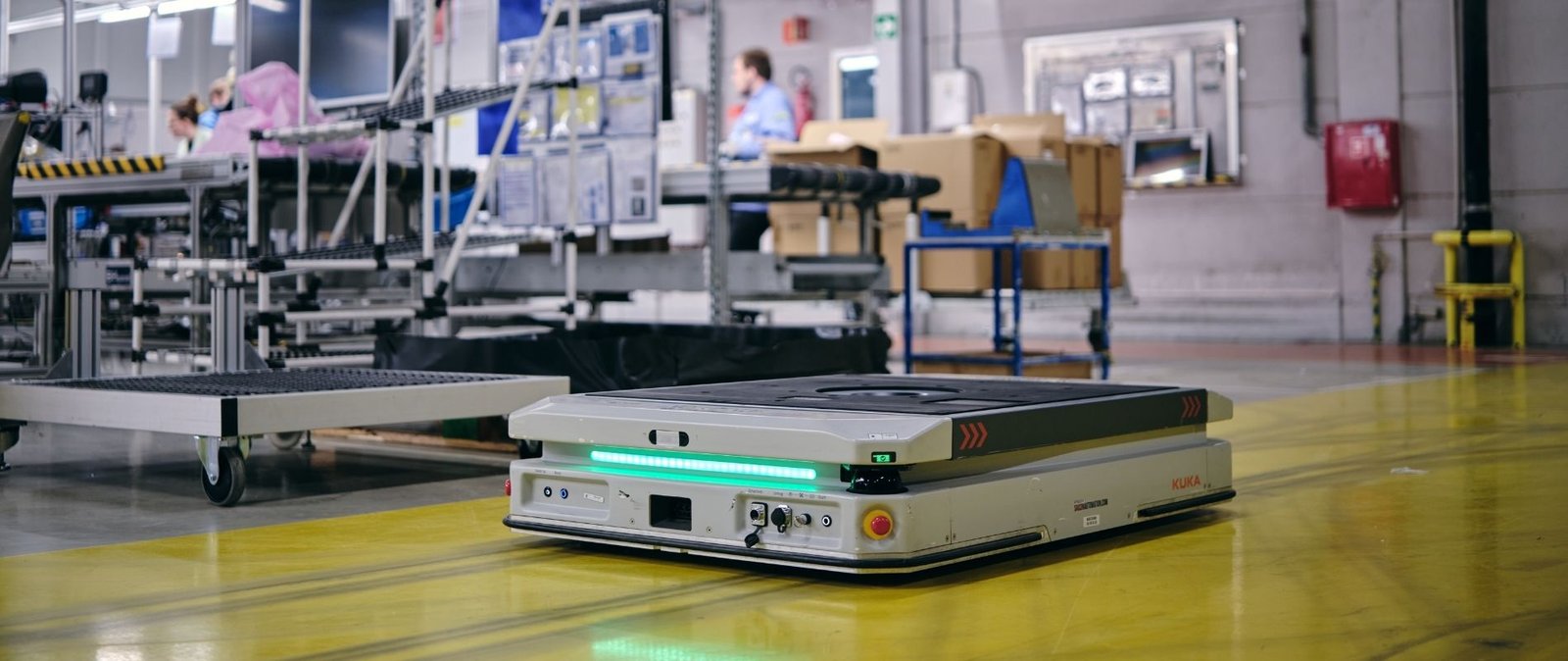
Featured image: KUKA Group — KMP 1500P in an industrial environment. Press material used solely for editorial reporting.
A pallet-transport robot can look like a simple replacement for a forklift, but in practice you are buying an entire material-flow system. The vehicle is only one component. Project performance also depends on pallet pickup tolerance, aisle geometry, drop-off method, fleet management, charging, WMS/MES/ERP integration, safety and what the system does when a pallet is 12 cm away from its ideal position.
The first question is therefore not “which robot has the highest payload?” but: do we want to carry pallets on a mobile platform, pick them directly from the floor, service stands and machines, or replace part of a conventional forklift workflow? That decision defines the architecture.
Three main architectures for automated pallet transport
| Architecture | How it works | Best fit | Main risk |
|---|---|---|---|
| Top-load / under-ride AMR | Robot drives under a carrier or uses a lifting module | Standard carriers, production lines, mobile racks, milk-runs | Requires compatible carriers and well-designed transfer points |
| Autonomous pallet jack | Forks pick a pallet in a way similar to a manual pallet jack | Floor pallets, staging, warehouse-to-production flows | Pallet quality, wrap, positioning and fork-entry tolerance |
| Autonomous forklift | Picks from floors, stands or machines and can lift higher | Processes requiring higher transfers and broader forklift replacement | Larger footprint, manoeuvring space and more complex safety/integration |
The categories increasingly overlap. KUKA KMP 1500P is a low-profile AMR platform with an optional 60 mm lift and payload up to 1.5 tonnes. OTTO Lifter is an autonomous forklift/pallet-handling vehicle designed to pick pallets from floors and stations. MiR1200 Pallet Jack automates detection, transport and delivery of EU pallets up to 1,200 kg. They solve a similar business problem with different process assumptions.
Start with the process, not the robot
A common procurement mistake is to begin with catalogues. A strong project begins by observing the real material flow across complete shifts. Count not just trips but exceptions: skewed pallets, damaged pallets, stretch wrap over fork openings, occupied docks, manual pallet jacks in aisles, blocked doors, unavailable drop-off points and unplanned production calls.
If 95% of transports are perfect but the remaining 5% require human intervention, that 5% can determine overall system availability. Pallet automation is less glamorous than a demo of a robot avoiding a pedestrian, but much more dependent on process quality.
Payload is only the first filter
KUKA specifies up to 1,500 kg payload for KMP 1500P, up to 1.8 m/s unloaded and 1.5 m/s loaded, plus an optional 60 mm lift. OTTO Lifter is designed for loads up to 1,200 kg and up to 1.5 m/s. MiR1200 Pallet Jack also targets pallets up to 1,200 kg.
Those numbers do not answer the key questions. You still need centre of gravity, maximum load height, pallet rigidity, overhang, wrapping, empty carrier mass and position tolerance. A stable 900 kg pallet can be easier to automate than an unstable 400 kg load.
Pallet acquisition: where the demo ends and engineering begins
The robot must do more than arrive near a pallet. It has to identify the load, estimate entry position, insert forks or a lift, confirm secure acquisition and leave without hitting the load or infrastructure.
OTTO describes a sensing stack for autonomous pallet acquisition including 3D cameras, fork impact/force sensing and payload stability monitoring. The company says Lifter can handle pallets that are misplaced or partially obscured by stretch film. That is exactly why an RFQ should require testing with your worst real pallets, not a pristine carrier prepared by the supplier.
How much space does the robot really need?
Separate robot width, one-way aisle width, 90-degree turn space, safety fields and pallet-acquisition clearance. An autonomous forklift can have a good chassis turning radius while its actual work envelope with long forks and a pallet is much larger.
OTTO Lifter's published technical sheet, for example, lists different minimum aisle widths depending on speed and a separate requirement for a 90-degree turn-in. That is why a single “minimum aisle width” figure should never be copied directly into a project. Traffic must be simulated with the real load and safety fields.
Throughput: missions per hour beats top speed
A robot capable of 1.8 m/s may not move more pallets than one capped at 1.5 m/s. The bottleneck can be docking queues, waiting for a workstation, intersections, lifting time, charging or communication with the supervisory system.
Define contractual KPIs before purchase:
- completed missions per hour at peak demand,
- median and 95th-percentile mission time,
- manual interventions per 1,000 missions,
- recovery time after a fault,
- system availability rather than single-vehicle availability,
- waiting time for free pickup/drop-off points,
- share of time spent driving, waiting and charging.
If a proposal gives only maximum vehicle speed, it is not enough for an investment decision.
Fleet management and integration: the expensive part you cannot see in a photo
With two robots, many issues can still be managed manually. With ten or twenty, the system must orchestrate priorities, intersections, queues, docks, charging, failures and deadlocks. More importantly, it must connect to plant logic: who creates the transport order, how does the system know a pallet is ready, and what happens when the destination is occupied?
A useful real-world example is KUKA's deployment at TPV Displays Polska in Gorzów Wielkopolski. In 2026 KUKA described a fleet of 22 KMP 1500P platforms moving between the warehouse and ten assembly lines. The integrator connected the fleet to higher-level plant systems, built the material-flow logic and deployed IT infrastructure including server, storage and active backup. It is a strong reminder that a “pallet robot” is an IT/OT and process project, not just hardware.
New projects should also ask about VDA 5050 3.0. The 2026 version extends the common interface between mobile robots and master control, especially relevant to mixed fleets. It is not a magic compatibility certificate: verify the exact protocol version, supported actions and failure behaviour.
Charging: does 24/7 really mean 24/7?
KUKA specifies up to 10 hours of use and around 2 hours of charging for KMP 1500P, with conductive and inductive charging options. A multi-shift project must model opportunity charging, charger count, charger queues and battery degradation over several years.
For a 24/7 fleet, ask what happens if a charger fails, how batteries are serviced, how a disabled robot is recovered, and how many vehicles are required to maintain target throughput while one unit is under maintenance.
Safety: the robot is not safe independently of its application
ISO 3691-4:2023 remains the published international standard covering safety requirements for driverless industrial trucks and their systems; its examples explicitly include AGVs and AMRs. In 2026 a third edition is still at ISO/DIS stage, so it should not be presented as the currently published standard.
Risk assessment has to include not only travel but forks, lifting, crush points, unstable loads, pedestrian crossings, manual forklifts, blind corners and maintenance. Management of change matters: a new pallet type, relocated rack or changed production line can alter the risk profile.
EU projects should also be designed with Regulation (EU) 2023/1230 on machinery in mind; EUR-Lex states that it applies from 14 January 2027.
What does it cost? There is no honest single “robot price”
Industrial AMRs and autonomous forklifts are commonly quoted per project because hardware is only part of total cost. Build a TCO model instead:
| Cost block | Include |
|---|---|
| Robots | vehicles, lift modules, forks, scanners and options |
| Infrastructure | chargers, docks, markers, stands, barriers, floor changes |
| Software | fleet manager, licences, server, backup, APIs, monitoring |
| Integration | WMS/MES/ERP, PLCs, call systems, testing, exception logic |
| Safety | risk assessment, validation, documentation, signage and acceptance |
| Operations | Wi-Fi/5G, energy, parts, batteries, service, SLA and training |
| Process change | new carriers, pallet standardisation, staging redesign |
The best denominator is not “price per robot” but cost per correctly completed transport mission at the required system availability.
How to calculate ROI without marketing
A simple annual model is:
Annual benefit = avoided transport labour + avoided overtime + reduced error/damage cost + value of added throughput − incremental service, software and infrastructure cost.
Then compare project cost with the realistic annual benefit stream. Do not assume every minute transferred to a robot becomes payroll savings. If the employee remains on the shift and does higher-value work, the benefit may instead be productivity, vacancy avoidance or reduced physical strain.
TPV Displays Polska publicly described three motivations: limited availability of new employees, removing physically demanding work and improving process economics. That is a more realistic ROI picture than a generic promise of “payback in X months” without process data.
When does pallet automation make the most sense?
- Many repetitive trips per shift between stable or semi-stable points.
- Material transport is a bottleneck and operators regularly wait for parts.
- Logistics roles are difficult to staff or the work is monotonous and physically demanding.
- The process can be standardised: pallet types, staging and transfer points are controlled.
- The plant has enough IT/OT discipline to manage orders and exceptions.
When can it be a bad project?
- pallets are frequently damaged, inconsistent and randomly positioned,
- aisles are permanently blocked,
- pickup/drop-off logic is unstable,
- most moves are ad hoc and require human judgement,
- the organisation expects automation without changing the process,
- no one owns integration across logistics, IT, automation and EHS.
A robot can navigate around some chaos. It cannot repair a process nobody controls.
12 questions to ask before RFQ and acceptance
- Which exact pallet types and dimensions are supported?
- What position and yaw tolerance is allowed at pickup?
- How does the robot handle stretch wrap, damaged boards and load overhang?
- What is the real turning and docking space with our load?
- How many missions per hour are guaranteed in our layout?
- What happens after loss of Wi-Fi, localisation, fleet manager or supervisory control?
- How does manual recovery work and how long does it take?
- How does the fleet manage congestion, priorities, charging and a failed vehicle?
- Which APIs and WMS/MES/ERP integrations are available?
- What is the actual scope of VDA 5050 3.0 support?
- Who owns application-level risk assessment and conformity after integration?
- Which KPIs and FAT/SAT tests will be contractual?
Pilot: how not to waste the first four weeks
The safest start is a limited but representative slice of the real process. The pilot should include normal pedestrian and forklift traffic, at least two pallet types, genuine peak hours and actual exceptions. Avoid building a temporary “demo zone” that disappears after acceptance. Before launch, define who can manually recover the robot, who analyses faults, how blockages are reported and which events are logged automatically.
After the pilot, do not ask only “did the robot drive?”. Compare planned versus completed missions, blockage time, intervention count, availability, docking time and the effect on operators. Scale only after those metrics are stable. If the pilot needs a permanent “robot babysitter”, buying more vehicles rarely fixes the root cause.
RoboMorrow verdict
A pallet-transport robot pays off not when it can drive autonomously, but when it can reliably close the whole loop: receive a mission, find the right pallet, acquire it safely, travel through real plant traffic, place it and confirm completion without human intervention.
For standard carriers and repetitive line feeding, a low-profile platform with lift can be the cleanest architecture. For pallets stored directly on the floor, an autonomous pallet jack is more natural. When the process requires higher lifts and more of a conventional forklift's flexibility, autonomous forklifts become the relevant category.
The common procurement rule is simple: test on your worst real process, not the supplier's best demo.
Read next
Sources
- KUKA — KMP 1500P
- KUKA — 22 KMP 1500P at TPV Displays Polska
- OTTO by Rockwell Automation — OTTO Lifter
- Mobile Industrial Robots — MiR1200 Pallet Jack
- OTTO — Lifter data sheet
- ISO — ISO 3691-4:2023
- ISO — ISO/DIS 3691-4, edition 3 project
- VDA — VDA 5050 Version 3.0.0, March 2026
- EUR-Lex — Regulation (EU) 2023/1230