PUDU D7 bets on a semi-humanoid: are wheels more practical than legs in factories?
PUDU D7 does not attempt to be a human copy. The manufacturer combined a mobile platform on wheels with two robotic hands and an embodied AI system. This design may look less impressive than a bipedal humanoid, but it can be more practical in orderly factories and warehouses.
Highlights
- total declared load capacity is up to 14 kg,
- the robot is to handle objects at a height of up to 2 meters,
- uses two hands with force control and touch sensors,
- has front and rear LiDAR and 360-degree ambient surveillance,
- supports autonomous battery replacement,
- works based on PuduFM 1.0 model,
- the price and date of regular sale in Poland have not been publicly announced.
What is semi-humanoid
The semi-humanoid retains those elements of the human structure that are needed to work in the existing environment - primarily hands, adequate reach and the ability to manipulate objects. However, it gives up the legs and replaces them with a stable, mobile base.
In the warehouse, most of the routes are flat. The robot does not have to overcome stairs or uneven terrain, and the most important things are working time, stability with a load, precise docking and the ability to quickly move between racks. In such conditions, wheels can consume less energy and be easier to service.
On the other hand, the base limits access to places with thresholds, stairs and obstacles. Therefore, D7 is not a universal robot for every environment. It is a specialized compromise between an autonomous mobile robot and a humanoid.
What tasks is it designed for
Pudu lists material handling, shelf picking, restocking, internal transportation, pushing carts, sorting, assembly, and precision operations requiring force control. The range of up to 2 meters is intended to allow the use of shelves and stands prepared for humans.
The 14 kg lifting capacity is sufficient for many containers, parts and products, but it will not replace a forklift or a heavy palletizing robot. The D7 value is intended to result from flexibility: one robot can move between stations and perform several types of activities.
Hands, Sensors and Precision
The manufacturer emphasizes force control and touch sensors. In industrial applications, this is important because the robot must distinguish between a firm grip and a situation in which the object is shifting, fragile or incorrectly positioned. D7 is designed to dynamically adjust pressure to the material and task.
Pudu declares control accuracy at the millimeter level. However, such formulation requires caution. In practice, the repeatability of the entire process, the type of gripper, element tolerances, speed of operation and the number of errors after many hours of work are important. A single demonstration does not replace production data.
Navigating and Working in a Mixed Environment
D7 is supposed to use front and rear LiDAR and additional sensors to observe the surroundings in a range of 360 degrees. In factories, the robot will encounter people, carts, pallets and changing obstacles. He must not only plot the route, but also safely slow down, stop and resume work.
Autonomous battery replacement is more important than you might think. In industrial robotics, long run times often require charging or manual pack replacement. If the D7 can actually replace the battery itself, it will be easier to use it in multi-shift work. Data on overall operation time, battery life and station availability are still needed.
PuduFM 1.0: a common "brain" for different robots
Pudu develops the "One Brain, Multiple Embodiments" strategy. The software and models are intended to be used in delivery robots, cleaning robots, semi-humanoids and full humanoids. D7 uses PuduFM 1.0, which is designed to combine image understanding, language, navigation and manipulation.
The company claims that the model learns from data collected in real implementations. Pudu has experience in service works and, according to its own information, it has delivered over 130,000. devices to over 85 countries and regions. An existing customer base, fleet management system and partner network can be an advantage over a startup starting with a single humanoid prototype.
However, the scale of sales of specialized delivery and cleaning robots should be separated from the readiness of D7. The new semi-humanoid has much more complex hands and tasks. Navigation experience helps, but does not automatically solve manipulation problems.
Why wheels can beat legs
The bipedal robot is attractive because it can theoretically climb stairs and use all human infrastructure. However, legs increase price, energy consumption, fall risk and safety requirements. Most warehouses have flat floors, so a mobile base may provide a better cost-to-use ratio.
D7 may be a harbinger of a broader trend: companies don't have to wait for the perfect humanoid. They can choose the form of the robot suited to the task. In a hotel it may be a delivery robot, in a hall a semi-humanoid, and on stairs or difficult terrain a two-legged or four-legged structure.
What you need to check before purchasing
- device, license and integration price,
- availability of service partner in Poland or EU,
- compliance with European requirements and safety documentation,
- actual working time and intervention frequency,
- integration with WMS, MES, elevators, doors and access systems,
- cost of grippers and station adaptation,
- pilot conditions and guaranteed service response time,
- data ownership and scope of manufacturer's remote access.
Does D7 make sense for a small business
At this stage, D7 will likely be a product for larger industrial implementations and integrators. A small company should start with a specific, highly repeatable process. If the robot is to perform several different tasks only occasionally, the cost of integration may outweigh the benefits.
A better entry model may be paid pilot or Robot-as-a-Service. The contract should specify the measurable effect: number of containers moved, supervision time, robot availability, number of correct operations and service response.
RoboMorrow assessment
Status: industrial product showcased, no public price and full performance data. PUDU D7 is interesting because it does not subordinate the marketing structure to the vision of a humanoid. Wheels, two hands and energy autonomy can be a rational combination for factories and warehouses. However, its value will be determined by long-term implementation, integration, security and overall cost, not the list of parameters alone.
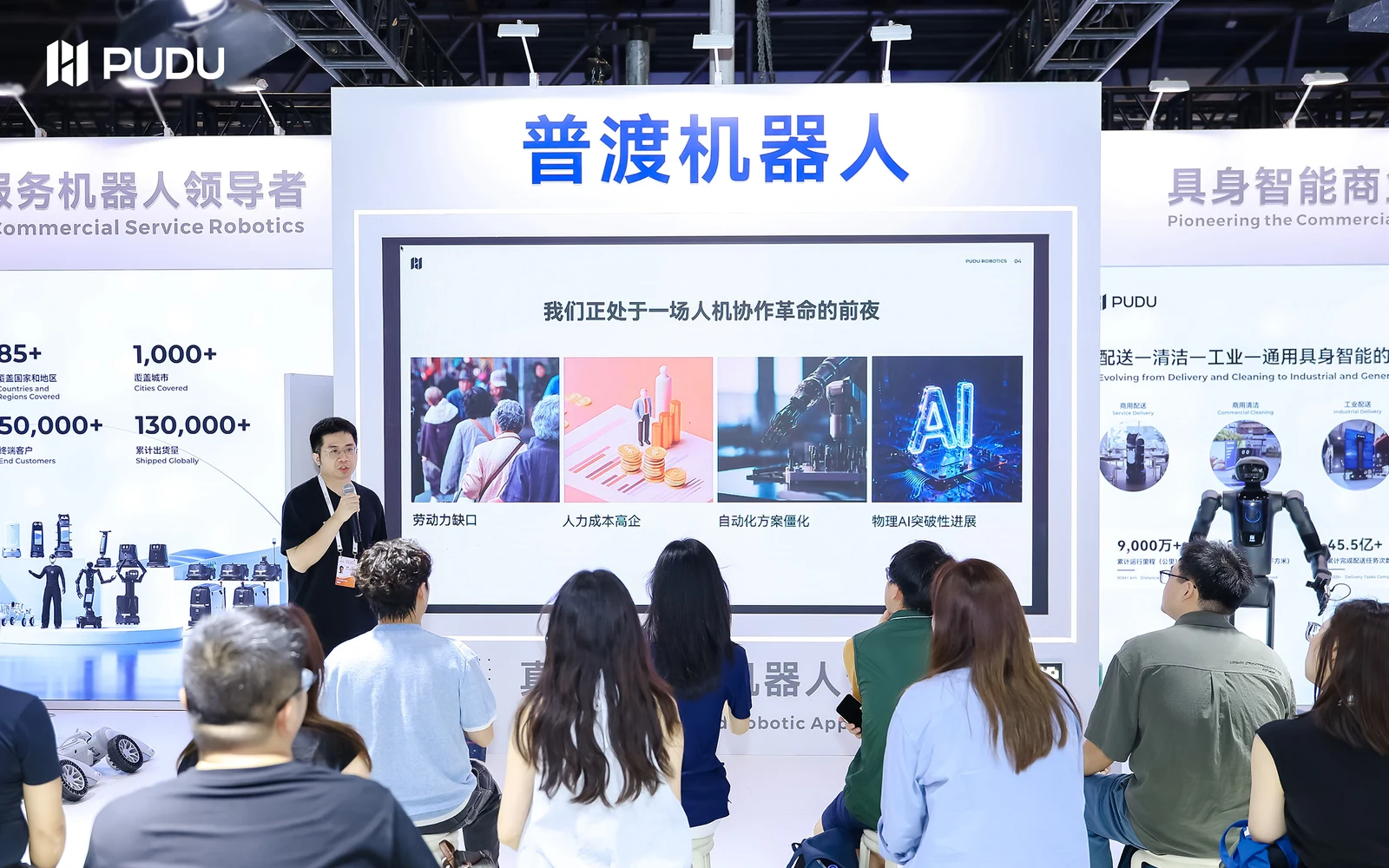
The photo comes from official Pudu Robotics materials related to the presentation during WAIC 2026.
Sources
Pudu Robotics: PUDU D7 premiere
Pudu Robotics: Presented at WAIC 2026
Pudu Robotics: PuduFM 1.0