Qualcomm plans a Japan Robotics Center backed by FANUC, Toyota, Sony and Kawasaki
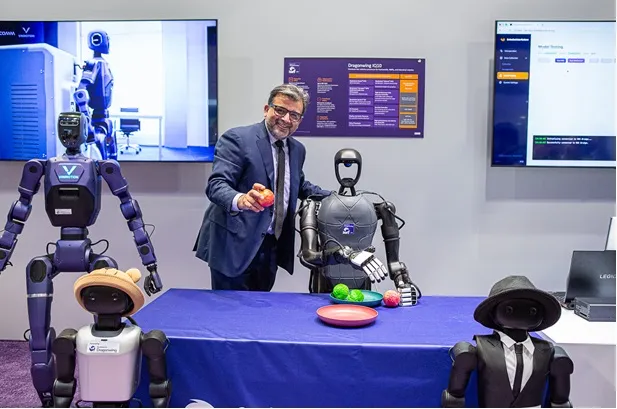
Qualcomm is moving deeper into robotics not by launching a humanoid, but by building Physical AI infrastructure. The proposed Japan center is designed to connect applied R&D, startups, industry, academia and commercialization. The strongest signal is the partner list, ranging from FANUC and Kawasaki to Sony and Toyota.
The new center is intended to be more than a chip lab
Qualcomm describes the Japan Robotics Center as a hub for applied R&D, ecosystem collaboration, workforce enablement and commercialization. The program is meant to span the full lifecycle from early development through access to hardware and software platforms and into global market expansion for Japanese robotics companies.
The announcement does not disclose an investment amount, a specific facility address or a full opening date. Qualcomm uses language such as “aims to establish” and “intends,” so RoboMorrow treats this as an officially announced initiative and investment plan rather than a fully operational center of known scale.
The partner list gives the initiative weight
Supporters include FANUC, Fujitsu, Kawasaki Heavy Industries, KDDI, NEC, NTT DOCOMO, Panasonic Industry, Preferred Networks, Sony and Toyota, alongside academic teams including the University of Tokyo. That mix connects robot makers, telecoms, industrial companies and AI groups — exactly the layers Physical AI needs.
Qualcomm does not say every organization will become a customer of a specific processor or that all have signed deployment contracts. The list is better read as ecosystem support and an intent to collaborate around the center.
Four pillars: center, ecosystem scaling, go-to-market and lighthouse deployments
The investment framework has four parts. The Japan Robotics Center is the first. The second is an ecosystem-scaling program giving startups and researchers access to Qualcomm products, expertise and enablement. The third is a global go-to-market accelerator for Japanese robotics companies. The fourth supports flagship “lighthouse” Physical AI deployments.
That makes the story more interesting than a new office. Qualcomm is positioning itself as infrastructure between the robot, connectivity, on-device AI and commercialization, rather than only as a component supplier.
Technical context: Dragonwing IQ10
In June Qualcomm unveiled the Dragonwing IQ10 Robotics Reference Design, a platform rated by the company at up to 700 TOPS with support for multiple cameras, LiDAR, ToF, IMU, ROS 2 and deterministic control for AMRs, industrial robots and humanoids. A dedicated robotics center could shorten the path from this reference stack to production systems.
That still does not mean Qualcomm is building its own humanoid. The strategy is platform-centric: compute, connectivity, sensor integration and software across multiple robot forms.
Why Europe should watch
Europe has a strong industrial machinery and robotics base, but Physical AI increasingly requires compute platforms designed together with sensors and connectivity. If the Japanese center materially accelerates deployments, it may become a template for similar regional programs elsewhere.
European manufacturers will also want to know how open Qualcomm’s tools and reference designs are across partners versus how tightly the ecosystem remains coupled to Qualcomm silicon. No equivalent European robotics center has been announced in this initiative.
Sources and methodology
Primary source: Qualcomm, Aug. 25, 2026. Technical context: Dragonwing IQ10 Robotics Reference Design. Qualcomm has not disclosed the investment amount, exact center location or full opening date.
This is more than another research lab
The partner list suggests Qualcomm is trying to build a bridge from semiconductors to deployable robotics. FANUC and Kawasaki bring industrial automation, telecom operators contribute connectivity and edge infrastructure, Sony and Panasonic add sensing and consumer-device expertise, and Toyota brings manufacturing scale. That mix matters because robotics is no longer short of impressive prototypes; the difficult part is integrating compute, sensing, safety, software and deployment processes into products that can be supported for years.
Qualcomm also has a clear business incentive. If robots become another major class of edge-AI device, the company wants developers to design around its compute platforms much as smartphone makers built around Snapdragon. A Robotics Center can shorten the path from a reference design to a specific AMR, arm, drone or humanoid while helping Japanese manufacturers reach global markets.
What still needs to be proven
The announcement does not disclose the investment amount, exact center location, full opening date or the specific robots that will emerge from the initiative. It is also unclear how many supporters will move from ecosystem endorsement to commercial products using Dragonwing. RoboMorrow therefore treats this as a meaningful ecosystem move rather than evidence of new robot sales. The next proof points should be named lighthouse deployments and public performance data for IQ10-based systems in real robots.
Japan has a particular reason to accelerate
Japan has enormous experience in industrial robotics, but generative Physical AI shifts the center of gravity from precisely programmed cells toward systems that interpret changing environments. Qualcomm is targeting that gap by supplying compute and reference designs that can connect established mechatronics with newer AI models. If the initiative works, existing manufacturers may be able to add perception and multimodal models faster without building an entire semiconductor stack themselves.
The consortium model is also relevant to Europe. Instead of a single startup trying to build everything, a large chip supplier is connecting telecom operators, machine builders, universities and industrial companies around a shared stack. A similar structure may be useful in the EU, where expertise is distributed across automation, automotive, research institutions and component suppliers.
The featured image is illustrative: it shows a Qualcomm/Dragonwing IQ10 robotics demonstration at CES 2026, not the planned Qualcomm Japan Robotics Center.