KEENON DINERBOT T10: 40 kg, 59 cm aisles and 23.8-inch display
BUYING IN YOUR MARKET
Availability in your country
Sales, delivery and support can differ by country and exact model. Choose your market to see the evidence we have checked.
KEENON DINERBOT T10: 40 kg, 59 cm aisles and 23.8-inch display
Germany
Local store offer — check checkout availability
- Seller / sales channel
- Reichelt
- Price
- See the local offer for the current price and exact bundle
- Delivery
- Confirm stock and the delivery date for your address with the seller
- Warranty and service
- Confirm written warranty terms, parts and service coverage for your address
Reichelt lists this exact model for this market. A listing is evidence of a buying route, not a delivery commitment.
Evidence checked: · Not a live stock feed
Reichelt: check local offer ↗No verified local offer in this dataset
No country-specific offer for this exact model has been established in our current sources. This is a gap in our research, not a statement that the robot cannot be bought here. Use the manufacturer’s sales contact to request a supplier serving your address; confirm configuration, imports, warranty and service.
- Price
- No verified local price in this dataset
- Delivery
- No confirmed date for your address
- Warranty and service
- Local coverage not verified
“Listed” confirms a product page or sales route, not stock, delivery to every address or local service. “Pre-order” is not immediate availability. Unverified means we lack evidence; it does not mean unavailable. Prices belong to the named market and currency. Confirm the exact version, tax, shipping and support before ordering.
Verified 1 September 2026. KEENON DINERBOT T10 is a commercial service robot from KEENON Robotics, designed primarily for restaurant delivery, dish-return workflows and customer-facing marketing. This profile is based on current manufacturer documentation. RoboMorrow has not run a joint laboratory test of this model, so manufacturer figures are treated as specifications rather than independent performance results.
Short answer
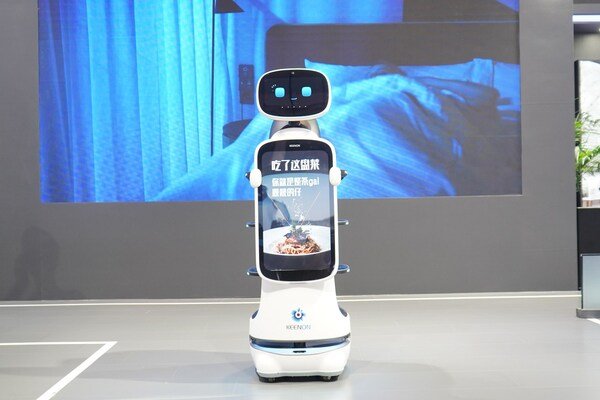
DINERBOT T10 is a restaurant delivery robot with a 40 kg total payload, a manufacturer-quoted 59 cm minimum passage width and a large 23.8-inch display. Its value is not one record number: KEENON combines a mobile delivery platform, tray detection, customer interaction and multi-robot fleet coordination.
Key specifications
| Dimensions | 48.6 × 55.5 × 139.9 cm |
|---|---|
| Weight | 58 kg |
| Total payload | 40 kg |
| Minimum passage width | 59 cm |
| Maximum speed | 1 m/s |
| Quoted battery life | 9–12.5 h |
| Charging time | 5.5 h from 15% to 100%, per manufacturer note |
| Slope angle | 5° |
| Display | 23.8" |
| Perception | 4 stereo-vision sensors + VSLAM + 1 RGB camera |
59 cm is a number to test, not merely quote
KEENON positions T10 for relatively narrow restaurant aisles. In practice, 59 cm is a minimum-passage specification, not a recommendation for the entire venue. Guests move chairs, staff carry trays and queues form around bottlenecks. A meaningful pilot should be run during a real peak period, not only in an empty dining room.
Tray detection and interaction
The manufacturer describes AI Tray Detection, tray lights, on-screen pickup guidance and voice prompts. The display also acts as a marketing surface. That can be useful in food courts and self-service environments, but the advertising function should be measured separately from operational throughput.
Navigation and fleet coordination
T10 uses four stereo-vision sensors, VSLAM and an RGB camera. KEENON also describes route-planning algorithms, multi-robot dispatching and fleet coordination. Those functions matter when multiple robots share the same floor because poorly designed traffic can create robot-versus-robot bottlenecks.
Autonomous navigation is not an autonomous restaurant. People still load trays, check orders, deal with exceptions, maintain hygiene and manage guests. The robot automates transport between defined points.
Battery life needs context
KEENON quotes 9–12.5 hours of operation and 5.5 hours of charging. The product page notes that actual battery results depend on use and settings, and that charging time refers to 15% to 100% with the robot powered on. For a restaurant, shift coverage through lunch and dinner peaks matters more than the headline maximum.
Practical use cases
- kitchen or pass-to-table delivery;
- dish-return transport in a designed workflow;
- mobile promotion and campaign messaging;
- large venues where staff walking distance is meaningful;
- multi-robot operation with proper fleet and traffic management.
Price and purchase in your country
KEENON's global product page routes buyers to sales contact rather than displaying a universal retail price for all countries. A B2B quote should include the robot, mapping, training, service, parts, accessories and warranty conditions. Ask whether the integrator performs a pre-deployment site visit and a real route test.
How to read customer stories
KEENON publishes customer testimonials, including a Burger King Redi example describing T10 table delivery and marketing use. This confirms that the scenario is deployed, but it is not an independent ROI study. The public page does not provide a full before/after methodology, robot cost or intervention log.
RoboMorrow verdict
T10 is most interesting when transport and customer-facing marketing both matter, especially in venues with constrained aisles. The purchase decision should come from an operational pilot: trips, route width, exceptions and service. The 23.8-inch display is a feature; the process is what creates ROI.
Pickup-point design can matter more than the robot
Deployment starts with where the robot stops and who removes the load. A pickup point next to a doorway, bar or main pedestrian flow can create a bottleneck even when T10 navigates correctly. Design loading and handoff locations first, then test them with the venue operating at full density.
If guests remove meals themselves, tray lighting and on-screen guidance need to be understandable without staff assistance. If a waiter performs the final handoff, the robot may terminate at a service point rather than approach every table. Those are different workflows and can produce very different ROI.
T10 deployment checklist
- measure the narrowest aisle with chairs in realistic positions;
- test turning geometry at the bar, pass and lift entrances;
- assign responsibility for charging and daily inspection;
- test peak crowds and simultaneous staff traffic;
- with multiple robots, test a shared bottleneck under load;
- define a fallback procedure for network loss or robot downtime.
These checks separate an impressive demonstration from a deployment that actually removes repetitive transport work month after month.
Sources
Where to buy
We do not yet have a verified exact Amazon product page for this model. Check the official source above.
News about this robot and brand
No related news is available yet.
Guides
No related guides are available yet.
Comparisons and rankings
No related comparisons are available yet.