RTK or boundary wire? Robot mower systems compared
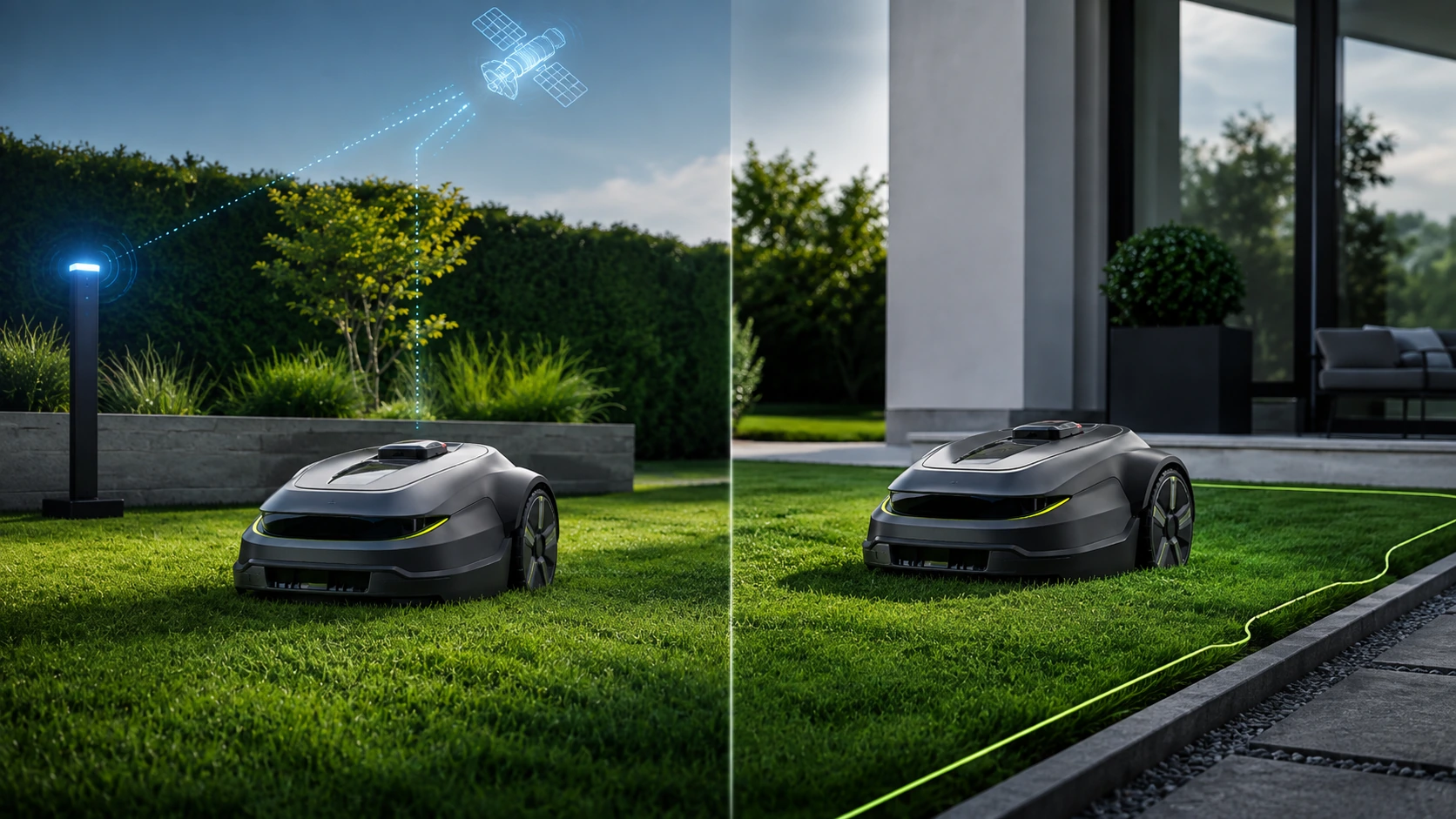
RTK and boundary wire solve the same problem: they tell the robotic lawnmower where to work. However, they do it in a completely different way.
The wire creates a physical boundary detected by the device. RTK allows you to save the boundary digitally in the application thanks to precise satellite positioning and correction data.
RTK is more flexible. The cable tends to be more predictable. No solution is automatically best for every garden.
Key differences
| Criterion | RTK / virtual border | Boundary Wire |
|---|---|---|
| Installation | mapping in application, sometimes antenna or network service | physical arrangement and connection of the cable |
| Change limits | fast map editing | rewiring or repairing the cable |
| Trees and high walls | may impair positioning | usually do not affect the border itself |
| Strip mowing | often available | depends on the model, many classic robots drive randomly |
| Border Failure | signal, corrections or map problems | broken or damaged cable |
| Time Zones | usually easy to create | more difficult, depending on installation and robot function |
| Initial cost | often higher in hardware | possible cost of professional installation |
| Cloud Dependency | depends on manufacturer | usually smaller |
| Flexibility | high | low after installation |
How does the boundary wire work?
The wire is laid along the edge of the mowing area. The station sends a signal that the robot detects using sensors. In many systems, an additional guide wire helps you return to the station or pass through narrow sections.
Advantages of the cable
- technology developed for many years;
- stable border independent of satellite visibility;
- good performance under trees and against walls;
- less dependency on network services;
- often lower price of the robot itself;
- large selection of models and services.
Cable defects
- time-consuming assembly;
- can be cut with a spade, scarifier or during other work;
- difficult to change the garden layout;
- detecting the break point can be tricky;
- installation around multiple rebates can be complex;
- after several years, the cable routing documentation may be incomplete.
How does RTK work?
The regular satellite signal is not accurate enough to guide the robot near the border. RTK uses correction data to limit position error.
Corrections may come from:
- local reference station set in the garden;
- network of stations providing corrections via the Internet;
- the manufacturer's system combining RTK with a camera, LiDAR and motion sensors.
Advantages of RTK
- boundaries changed in application;
- fast adding forbidden zones;
- precise, parallel passes;
- easy management of multiple zones;
- no risk of physically cutting the wire;
- possibility to temporarily turn off a section of the lawn.
Disadvantages of RTK
- satellite visibility requirements;
- potential problems under dense trees and high walls;
- local antenna may require a good location;
- network system may depend on internet and service conditions;
- higher software complexity;
- change of behavior after update is possible;
- coordinates alone are not sufficient to recognize obstacles.
When to choose RTK?
RTK is especially convenient when:
- the garden has open space and good sky visibility;
- you often change the layout of flower beds or equipment;
- need multiple zones;
- you want to set temporary forbidden areas;
- you care about systematic mowing;
- you don't want to install the cable;
- map and remote management are important to you.
Example: garden with seasonal swimming pool. In spring, the robot uses the entire lawn, and in summer you add a forbidden zone around the pool in the application.
When to choose cable?
Wire will be reasonable when:
- the garden has a lot of trees and high walls;
- boundaries do not change over the years;
- you want a simple, mature solution;
- you don't want to depend on cloud and network adjustments;
- budget is limited;
- you can do professional installation;
- there are very narrow, obscured passages in the garden.
Example: an old garden surrounded by a high hedge, with a canopy of trees over most of the lawn and an unchanged flowerbed pattern.
What about camera-supported RTK or LiDAR?
The hybrid system mitigates some of the weaknesses of RTK. The camera can recognize boundaries and obstacles, and LiDAR helps locate itself relative to the surrounding geometry.
This does not mean that the problem disappears completely. The robot still needs to have well-designed behavior after it loses satellites, gets a dirty sensor, or changes the appearance of the garden.
When comparing hybrids check:
- which functions work without RTK;
- how long the robot can work in substitute mode;
- does it stop safely when in an uncertain position;
- can the map be corrected manually;
- are subscriptions required;
- whether the manufacturer publishes regular updates.
Installation and Operation Cost
Cable
Cost includes cable, pins or machine laying, connectors, possible guide wire and installer's work. There may be a cost for interrupt diagnosis in the future.
RTK
The cost may include a reference station, fixture, mast, power extension, or network service. Some systems do not require a local antenna, but can use cellular communication.
So don't just compare robot prices. Compare the cost of a complete, working installation over several years.
Reliability: Which System Wins?
It depends on the type of failure.
The wire can work very stably as long as it remains continuous. After an interruption, the robot usually stops working, and finding the location of the damage may require a meter or service assistance.
RTK has no wire to cut, but may lose accuracy due to sky obstruction, corrections, connectivity, or software issues. A hybrid system can reduce these risks.
The most reliable system is one that fits the environment, not the one with a more modern name.
Does RTK mow closer to the edge?
Not always. A precise position helps guide the robot close to the digital boundary, but the width of the uncut strip also depends on:
- cutting disc position;
- housing shape;
- edge type;
- safe margin set by the manufacturer;
- ground stability;
- slope at boundary.
The wired model with a side disc can leave less grass on the wall than an RTK robot with a central disc.
Can I have both systems?
Some models allow you to work with a physical or virtual boundary depending on the configuration. This solution gives you flexibility, but you need to check whether all functions are available in both modes and what accessories are required.
The ability to return to the wire can be valuable in a very difficult part of the garden.
Simple selection by garden type
Open garden, few trees
Most often RTK or hybrid system.
Garden under big trees
Cable or LiDAR/vision with well-documented non-full RTK operation mode.
Garden changed frequently
RTK or other virtual boundary.
A solid, simple lawn and a limited budget
Cable.
Multiple separate zones
Virtual border, as long as the robot supports the required number of maps and passes.
Very narrow passage between walls
Don't choose based solely on technology. Check the minimum width and real test of a specific model.
RoboMorrow Recommendation
RTK is better for the user who needs flexibility and has a garden that is conducive to SEO. Cable is better for the user who values stability and has an environment that is difficult for satellites.
In 2026, the best cordless systems are increasingly hybrid. Nevertheless, classic cable is not a pointless technology - in the right garden it can be the most reliable and economical choice.
FAQ
Does RTK need an antenna in the garden?
Not always. Some robots use the local station, and some use network corrections. You need to check the requirements for your specific model.
Can the cable be buried?
Yes, within the depth range allowed by the manufacturer. Laying too deep may weaken the signal and make repair more difficult.
Does RTK work without internet?
The local station may reduce Internet dependency, but the remote application and functions may still require it. Network RTK systems need connectivity to download corrections.
What happens when the wire breaks?
The robot usually reports no loop signal and does not start working. The interruption must be located and repaired with the appropriate connector.
Can the virtual border move?
The system should hold position, but accuracy may temporarily drop when the signal is weak. Good robots use safety margins and additional sensors.
What's cheaper?
A wired model often costs less, but professional installation increases the cost. RTK may have more expensive equipment or accessories. Please compare the complete set.
Official sources
- Husqvarna - Installation Kits with Cable
- Husqvarna - Automower without cable
- Segway Navimow - RTK, LiDAR and Vision Systems
- GARDENA smart SILENO free
- Mammotion YUKA mini 2 1000
Related tabs in Robot Database
Check verified model cards associated with this advisory. Product price, availability and status are updated separately in the Robot Database.
- MAMMOTION YUKA mini 2 800
- MAMMOTION LUBA 3 AWD 3000
- SEGWAY NAVIMOW i210 LiDAR Pro
- HUSQVARNA Automower 410VE NERA
- GARDENA smart SILENO free 800
- ECOVACS GOAT O800 RTK
See the entire Robot Database →
Where to buy models from this article
We show only exact verified Amazon product pages. Before purchase, confirm the variant, seller, warranty and box contents.
Exact Amazon links. Where a verified RoboMorrow marketplace tracking ID is active, the link is an affiliate link and we may earn from qualifying purchases. Price and availability can change after you click.