SOMA launches embodied-AI robots: desktop from $6,999
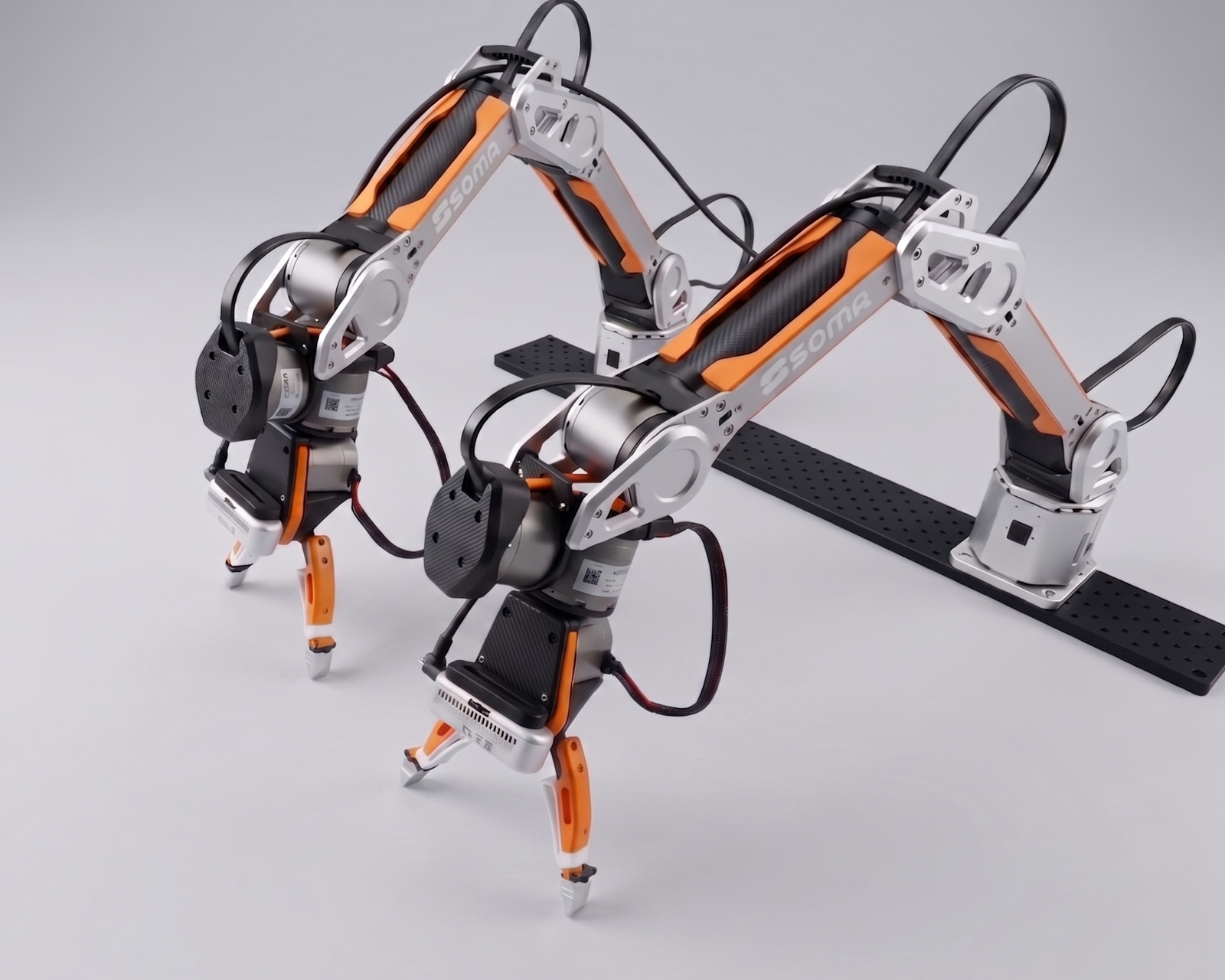
SOMA published pricing on September 22, 2026. soma one desktop starts at $6,999 and mobile soma one at $12,499. The company currently lists US-only shipping, so this is not yet a direct European buying route.
SOMA Robotics has done something still uncommon in embodied AI: it published a transparent price list for a complete bimanual research platform. Instead of a contact-sales form, buyers can see configurations, prices and a purchasing path. The desktop version starts at $6,999, while the mobile robot starts at $12,499.
This is not a home robot or a turnkey factory worker. SOMA is targeting labs, startups and teams developing manipulation policies, teleoperation and learning from demonstrations. That is why the price matters: it provides a benchmark against building a custom rig from two arms, cameras, grippers, compute and software.
What the buyer gets
Both platforms use two six-axis arms, grippers and depth cameras. SOMA lists control and state streaming up to 500 Hz and rated repeatability of ±0.1 mm. Mobile soma one adds an omnidirectional base and lift column, while the desktop system is designed for a laboratory bench.
The software layer is equally important. SOMA describes soda OS as supporting VR teleoperation, recording demonstrations as HDF5 trajectories with camera video, APIs for joint position, impedance and torque control, and workflows for training and deploying policies. The product proposition is therefore not just two robot arms; it is a pre-integrated experimentation pipeline.
Pricing and configurations
The desktop has three tiers: Base from $6,999, Data from $7,999 and Research from $9,499. Mobile soma one starts at $12,499, with Data at $13,999 and Research at $16,999. SOMA is using early-bird pricing for the first units, so some prices can rise after the launch allocation is exhausted.
The company describes the systems as build-to-order with a stated 4–6 week shipping window. That is a manufacturer estimate rather than an independently verified customer lead time. The desktop is intended to go on sale at launch, while the first mobile soma one batch is expected to ship in the fall.
Why this matters for embodied AI
Manipulation research increasingly runs into a hardware and data problem, not only a model problem. A team building its own setup can spend weeks on calibration, camera synchronization, teleoperation and failure handling. A standardized platform is valuable if it compresses that integration work and allows multiple labs to reproduce similar experiments.
That does not automatically make SOMA cheaper over the full lifecycle. Buyers still need compute, possibly VR hardware, wear parts, shipping, taxes, service and engineering time. Europe adds questions about availability, conformity and local support. The US dollar prices should therefore be treated primarily as a research-platform benchmark today.
The comparison with humanoids is also instructive. Some humanoid bodies now have lower headline prices, but buying the body does not always provide the same low-level control, teleoperation stack or reproducible data pipeline. Our Unitree G1 profile makes the same distinction between entry hardware pricing and the configuration actually required for advanced development.
What we still do not know
- when SOMA will ship directly to Europe;
- what an EU delivered price will look like after tax and logistics;
- how rated repeatability holds up during long sessions;
- failure rates and spare-parts availability;
- whether early-bird units are physically stocked or fully build-to-order.
RoboMorrow take
SOMA is not competing with a factory humanoid today. It is competing with the custom research rig. A $6,999 public starting price for a dual-arm desktop matters because it lowers the visible entry point and gives the market a clear benchmark for future embodied-AI platforms. For Europe, the material update will be official regional sales, pricing and support.
Who SOMA makes the most sense for today
The clearest customer is a team that needs many hours of manipulation demonstrations but does not want to spend the first months of a project on mechanics and integration. The desktop system can be attractive for labs working on bimanual manipulation, imitation learning and VLA because it uses less space than a full humanoid and concentrates on the part of the system where training data is most valuable: arms, grippers and cameras.
It makes less sense for a company expecting turnkey production automation. SOMA does not publish industrial MTBF data, full machine-safety certification, production-cell safety parameters or a service network comparable with major cobot vendors. This is a research platform. Its value should be measured by time to first experiment, API quality and reproducibility rather than cycles per shift.
Standardization can also matter for universities. If multiple labs use the same platform, experiments may be easier to compare than results from custom rigs with different mechanics and sensors. That could become a bigger advantage than the sticker price. Europe still lacks an official buying route, so EU teams should wait for clear shipping, warranty and conformity terms rather than treating the US price as a final landed cost.