SUPCON T2 traffic robots are working on Hangzhou streets
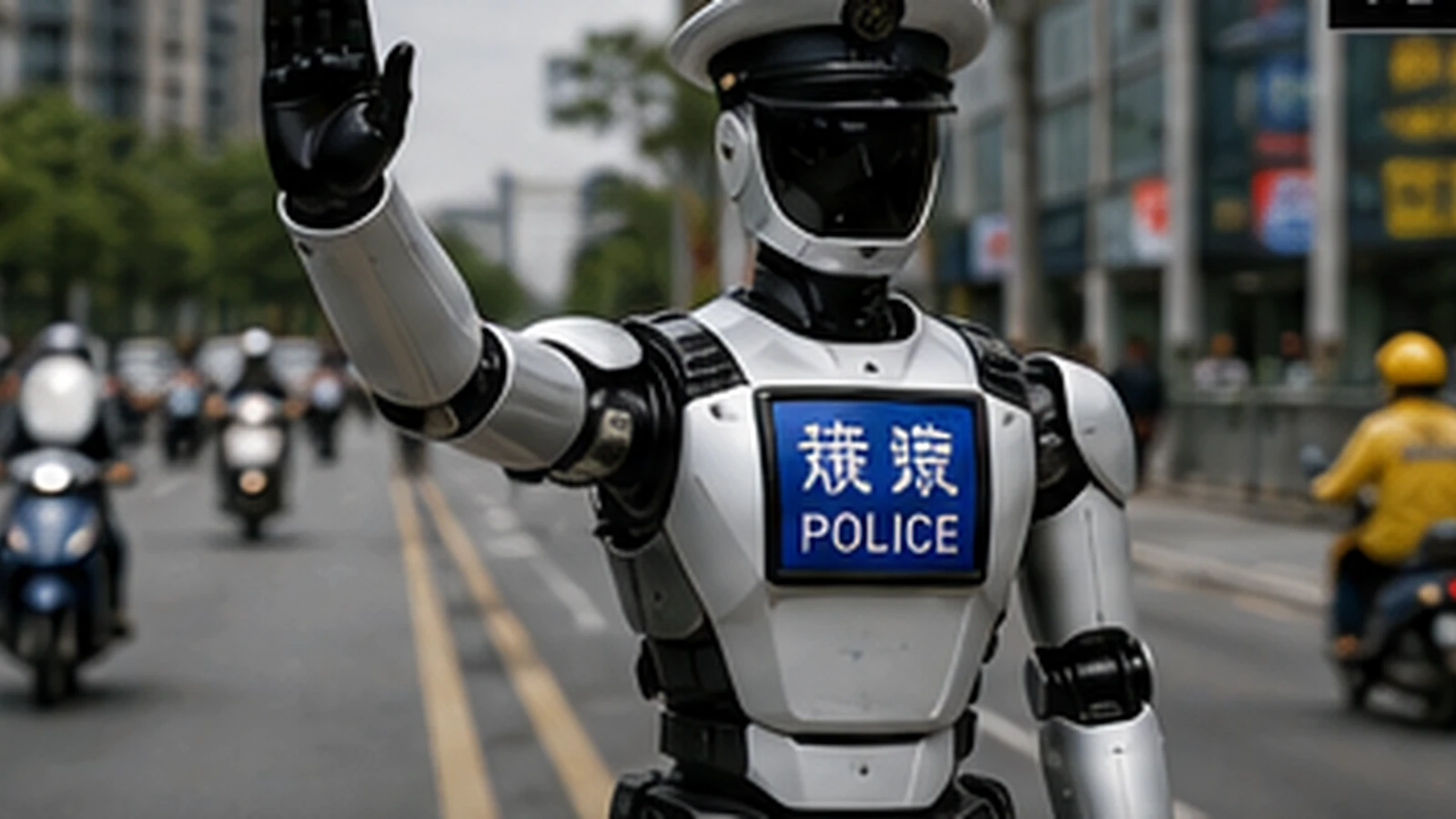
Fifteen SUPCON Information T2 robots are operating at intersections in Hangzhou. They are not walking humanoids: they are 1.88-metre-tall, 98 kg wheel-based machines with articulated arms, cameras, radar and onboard computing. Reuters confirmed that the deployment has been running in real traffic since May 2026.
The most eye-catching performance numbers—more than 170,000 warnings and a claimed reduction of more than 40% in selected violations—come from SUPCON. Hangzhou traffic police did not respond to Reuters’ request for comment and Reuters could not independently verify those results. The deployment is real; its measured impact is not yet independently audited.
What T2 does on the street
T2 uses cameras, radar and onboard processing. According to SUPCON it identifies defined behaviors including riding an e-bike without a helmet, carrying a passenger on an e-bike, stopping beyond a marked line and pedestrians crossing against signals. It can issue a warning and use its seven-jointed arms to reproduce standard traffic-police gestures synchronized with the lights.
The robot can also answer questions about directions, parking and traffic rules. An emergency function connects users with local police. SUPCON says the machines autonomously move between preset positions at intersections and operate from roughly 7 a.m. to 6 p.m. without remote driving.
A real deployment is not the same as proven ROI
SUPCON says the 15 Hangzhou robots have issued more than 170,000 warnings since May and helped reduce monthly cases of helmetless riding and vehicles crossing stop lines by more than 40%. It also claims violation-recognition accuracy above 95%. Reuters explicitly says it could not independently verify the figures.
Without false-positive rates, operator-intervention data, downtime and maintenance costs, it is impossible to calculate deployment value. A large warning count shows activity, but not necessarily how many violations were prevented or how often a human officer had to correct the system.
SUPCON targets roughly 200 units by year-end
The company says nearly 50 of the robots are already operating across about eight cities in three Chinese provinces and expects deployments to approach 200 by the end of 2026. If delivered, that would make T2 a meaningful example of scaling public-service robotics beyond a single pilot.
SUPCON says it tested the machines for thousands of hours in tourist areas, school zones, business districts, rush-hour conditions and poor weather. It also acknowledges that strong sunlight, rain and temperature extremes can still affect cameras and radar.
This is not an autonomous police officer
T2 has no arrest power and does not autonomously issue criminal punishment. Its role is narrower: monitor selected behaviors, deliver reminders, make traffic-control gestures, answer basic questions and connect exceptional situations to a human. That is a more realistic automation model than the “RoboCop” label suggests.
Its form factor also matters. T2 has an anthropomorphic upper body and arms but moves on wheels. It should not automatically be counted in the same category as a full bipedal humanoid. Product-scope differences like this are one reason market shipment totals can diverge between research firms.
What an EU deployment would have to address
A comparable European system would have to be assessed both as a machine and as a sensor platform operating in public space. The purpose and legal basis for image processing, data minimization, retention, access controls, cybersecurity and public notice would all matter.
Traffic safety adds another layer. A machine reproducing police gestures must fail predictably if a sensor or network connection is lost, and any conflict between the robot and traffic signals needs a defined priority. Human operators must be able to disable or override the system quickly, while procedures have to specify which robot messages carry legal authority.
Why this case matters more than another trade-show demo
The valuable part of T2 is continuous exposure to a public environment. The robot has to deal with weather, dust, unpredictable people, traffic and long operating hours. That is a different engineering problem from performing a polished routine inside a controlled booth.
For service robotics, it may illustrate a practical division of labor: automate repetitive presence and monitoring, provide basic guidance, and escalate exceptions to people. Independent effectiveness and cost data will still be needed before we know whether that model is economically better than conventional alternatives.
How the 170,000-warning claim should be audited
The warning count alone cannot establish effectiveness. An audit would need a denominator: traffic volume through monitored intersections, active robot-hours and the number of events classified as violations. A random review of recorded events should then estimate false-positive and false-negative rates for each behavior category rather than relying on one aggregate recognition figure.
The claimed reduction of more than 40% needs an even stricter before-and-after design. The same intersections should be compared at similar hours and under comparable weather and traffic conditions, while changes in police presence or enforcement campaigns are controlled for. Otherwise part of the improvement could come from unrelated factors or regression to the mean.
Finally, ROI requires operating-cost data: maintenance, connectivity, sensor cleaning, charging, remote supervision and human interventions. T2 is therefore a meaningful operational deployment, but the company performance figures remain weaker evidence until the measurement methodology is published or independently audited.
Sources and verification
This article is based on: Reuters — SUPCON T2. Manufacturer and analyst figures are identified as claims or estimates rather than audited facts. RoboMorrow verification: 20 August 2026.