Tuya Doova: mobile AI robot for seniors debuts at IFA 2026
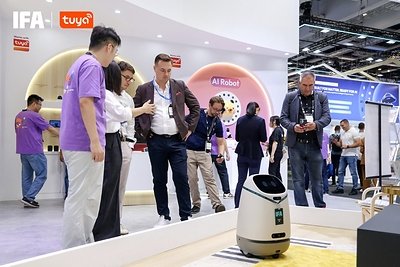
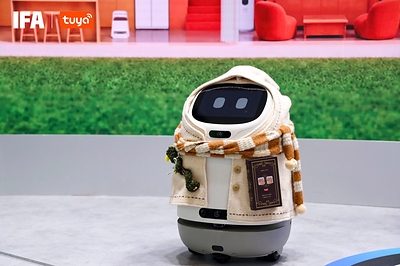
Tuya has unveiled Doova, a mobile home robot designed around seniors who live independently. It is not a humanoid and does not attempt to replace a person for household chores. Instead of arms it uses wheels, LiDAR, cameras, microphones, a display and access to Tuya’s AIoT ecosystem. That makes the strategy notably pragmatic: Doova is meant to become a moving point of contact, monitoring and smart-home control.
The robot debuted at IFA 2026 in Berlin. Tuya positions Doova as a combination of AI assistant, mobile safety device and smart-home hub. The key scenario is an emergency. The robot is designed to localise a voice, drive toward the user and start an assistance workflow. If no response is detected for 60 seconds, Tuya says Doova can automatically alert family members and initiate a two-way video call.
Mobility instead of a humanoid body
Doova moves on a dual-wheel base with supporting caster wheels and supports autonomous docking and charging. Navigation uses LDS LiDAR. A four-microphone array is intended to locate the direction of a voice, while the vision system uses skeletal or posture-recognition algorithms. Together, these systems are supposed to let the robot find a person calling for help and assess their position.
There is an important distinction between confirmed hardware and proven safety performance. Tuya confirms the sensors and describes the emergency workflow. There is no independent data yet on false-alarm rates, real-world fall-detection accuracy, low-light performance, edge cases or what happens when internet connectivity fails. For a product associated with elder care, those details matter more than a compelling trade-show demonstration.
A 10.1-inch display and multimodal AI
The robot has a 10.1-inch HD display and animated facial expressions. Tuya says its conversational layer uses a multimodal large language model. Planned functions include open-ended conversation, entertainment, medication and schedule reminders, weather information and help with understanding bills and letters. Doova is also meant to flag potential scams and guide users through smart-appliance operation.
This is useful territory but also one that needs careful language. Large language models can be wrong, and an incorrect interpretation of a document or a false scam warning can have real consequences. Tuya has not yet published a full description of responsibility for AI answers, supported European languages, offline capabilities or how sensitive content will be processed in European deployments.
A moving home-monitoring device
When users are away, Doova is designed to move between selected points in the home, perform 360-degree scans and generate a safety report for the owner’s phone. Tuya frames its node-oriented coverage as less intrusive than a conventional wall-following patrol. For buyers, the more important question will be whether the robot can reliably identify changes that actually require attention.
Privacy is an obvious European issue. Cameras, microphones, posture analysis, conversations and remote video create a highly sensitive data set. The launch materials do not provide a complete answer on local versus cloud processing, retention, encryption, family-account permissions, consent or the final GDPR implementation. Those details will be central before any serious EU commercial rollout.
Doova as a Tuya AIoT hub
Doova is also designed to control connected devices across Tuya’s ecosystem. Voice commands can coordinate lighting, curtains, kitchen appliances and bathroom devices. This is a logical use of one of Tuya’s strongest assets: a very large installed developer and device ecosystem.
At IFA, Tuya presented Doova alongside a broader Physical AI stack including AI Home, AI Robot, AI Energy, Matter products and developer tools. The robot should therefore be read as more than a standalone gadget. It is a demonstration of how Tuya wants to connect AI models, sensors, devices and home automation into a single service layer. Strategically, that may matter more than the robot’s physical shell.
Amazon and purchasing: too early for a buy button
Doova currently has no verified Amazon offer and no confirmed regular EU retail launch. We therefore do not show a synthetic purchase CTA or substitute a similar device. If the exact model later appears with a verified SKU/ASIN for a given market, the offer router can send readers to the appropriate local store.
What we still do not know
- Price: no official MSRP for Poland, the euro area or other markets.
- Sales date: no confirmed consumer on-sale date.
- Markets: no final list of EU countries or supported local languages.
- Privacy: no complete European description of on-device/cloud processing, retention and privacy controls.
- Safety: no independent fall-detection benchmark or false-alarm data.
- Subscription: Tuya mentions future value-added services but has not announced pricing.
Why Doova could matter more than a flashy humanoid
Home robotics is currently dominated by attention around machines with arms and legs. Doova represents the opposite design choice: reduce mechanical complexity while adding mobility, perception, AI and integration with specialised devices that already perform specific tasks. In a single-level home, that could be cheaper, simpler and potentially more reliable than a fully humanoid platform.
It is also an important signal for the ageing-in-place market. Real value will not be determined by how pleasant the robot is to talk to, but by whether it shortens response time in genuine emergencies without producing an unacceptable number of false alarms. If Tuya later publishes pilot results, care-provider partnerships or certification data, that would materially update the story.
Why it matters in Europe
For Polish buyers, Doova is currently a category preview rather than a purchasable product. Without price, a sales date or local availability, it does not belong in a buying ranking. It is worth tracking, however, as an example of robotics aimed at ageing populations and as a possible route for Tuya’s platform into care-related services.
In Europe, broad smart-home compatibility could become a competitive advantage, while privacy, cybersecurity and responsibility for emergency functions will be major hurdles. If those issues are handled well, a mobile robot-hub may prove more practical than many far more dramatic humanoid demos.
RoboMorrow verdict
Publish as a new IFA 2026 story and add it to the Live Desk. Doova has a clear use case, a distinct product form and a credible link between Physical AI and an existing IoT ecosystem. We are not treating its care functions as independently proven. The next checkpoints are price, EU sales, privacy rules, supported languages and independent evidence on the emergency workflow.
We are tracking the most important Berlin launches in the IFA 2026 Live Desk.