Unitree says it has produced about 18,000 humanoids as manufacturing outpaces mature deployments
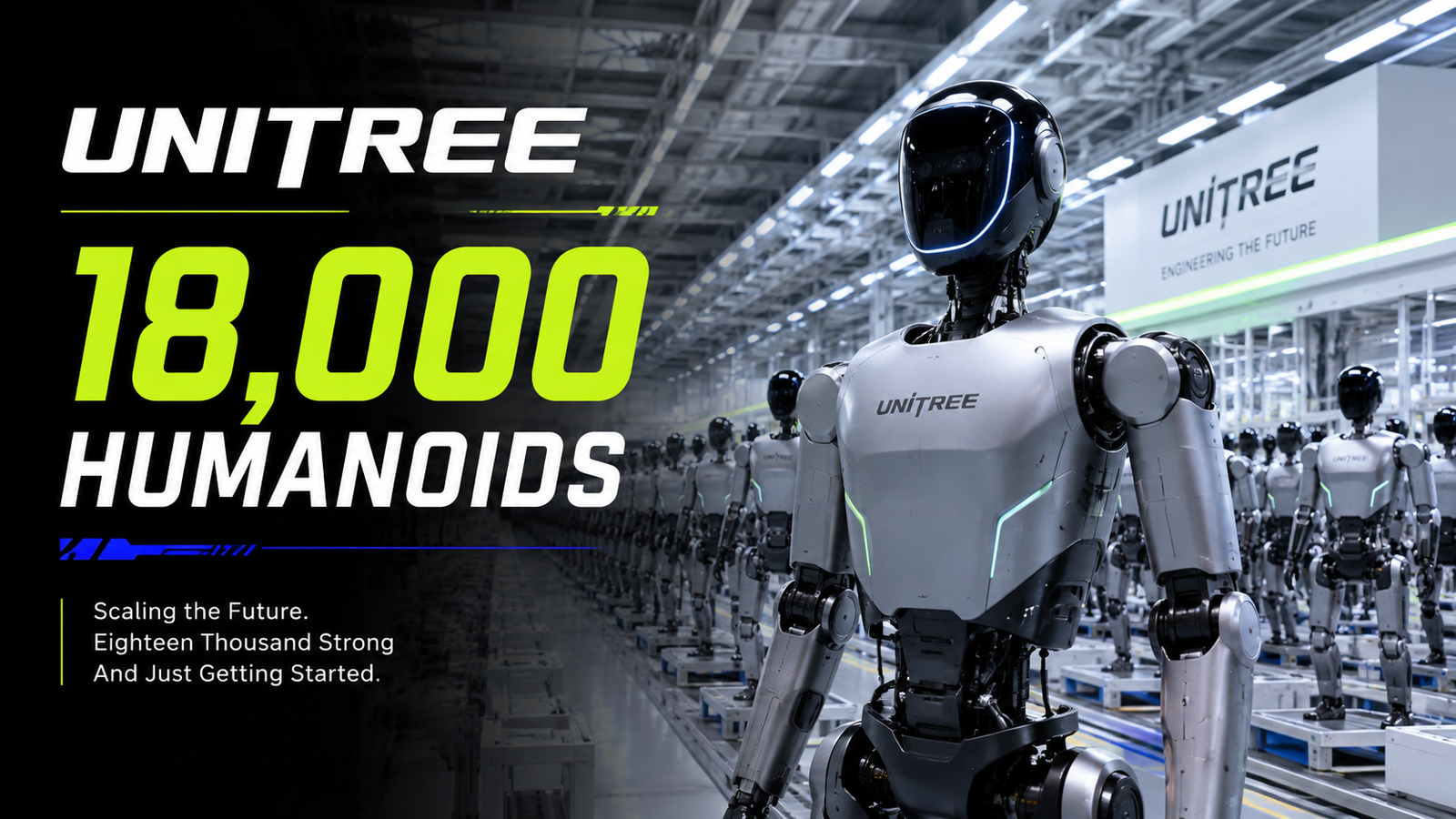
Unitree says the cumulative number of bipedal humanoid robots produced and rolled off its production lines has reached approximately 18,000 units. The company published the figure on August 12, 2026 and said it counts bipedal humanoids only, excluding wheeled platforms and other humanoid-like robot types.
The milestone is a useful indicator of Unitree's growing manufacturing scale, but it needs one important qualification: 18,000 robots produced does not mean 18,000 machines sold to end customers or 18,000 autonomous robots working in commercial operations today. Production, shipments and active deployments are different metrics.
What Unitree actually confirmed
Unitree's official post gives a cumulative production figure of about 18,000 bipedal humanoids. It does not provide a model-by-model split across G1, H1, R1 and other variants. It also does not disclose how many robots went to factories, laboratories, universities, research programs or other customer groups.
Gasgoo, reporting on the announcement on August 14, adds a useful reference point: in June, Unitree reportedly said cumulative production of the G1 had passed 11,000 units, compared with roughly 6,500 units produced during all of 2025. Those figures are reported by Gasgoo and are not part of Unitree's latest 18,000-unit post itself.
Production is not the same as shipments
Gasgoo also cites market-research firm SAG as estimating global humanoid shipments at about 19,100 units in the first half of 2026. Unitree accounted for around 5,900 units, or 31% of the market during that period, according to those figures.
That does not conflict with the 18,000 figure. One number is cumulative production reported by the manufacturer; the other covers shipments during a specific six-month period according to an external market source. Neither figure directly tells us how many robots are currently doing regular productive work without frequent human intervention.
Why manufacturing scale matters
Building thousands of robots gives a manufacturer more than a headline number. Higher volume can expose recurring problems in actuators, batteries, sensors, assembly and quality control. It can also accelerate work on unit costs, parts logistics and serviceability.
It does not automatically create an autonomy advantage. Reuters notes that the humanoid market remains at an early stage of commercial adoption and that a significant share of current demand comes from education, research and demonstrations. Reliability, dexterity, task generalisation, safety and sustained operation in unstructured environments remain major constraints.
Unitree is planning much larger production capacity
Gasgoo reports that Unitree's planned intelligent-robot manufacturing base is designed for annual capacity of about 75,000 humanoid robots and 115,000 quadrupeds, with a two-year construction period.
This is a capacity target, not a sales forecast. A factory capable of producing 75,000 humanoids per year does not mean the market will immediately absorb that volume.
At the same time, Unitree has raised about 6.1 billion yuan through its Shanghai public offering. Reuters says the proceeds are intended to support areas including embodied-AI model development, robot-body research and manufacturing expansion.
What remains unknown
The 18,000-unit announcement does not disclose end-customer sales, the number of active industrial deployments or average operating time without human intervention. It also does not provide a full model-level breakdown of cumulative production.
Price and availability: the production milestone does not introduce new pricing or availability terms for Unitree's individual models.
Teleoperation: it is not relevant to this production-volume announcement. The 18,000 figure says nothing about the autonomy level of the robots counted and should not be interpreted as evidence that all of them perform tasks independently.
Why this matters for Poland and the EU
For Europe's robotics industry, the key signal is that a Chinese manufacturer is accumulating production experience across thousands of humanoid robots. That scale can accelerate supplier learning, cost reduction and hardware iteration.
It does not prove an advantage in AI or industrial deployment quality. European companies can still compete through safety, integration with automation systems, regulatory compliance and process-specific engineering. But the manufacturing-learning advantage created by serial production is becoming harder to ignore.
RoboMorrow assessment
18,000 units is a meaningful manufacturing milestone, but it is not evidence of mass commercial deployment. The more important shift is that the humanoid race is moving beyond isolated demonstrations toward serial production, reliability, cost, service and the ability to find productive work for a growing installed base.
If Unitree combines manufacturing scale with meaningful gains in autonomy and reliability, it could build a durable advantage. For now, the safer conclusion is narrower: the company has demonstrated manufacturing scale that should not be confused with the scale of mature deployments.
Sources
- Unitree Robotics — official August 12, 2026 post reporting about 18,000 bipedal humanoids produced
- Gasgoo — production, G1, SAG shipment and planned-capacity figures, August 14, 2026
- Reuters — Unitree profile and humanoid commercialisation constraints, updated August 11, 2026
- Reuters — Unitree IPO and 6.1 billion yuan raised, August 14, 2026