Unitree R1 lowers entry costs: a humanoid from $4,900
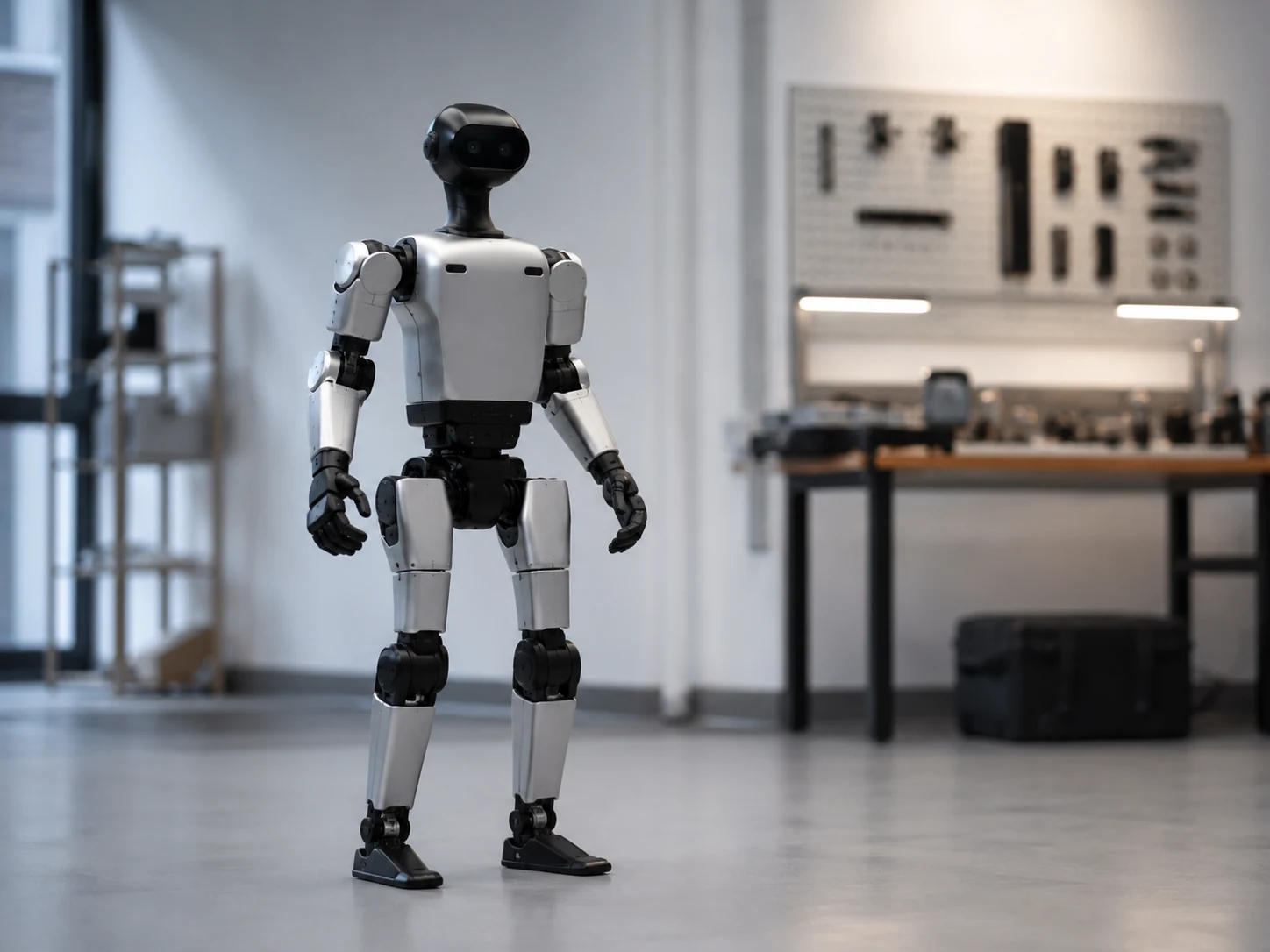
Unitree R1 is one of the first humanoids whose price begins to resemble that of an advanced machine rather than a multi-million research project. The manufacturer quotes $4,900 for the R1 AIR version and $5,900 for the base R1 model, excluding taxes and shipping. This is an important signal for the market, but not proof that for a few thousand dollars we get a ready-made employee for home or business.
What are we actually buying for $4,900?
R1 is a lightweight humanoid platform primarily intended for education, research, makers and integrators. Unitree provides interfaces related to drives and sensors, and also supports work in simulation environments. This means that the robot can be the basis for creating your own applications, but the buyer still needs software, competences and conditions for safe tests.
The low price is possible, among other things, because the manufacturer does not sell a complete business solution. The buyer does not automatically receive the implementation process, integration with the warehouse, ready-made security procedures or a European service network. This is a difference similar to that between purchasing a computer and purchasing the entire IT system operating in the enterprise.
The list price is only the first line of the budget
The price of the robot must include transport, taxes, possible customs duties, shipment insurance, spare parts and service tools. Then there is the cost of integration: programming behavior, building a test stand, preparing data, training the operator and creating procedures for stopping the device.
The company may also need a risk assessment, separation of a safe zone, additional sensors and consultation with an integrator. At home, there are also issues of stairs, children, animals, delicate items, privacy and responsibility for the unpredictable movement of the machine.
The most important question: what does the robot do itself?
Videos showing running, dancing or dynamic movements do not answer the usability question. What is more important for the customer is whether the robot can repeatably pick up a specific object, move between stations, perform the task a hundred times and return to work on its own after a minor error.
Four levels must be separated: programmed motion, human control, autonomy in a controlled environment, and autonomy in a variable home or business. Only the last level allows us to talk about real replacement of part of human work.
For whom does R1 make sense today?
- universities and technical schools developing robotics competences,
- research teams testing robot control and learning,
- integrators looking for an affordable demo platform,
- event companies and technology developers,
- enterprises conducting a controlled pilot rather than expecting a ready return on investment.
Importance for Poland and Europe
R1 may increase access of Polish universities and small companies to humanoids, because so far the cost of the device has often excluded experiments. At the same time, the importer or integrator must check the documentation, manuals, warranty conditions, regulatory compliance and parts availability. Just because a robot can be ordered online doesn't mean it can work safely alongside customers or employees.
What would a reasonable pilot look like?
The first project should not be a generic "help in stock" command. It is better to choose one site, one type of container and a short route. Then determine the number of correct cycles, allowable execution time, number of interventions and conditions for stopping the test. It is also worth measuring how many hours of integrator work are required for each subsequent improvement.
If the robot is to be used for marketing purposes, a separate promotional value account should be kept. An event demonstration can make money despite low autonomy, but it is not the same as operational implementation.
The most common buyer mistakes
- assuming the manufacturer's video shows a standard feature of the shipped model,
- no budget for parts and damage while learning,
- testing immediately among customers,
- no technical person responsible for the device,
- comparing the platform price with the employee's annual salary.
What should be included in the request for quotation?
Request detailed configuration, software version, list of items included, documents for the EU market, warranty conditions, availability of remote support and approximate prices of the most expensive parts. It is also important to confirm whether software modification affects the warranty and whether the manufacturer provides system images allowing the robot to be restored after a failure.
RoboMorrow Evaluation
R1 lowers the financial entry threshold but does not automatically lower the technological entry threshold. This is an interesting platform for learning and prototyping. We would not currently treat it as a ready-made home robot or an autonomous employee of a small company.