Unitree unveils ‘Superman’ humanoid, claiming 45.6 km/h and a 2-metre standing jump
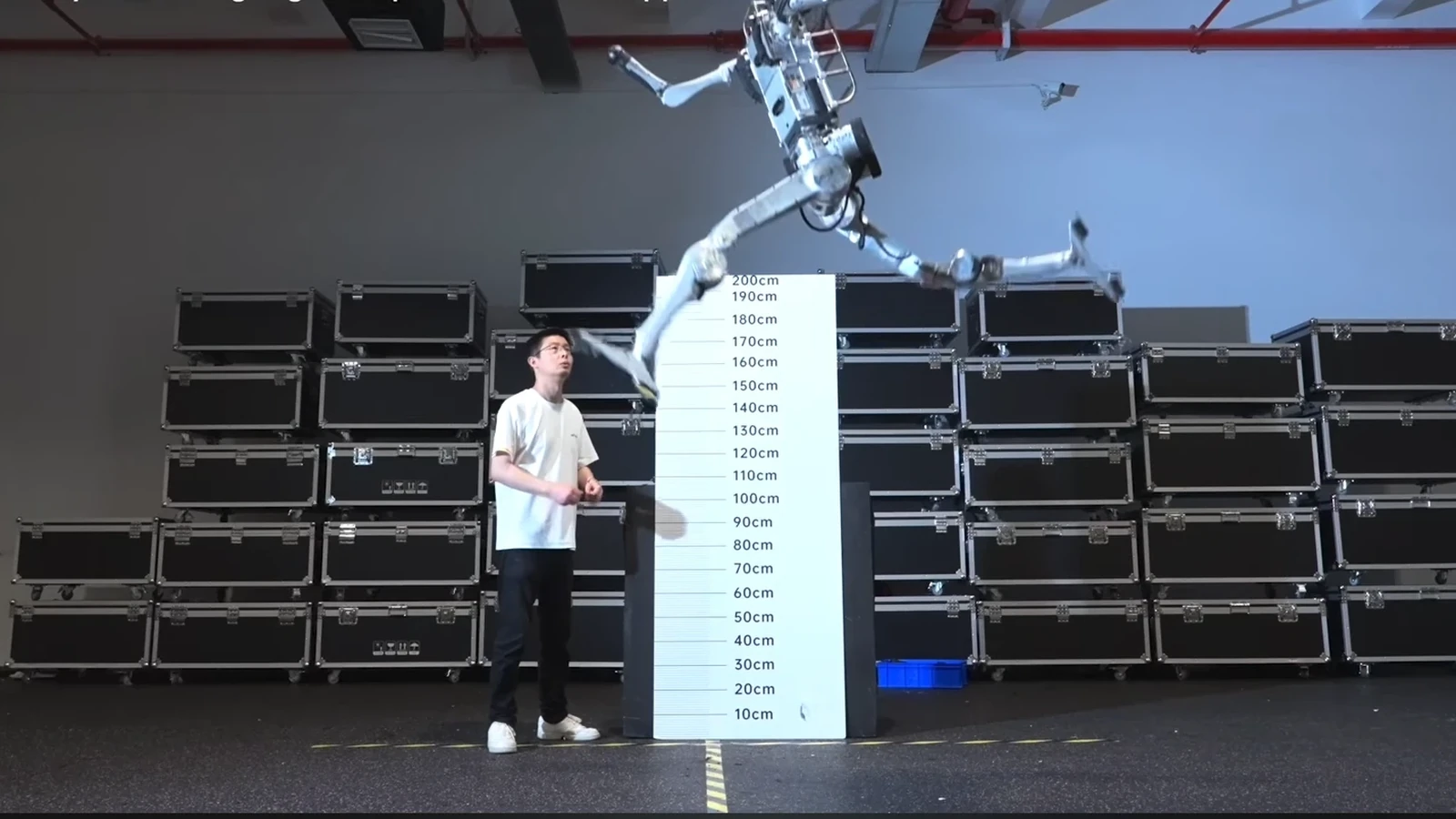
Unitree has unveiled a new humanoid referred to as “Superman”, with the demonstration focused on extremely dynamic locomotion. The company claims a standing jump of around 2 metres, a maximum speed of 12.66 m/s — about 45.6 km/h — and a leg length of 0.85 m.
The preview matters not because the robot has somehow “beaten humanity”, but because it shows the pace at which humanoid actuators and whole-body control are advancing. At the same time, Unitree has not disclosed price, sales timing, runtime, mass, a complete specification or enough information to assess the autonomy of the new machine.
What Unitree actually showed
Unitree's official post is titled “New Robot Preview: Superman”. The footage shows the robot making a very high jump without a run-up and running at high speed. The company provides three figures: a 2 m standing jump, a 12.66 m/s maximum speed and a 0.85 m leg length.
Reuters independently confirmed on 17 August that Unitree had unveiled the new high-speed “Superman” robot and reported that, according to the company, it had been developed in just over three months. This independently confirms the event and the existence of the manufacturer's claims — not the measured performance itself.
There is no complete product sheet at publication time. The robot's mass, battery capacity, runtime, degrees of freedom, actuator output, sensor suite and onboard computing platform remain undisclosed. Unitree has also provided no price, commercial launch date or confirmed European availability.
45.6 km/h is spectacular. It does not yet tell us whether the robot is useful
12.66 m/s is approximately 45.6 km/h. Unitree compares the result with peak human athletic performance and presents “Superman” as breaking human motion limits. It is effective marketing, but it should not be confused with an assessment of a practical robot.
A maximum speed reached during a short demonstration does not reveal how far the robot can maintain the pace, how many trials were performed, how repeatable the result is, or how quickly actuator temperatures and energy consumption rise. Likewise, a two-metre jump says little about gearbox durability, landing loads or safe repetition.
For useful deployment, stability on uneven ground, disturbance recovery, controlled braking, payload transport, manipulation and hours of repeatable operation without failure will be far more important.
Autonomy remains unknown
The video is not evidence of general autonomy. Unitree does not provide a detailed description of the control setup. We do not know which elements were pre-programmed, which were generated by a learned motion policy, how sequences were triggered or how much operator involvement was required during trial preparation.
There is also no basis for calling the demonstration real-time teleoperation. The manufacturer does not make that claim. The most accurate description today is therefore a demonstration of the dynamic capabilities of a new platform, without enough evidence to rate its autonomy.
“Superman” is not yet a full commercial product
Unitree calls the announcement a “preview” rather than launching a normal product page with price and specifications. It is not clear whether “Superman” will remain the commercial model name. From a buyer's perspective, it is safest to treat the machine as a preview of a highly dynamic new humanoid platform.
That matters because Unitree already operates across very different positions in the humanoid market. R1 reduces the financial entry point, while H1 and H2 are larger platforms. “Superman” appears to explore the other end of the spectrum: maximum dynamic performance rather than minimum cost.
See more RoboMorrow humanoid coverage →
Timing: two days before Unitree's stock-market debut
The demonstration arrives immediately before Unitree's planned debut on Shanghai's STAR Market. Reuters reports that trading is scheduled to start on 19 August 2026. Unitree had priced the IPO at 150.8 yuan per share and raised approximately 6.1 billion yuan.
There is no evidence that the “Superman” demonstration was created solely for the listing. The timing nevertheless gives the technology showcase an obvious investor-relations dimension: it appears during a period of exceptional attention around the company and China's humanoid robotics sector.
Unitree's scale changes the meaning of the preview
“Superman” is not a demonstration from an unknown laboratory. Reuters reports that Unitree had delivered around 18,000 bipedal humanoid robots across its models by July. That does not mean 18,000 robots are performing autonomous commercial work, but it does demonstrate manufacturing scale.
That makes even a prototype preview more significant than a similar demonstration from a team without volume-production capability. If parts of the actuator and control technology later migrate into commercial models, Unitree already has manufacturing capacity and sales channels capable of moving technology from demonstrations into subsequent hardware generations relatively quickly.
What it could mean for Poland and the EU
For European users, maximum speed will probably be among the least important parameters. A humanoid capable of moving with the energy associated with speeds above 45 km/h creates a very different risk profile from a robot working slowly at an assembly station.
Motion-energy limitation, emergency stopping, predictable behaviour, functional safety, risk assessment and compliance of the complete application with European requirements become critical. In environments shared with people, some of the performance demonstrated by “Superman” would likely need to be software-limited.
On the other hand, higher actuator headroom and better whole-body control can be valuable without ever using maximum speed. They could improve stair and rough-terrain mobility, balance recovery and operation while carrying loads. For now, however, that is a possible technology transfer rather than a confirmed feature of a commercial Unitree product.
RoboMorrow assessment
“Superman” is an important technology preview, but it is not yet a product that can be fairly compared with H2, Figure 03 or another humanoid designed around a defined job. Unitree is showing that it can advance dynamic control and actuator capability rapidly. It is not yet showing repeatable autonomous work.
We therefore treat 12.66 m/s and 2 m as manufacturer-claimed demonstration results, not as a purchasing argument. The next important step will be whether the underlying technology reaches a production model with a price, runtime, full specification, safety systems and concrete applications.
Sources
- Unitree Robotics — official “New Robot Preview: Superman”
- Unitree Robotics — official LinkedIn post
- Reuters — independent confirmation and IPO context
Featured image: frame from the official demonstration published by Unitree Robotics. Shared PL/EN visual with no additional language-specific messaging.