A robot carpenter sounds like science fiction. DEWALT has already taken the first step
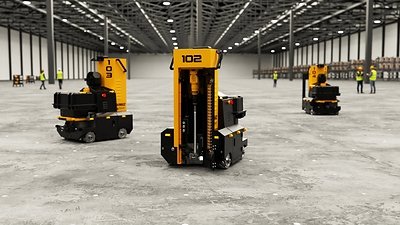
RoboMorrow thesis: one of the most important questions for the power-tool industry over the next decade may not be “what battery will the next saw use?” but who will own the robot that takes the tool to the work. That sounds futuristic until you look at what is already happening in 2026.
On July 9, DEWALT announced commercial availability of DALE, an autonomous fleet-capable robot for drilling concrete, developed with August Robotics. One month later, the same DEWALT announced a major expansion of cordless carpentry tools for cutting, sanding and fastening. The proximity of those two announcements may say more about the future of power tools than another humanoid demonstration: traditional tools and robotic execution are beginning to sit inside the same “jobsite solutions” category.
And this is why the “robot carpenter” may not look like a person holding a hammer. A more likely early form is a mobile platform that reads BIM or CAD, localises itself on site, selects a tool or end-effector, performs a repetitive task, records the result and escalates exceptions to a human. In that future, power-tool companies do not need to become humanoid companies. They need to decide whether they remain suppliers of the tool at the end of a human arm — or also own the tool at the end of a robot.
This is no longer pure science fiction: DEWALT is already selling a robot
After data-centre pilots, DEWALT and August Robotics brought DALE to commercial order in 2026. DEWALT says the system drilled at speeds up to ten times faster than traditional methods, achieved 99.97% location/depth accuracy across more than 230,000 holes and reduced project timelines by an aggregate 190 weeks across 26 construction phases. Those are manufacturer and partner results from specific deployments, not an independent benchmark for all construction, but the scale is no longer laboratory scale.
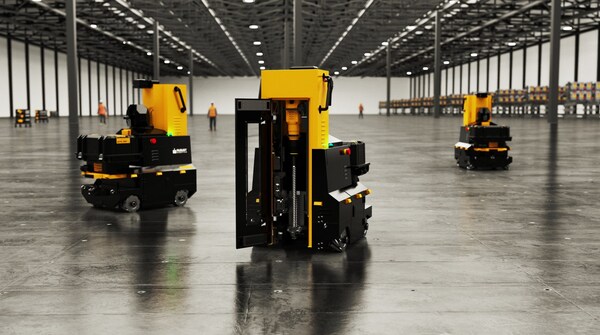
August Robotics describes a workflow in which drilling points are loaded from CAD/CSV. The robot optimises execution order, can share work with other units in a fleet, uses DEWALT SDS Max drilling technology, performs automated dust extraction and monitors quality. The interesting part is not simply that a machine can drill a hole. It is that a power-tool product no longer ends at the tool. Localisation, autonomy, project data, software, QA, fleet management and support become part of the offer.

August Robotics' own platform evolution makes the point stronger. The company began with Lionel, a mobile floor-marking robot, and then reused platform capabilities for drilling. That suggests a future in which the asset is not one isolated “robot for X,” but a mobile system that can take on additional repetitive operations over time.
Hilti demonstrated the same logic from another angle
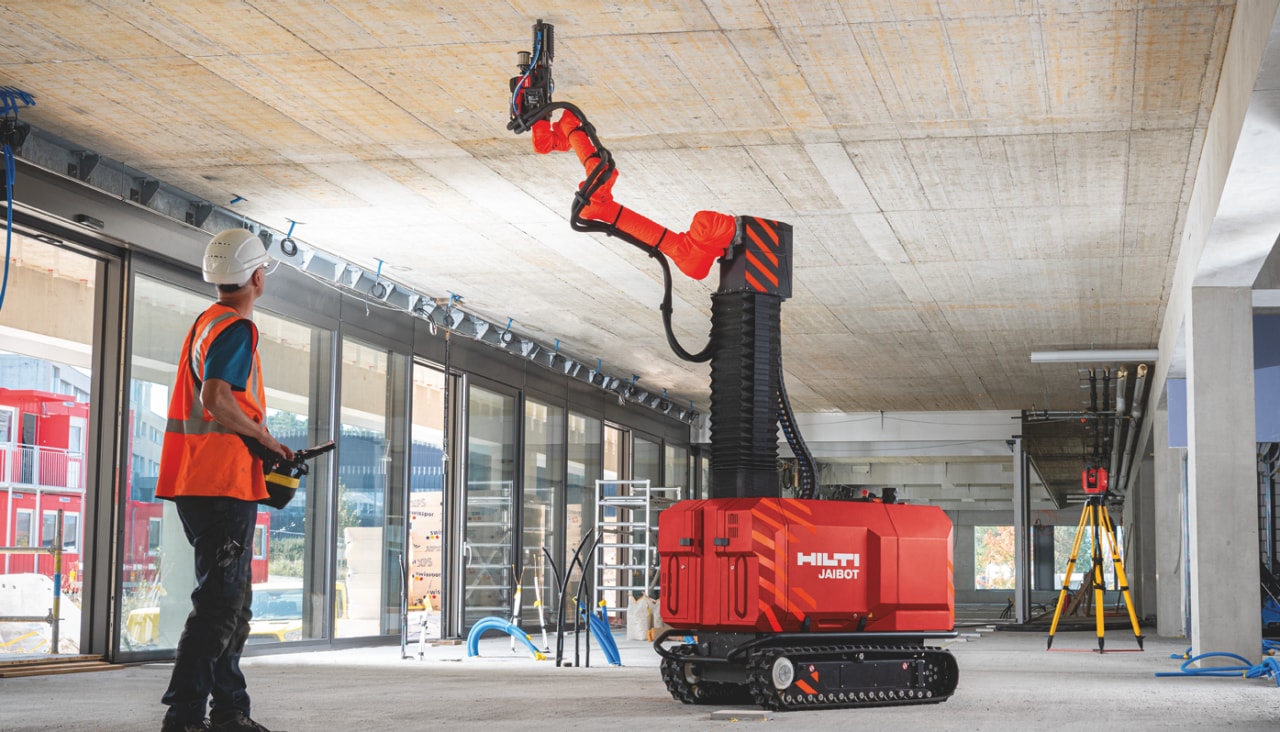
Hilti Jaibot is a semi-autonomous overhead drilling robot. An operator positions the platform, while the system uses digital design data and a robotic total station to mark and drill holes within reach. Hilti frames the benefit pragmatically: move strenuous, repetitive overhead drilling for MEP installations away from workers.
Jaibot matters to this thesis because it combines several capabilities a traditional tool company either owns or can build: the tool, dust management, safety, measurement, digital design, service and contractor relationships. It is not trying to “become a person.” It automates a slice of a trade where repetition and ergonomic burden create a clear business case.
Husqvarna shows another transition: the tool becomes a remote machine
Husqvarna's DXR family consists of remotely controlled demolition robots. They are not autonomous AI workers and should not be presented as equivalent to DALE. Strategically, however, they show an important shift: a breaker, crusher or shear can become an attachment on a robotic platform, with the operator moving from direct tool contact to controlling a machine at a safer distance.
That can be an intermediate stage between the power tool and autonomous execution. First the person holds the tool. Then the person controls the machine holding the tool. Later, the person defines the task, while software plans execution and requests help only for exceptions.
A plausible evolution:
human holds the tool → human controls the machine holding the tool → human defines the task and the system executes it.
HP SitePrint is a warning to the power-tool industry
HP is not a traditional power-tool company. Yet it built a construction robot using exactly its own advantage: printing, digital workflow and positioning. SitePrint takes CAD information and places construction layout directly on the slab. HP markets productivity gains of up to ten times for selected workflows and has been increasing autonomy with depth-camera perception, obstacle avoidance and dynamic route adjustment.
The lesson is that future construction robotics does not have to be won by companies that sell drills today. The winner can be whoever best combines task knowledge + mobility + software + site data + service. For power-tool companies, that is both an opportunity and a warning: new categories can form at the intersection of competencies, and competitors may arrive from printing, surveying, BIM, mobile robotics or software.
The robot carpenter probably will not be humanoid
Humanoids are compelling because human spaces are already built around the human body. Construction sites, however, are an unusually hostile environment: dust, rain, changing geometry, openings, scaffolding, unfinished stairs, people moving without fixed lanes and materials that rarely sit exactly as they did in simulation.
That is why the first wave of “robot tradespeople” is likely to look much less spectacular. Instead of one humanoid doing everything, expect machines focused on tasks where the loop can be closed: design → localisation → tool operation → quality check → report.
| Task | Why it is robot-friendly | What remains hard |
|---|---|---|
| layout / marking | geometry already exists in CAD/BIM; outcome is measurable | design changes, clutter and unexpected obstacles |
| repetitive drilling | repeatable geometry, expensive labour time, dust and ergonomics | rebar, variable substrates and exceptions |
| fastening / anchoring | position and torque can be controlled and logged | component selection and material tolerances |
| sanding / finishing | high repetition and physical load | surface-quality judgement and edges |
| cutting components | geometry can come from the digital model | material fixturing, tolerances and safety |
| material transport | large amounts of non-value walking and repeated routes | dynamic pathways, stairs and loading |
| demolition | dangerous environment and heavy tooling | structural judgement and unstable conditions |
| How could the power-tool category evolve? | |||
|---|---|---|---|
| 1. Power tool Human performs the operation |
2. Connected tool Tool measures and reports |
3. Robotic platform Machine positions the tool |
4. Autonomous task system Design → execution → QA |
The logical evolution: from power tool to robotic task system
For decades, power tools added layers: corded → battery → brushless → connectivity and telemetry → digital jobsite. The next layer may be a system in which the tool is only one module in a complete workflow.
Such a product will not be sold like another drill. The offer is likely to include a mobile platform, working tool, localisation, software, BIM integration, onboarding, training, support, SLA, parts and fleet monitoring — perhaps even billing by task. That changes category economics from hardware margin toward productivity as a service.
Why power-tool companies have a real advantage
1. They know the physics of the operation. Drilling concrete, cutting wood, anchoring, sanding and dust extraction are not merely software problems. Years of knowledge about materials, vibration, wear, tool geometry and safety are difficult to reproduce.
2. They own tool and consumable ecosystems. Drill bits, blades, anchors, nails and abrasives do not disappear in a robotic future. They can become an “end-effector ecosystem” — controlled working tools exchanged by a robotic platform.
3. They understand energy. Large battery platforms already solve parts of power delivery, charging, diagnostics and battery management. That does not mean a construction robot will simply use a standard drill pack, but the engineering base and scale matter.
4. They have contractor channels and trust. A robot worth tens or hundreds of thousands needs consultative selling, demonstration and service. A brand already inside contractors, rental companies and trade distribution starts from a different position than an unknown robotics startup.
5. They know safety, extraction and compliance. Construction robotics cannot treat safety as a feature added after the AI model. It is core product engineering. Traditional tool manufacturers already operate inside certification and liability frameworks.
But they do not need to build the whole robot themselves
The most interesting 2026 example is a partnership: DEWALT + August Robotics. One side contributes jobsite knowledge, drilling technology, tools and market access; the other contributes mobile autonomy, fleet orchestration and robotics software. That can be far faster than attempting to build a complete embodied-AI stack inside a tool company.
So the likely future is not “every drill manufacturer builds its own humanoid.” More plausible are partnerships, investment, white-label systems, acquisitions and shared platforms. The strategic question becomes: who controls the workflow and the customer relationship when a person no longer holds the tool?
What happens to batteries and compatibility?
Today's power-tool lock-in often comes from the battery platform. Robotic lock-in could be much deeper: batteries + tools + end-effectors + maps + project data + fleet software + service. That could create systems even more closed than today's 18/20/36/40 V families.
The opposite path is also possible: contractors may demand standardised interfaces, allowing robots to accept tools from multiple vendors like computers accept peripherals. That would be less comfortable for manufacturers but attractive to users. A future battle over mechanical, electrical and digital interfaces could become as important as today's battery-platform competition.
What happens to the tradesperson? The role changes before it disappears
DEWALT's U.S. slice of its 2026 AI in the Trades research shows an interesting gap: 90% of respondents believed AI would be indispensable within five years, while only 8% said they currently used AI in day-to-day work. That is not a robotics forecast and should not be interpreted as one. It does show that expected technological change is much larger than current adoption.
In the first phase, the skilled worker remains central. The job moves toward preparing tasks, validating digital information, setting up the robot, resolving exceptions and judging output. For many trades, that can mean a shift from performing every operation manually to managing execution. A highly skilled carpenter remains valuable precisely because construction has too many exceptions. Robots take the dull, heavy and sufficiently predictable parts first.
The biggest disruption may be the business model, not the product
If a robot performs an operation and verifies the result, the manufacturer can stop selling only a machine. It can sell one thousand correctly drilled holes, an hour of autonomous work, monthly fleet availability or guaranteed productivity. That pushes power tools toward industrial automation and SaaS-like economics.
Dealers may change as well. Instead of handing over a box, they can audit workflows, deploy, train and service fleets. Rental companies may become particularly important because contractors may not want to own a robot needed for only three weeks of a specific project phase.
Five signals that this thesis is becoming real
- More tool-company + robotics-company partnerships similar to DEWALT/August Robotics.
- Movement from single-function products to common platforms with multiple tasks or end-effectors.
- BIM/CAD integration becoming standard rather than an optional export path.
- Subscription or usage-based service alongside hardware sales.
- Trade-specific robots for framing, drywall, MEP, concrete, finishing and landscaping before one humanoid tries to do everything.
The core thesis: the next power tool may not be a better drill. It may be the entire robot, with the drill reduced to one end-effector in the system.
Will Bosch, Makita, Milwaukee, Festool or SKIL build robot carpenters?
This article does not claim that those brands are currently developing such systems. The question is strategic. If robotics moves from factories deeper into construction, tool manufacturers will have to choose their place in the new stack: tool supplier, end-effector supplier, robotics-platform partner, workflow integrator — or owner of the complete system.
The biggest mistake would be to view the future only through the humanoid category. The revolution may look more mundane: a yellow, red, blue or green machine rolls onto site, loads the digital plan, executes eight hundred repetitive operations and sends a quality report at the end of the shift. It does not look like a carpenter. But it performed part of the carpenter's current work.
What should power-tool companies do now?
If this thesis is directionally right, waiting for a humanoid to become a universal tradesperson would be the wrong strategy. Advantage can be built much earlier through specific task knowledge and data.
First: choose operations, not robot shapes. Start by identifying the customer's most repetitive workflows—thousands of holes, fasteners, cuts, sanding passes or measurements. The more measurable and physically unpleasant the task, the stronger the first automation candidate.
Second: design tools for machines as well as hands. Human ergonomics focus on grips, triggers, balance and vibration. A robotic end-effector needs digital control, state reporting, automatic accessory identification, repeatable mechanical mounting, quick change and process-quality data.
Third: preserve execution data. If a smart system knows that 400 anchors were installed, at which coordinates, with what torque and with which exception rate, that information can become part of project handover. In robotic workflows, “as-built” documentation can be created at the same moment as the physical operation.
Fourth: build partner ecosystems. Mobile robotics, computer vision, BIM and motion planning are evolving too quickly for every tool company to reproduce the entire stack. DEWALT/August Robotics is evidence that combining a robotics partner's platform with trade knowledge and distribution can be a credible route.
Fifth: define the human role. The most deployable form of automation does not begin by promising to eliminate a trade. It begins by identifying operations a skilled worker no longer needs to perform personally while retaining control over the outcome. That is easier to train, accept and operate safely on a live site.
What might the next ten years look like?
2026–2028: narrow task systems dominate—layout, drilling, transport, remote demolition, inspection and selected finishing tasks. Robots remain high-value productivity tools where thousands of repetitions justify the economics.
2028–2031: shared platforms begin to accept additional tools or modules. BIM integration, schedule data and automated quality reporting deepen. Rental companies and large distributors develop deployment skills, and contractors increasingly rent robotic capability for a particular construction phase rather than purchasing a machine.
2031–2035: the boundary between tool, machine and robot becomes increasingly blurry. Some platforms become more general, end-effectors get easier to swap and perception improves in changing environments. Humanoids may gain ground where human geometry genuinely has economic value, without necessarily replacing cheaper task-specific machines.
This is a scenario, not a roadmap attributed to any company named here. Its value is that it changes today's strategic question: is a manufacturer building only the next generation of its tool, or the competencies needed when a customer starts buying a completed task rather than the device used to complete it?
RoboMorrow verdict
Power tools are not disappearing. They may simply stop being a category defined only by a human holding a device. DALE, Jaibot, DXR and SitePrint are very different products with very different levels of autonomy, but together they show a direction: physical construction tasks are becoming easier to connect to digital models, mobile platforms and automated execution.
That is why the provocative question “will power-tool companies build robot carpenters?” is less futuristic than it sounds. The better question is: which tool company will first realise that the next power tool may be the entire robot?
Sources and reference points
- DEWALT — DALE commercial launch, July 9, 2026
- August Robotics — DALE workflow and specifications
- August Robotics — platform evolution from marking to drilling
- Hilti — Jaibot semi-autonomous drilling
- Husqvarna Construction — DXR demolition robots
- HP — SitePrint autonomous construction layout
- DEWALT — AI in the Trades 2026
- RoboMorrow — robotics for business