ZINOVA launches Tool Intelligence to make robots use existing tools
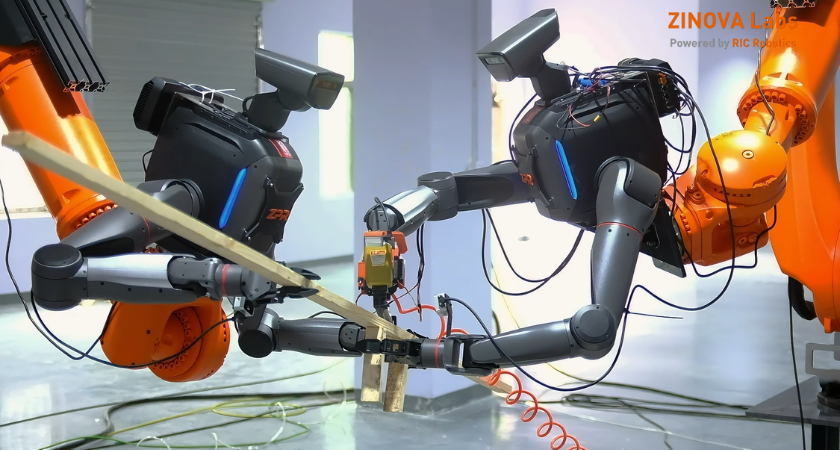
ZINOVA has formally launched as a Physical AI research and development company around an idea that may matter more than building another task-specific robot: teaching different robotic platforms to use tools designed for humans. The company calls the layer Tool Intelligence — hardware and software intended to help robots recognize, grasp, feel and operate existing tools across tasks and robot forms.
This is not another new robot
The key distinction is that ZINOVA is not introducing a single machine intended to replace a construction worker. It wants to build an execution layer that can sit on different robotic bodies. Its first public demonstration used systems associated with RIC Robotics and physical platforms from LimX Dynamics and KUKA. That flips the usual market logic: rather than engineering a new machine for each trade, ZINOVA wants robots to learn the existing tool ecosystem.
The three layers of Tool Intelligence
- Grasp / General Tool Grasp — research into recognizing, picking up and manipulating tools designed around the human hand.
- Feel / TEISI — a Tool–Embodiment Interaction Sensing Interface intended to capture force, torque, vibration, resistance, contact and material response between the tool, robot and environment.
- Form / The Third Form — research into robotic bodies designed around the work rather than human anatomy, potentially prioritizing reach, height or payload.
Why existing tools could be a shortcut to market
Construction companies, factories and maintenance teams already own an enormous installed ecosystem of tools, consumables, procedures and materials. If a robot can use what is already on site, deployment could require less custom infrastructure than a fully bespoke automation cell. That is still a hypothesis, not proven economics. Useful evidence will need to include grip durability, tolerance across tool variants, changeover time, work quality, safety and the frequency of human assistance.
The construction demo came earlier — that matters for deduplication
In early-September material, ZINOVA and LimX Dynamics showed a scaled tilt-up workflow using TRON 2, including formwork, multilayer rebar handling and tool use. That demonstration is therefore not a new 14 September breaking story. The fresh event is the formal launch of the company, the clearer architecture of Tool Intelligence and the definition of its three research areas. Keeping that chronology prevents a single demo video from being republished as multiple “new” events.
Human-governed autonomy instead of pretending full autonomy is here
The company’s launch messaging includes an important operating model: human-governed autonomy. ZINOVA argues that people can supervise edge cases while robots execute repeatable work and generate tool-interaction data. That is a more realistic route to commercialization than waiting for complete autonomy. It also means human supervision must be counted in the economics. Teleoperation or oversight can be a useful product feature, but it is still labor and should not disappear inside an “AI” label.
ZINOVA and RIC Robotics are connected but distinct
CEO Ryan Cox and founder Ziyou Xu have backgrounds with RIC Robotics. ZINOVA nevertheless describes itself as an independent R&D organization focused on early-stage Physical AI, validation models and experimental modules. Its relationship with RIC may give selected technologies a route toward jobsite testing and commercialization, while the companies retain different research and commercial priorities. That distinction matters when interpreting future demonstrations and deployments.
What we need to see before calling it a breakthrough
Pulling the trigger on a drill or nail gun is not enough. Tool Intelligence becomes valuable when one system can handle different brands and variants, worn tools, dirty environments, changing materials, imperfect placement and operator mistakes. Better metrics include success rate on unseen variants, tool-change time, interventions per operating hour, output-quality tolerance, recovery after failure and total cost per correctly completed work cycle.
A new user for power tools
There is a broader consequence for power-tool makers: the robot may become a new class of tool user. Handle geometry, digital control, telemetry, trigger repeatability, battery swapping, mechanical mounting points and APIs can start to matter as much as human ergonomics. Manufacturers could eventually design products for both hands and grippers. A “robot-ready tool” category may emerge before a truly general construction humanoid does.
Why Poland could be relevant
Poland’s construction and industrial base, labor constraints and large contractor ecosystem create a plausible future market for tool-using robots. That does not make ZINOVA a buyable solution today. There is no public price, Polish integrator, certified safety package or verified customer deployment. For now this is a strategic Physical AI topic rather than a purchasing recommendation.
What we still do not know
- pricing for modules or a Robotics-as-a-Service model;
- the supported tool and robot list in a production release;
- autonomy level on a real construction site;
- human interventions per operating hour;
- repeatability of work quality and cycle time;
- safety certification and an EU market path;
- whether the first paid deployments will be sold by ZINOVA, RIC Robotics or through a partner model.
RoboMorrow editorial assessment
The interesting part of ZINOVA is the inversion of the problem. Instead of asking how to build a separate robot for every job, the company asks how robots can use tools that already exist. That could become a valuable Physical AI layer. Today, however, we have a company launch and research demonstrations, not proof of scalable customer deployment. That is the standard we should use as this story develops.
Sources and methodology
ZiNova Labs — official launch post · ZINOVA press release, 14 Sep 2026 · Gasgoo — earlier TRON 2 demonstration, 4 Sep 2026. RoboMorrow verification: 15 September 2026.