ASTRA: Caltech Robot Assembles a Truss Bay in Orbit
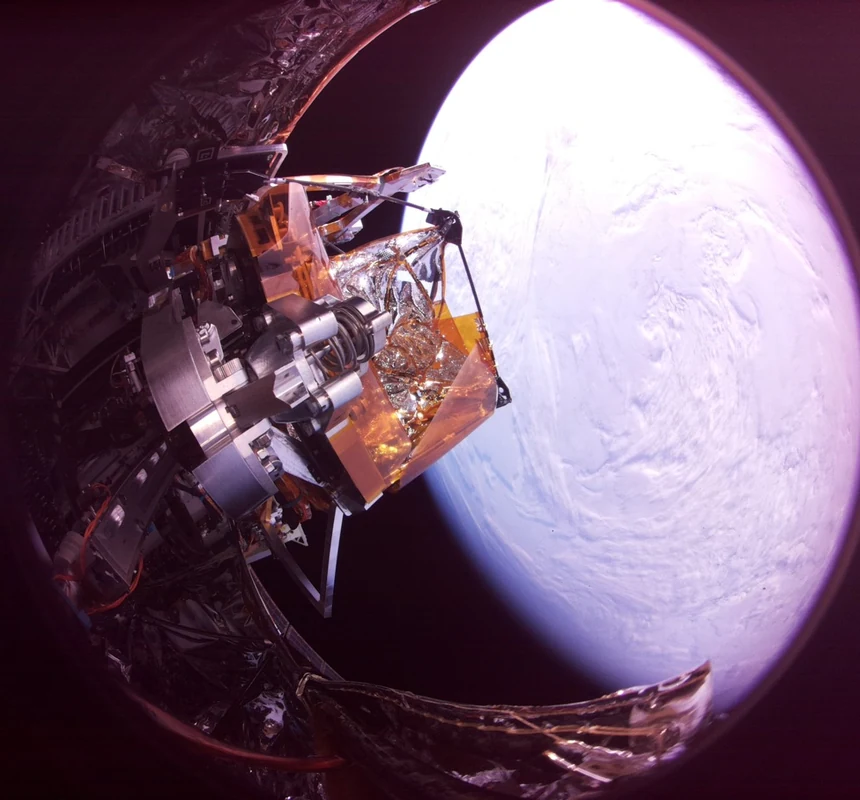
A Caltech robot assembled the third bay of a truss in orbit. That is the specific achievement reported by Caltech and DARPA on 5 November 2026. The first two bays were built on Earth and deployed after launch. The robot has not completed an entire antenna or built an operational space power station.
On this page
The distinction matters. Unfolding a structure assembled before launch and joining separate components in space solve different engineering problems. ASTRA demonstrated the second process at a limited scale. Here is what the result establishes, and what remains to be demonstrated.
What did ASTRA actually build?
ASTRA stands for Autonomous In-Space Tensioned Reflector Assembly, a demonstration in DARPA's NOM4D programme. The payload launched on 30 March 2026 aboard Momentus's Vigoride 7 vehicle on the SpaceX Transporter-16 mission. It carried preassembled sections, a manipulator and dispensers holding components for further construction.
After launch restraints were released and the two completed bays were deployed, the system assembled the third. The team sent commands from Earth and examined photographs of the results. This is automated execution of defined operations in a supervised experiment, rather than a robot choosing an arbitrary structure and building it without human involvement.
| Demonstrated | Not yet established |
|---|---|
| Assembly of a third truss bay in orbit | Completion of the entire reflector structure |
| Joining prepared struts and nodes | Manufacturing parts from raw material or 3D printing |
| Automation of manipulation sequences | Operation without ground commands, supervision or troubleshooting |
| A proof of concept in the space environment | A commercial service or a demonstrated economic return |
Watch the ASTRA assembly demonstration
Caltech's film introduces the project and assembly demonstration. Distinguish laboratory footage, illustrations of future applications and imagery from the mission. The featured photograph used here is an orbital image of actual hardware, rather than concept artwork of a future antenna.
Why assemble a structure in orbit?
Launching a large structure starts with a restricted space: the inside of a rocket. Designers can fold an assembly for transport and deploy it later, but the folding mechanism then becomes an important part of the design. Another approach is to transport smaller components and connect them where the structure will operate.
That changes the design question. Instead of asking only how to pack a completed structure, engineers can ask which components are easy to transport and reliably join. Mass, power and stability constraints remain. Some of the challenge moves from a single deployment event to an assembly operation that must work repeatedly.
The least spectacular parts may therefore be the most important: the gripper, dispenser, joint geometry and confirmation that a connection has succeeded. DARPA emphasises this mechanical integration. The achievement is not evidence that a humanoid form or a language model was required.
Autonomy supported from the ground
Caltech used a flight spare on Earth to reproduce problems encountered during the mission and test solutions before sending further commands. That working method is part of the engineering result. A physical counterpart makes it possible to investigate behaviour that a remote photograph cannot fully explain.
It also shows why the word autonomous needs context. A robot may execute movements automatically within a task while people choose the next steps, interpret faults and decide when to resume. Our guide to the operator's role in robotics explains why these distinctions matter when reading announcements.
What should the next demonstration prove?
Repeatability is the central question. One successful connection justifies further development, but a large structure needs many successful connections, reliable quality checks and a response to a failed step. As a sequence grows, detecting deviations before they prevent later operations becomes increasingly important.
For future updates, look for four measurements: completed bays, operator interventions, operating time and the method used to check each joint. Those details will make demonstrations comparable. A larger stated target diameter alone will not establish that the assembly process has become more dependable.
Related questions arise in terrestrial construction: can the machine perform the operation, how much preparation does it need, and what happens after a fault? Read about Origin OG-1 and preparing a robot for finishing work. The environments are very different, but separating a demonstration from repeatable operation remains useful in both cases.
Frequently asked questions
Has ASTRA finished an antenna?
No. Caltech reports assembly of the third bay, with the first two prepared before launch. The complete design has eleven bays. The team does not expect to finish the full truss before the mission ends in December.
Is the robot printing a structure in space?
Not in this demonstration. It joins prepared components. Producing material, assembling parts and unfolding a completed mechanism are separate processes.
When will this become a commercial service?
The reviewed sources do not give a commercial deployment date. The demonstration supports the feasibility of the approach, rather than the readiness of a product for purchase.
Sources
- Caltech: completed work and mission limitations, 5 November 2026.
- DARPA: NOM4D automated in-space assembly demonstration, 5 November 2026.
Sources checked 9 November 2026. Image: Caltech/Momentus. Film: Caltech. This article contains no sales offer or affiliate links for the demonstrator.