This robot sands walls. Origin is taking OG-1 towards European job sites
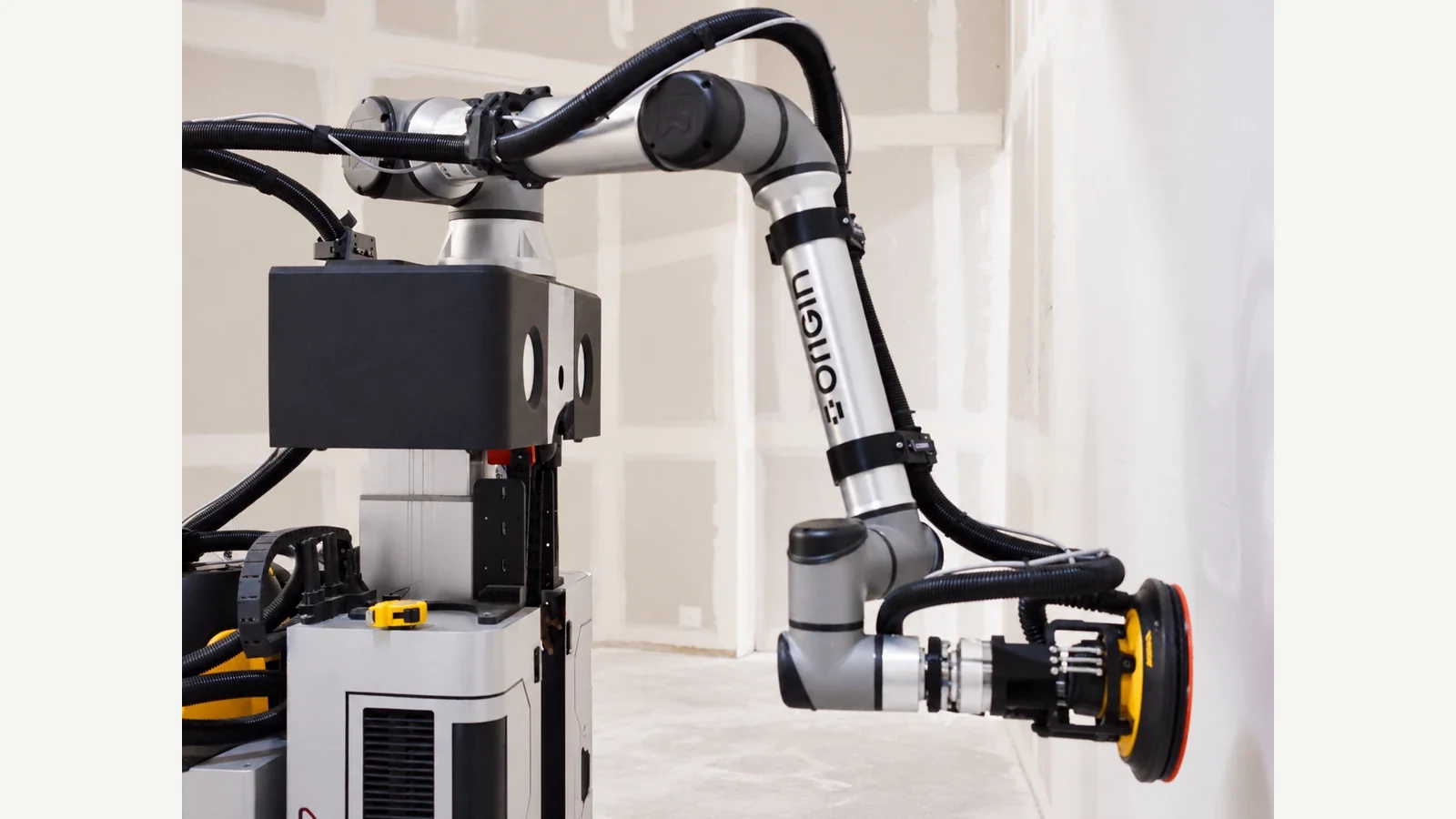
Sanding a wall, spraying compound and moving to the next work area: Origin shows its OG-1 robot doing jobs normally handled by an interior finishing crew. That is a useful starting point for construction robotics. The tool is making contact with a real surface, and the result has to be good enough for someone to accept.
The new development is Origin’s 15 October announcement: $20 million in funding and plans to expand its fleet. The company lists Germany, Sweden and France among its upcoming pilot markets. Its account of work on US construction sites and its claim of working at three times human speed remain manufacturer-reported evidence.
Watch the tool, not just the robot moving
Origin’s film takes viewers through room mapping, identifying wall surfaces and seams, applying compound and sanding with dust extraction. It makes the intended workflow easy to understand. The challenge is considerably broader than holding a sander against a fixed point.
On a job site, the transitions matter. A machine can move its head efficiently across a flat surface and still lose time during preparation or when an unusual detail needs attention. Look at who selects the work area, how tooling changes and what happens near an edge. Those moments determine how much work the machine actually takes over.
OG-1 should not be described as already installing entire walls. Drywall installation, drilling and further trades appear in the announcement as expansion plans. The current story is about surface finishing.
Pressure against the wall needs control
Origin’s product documentation describes a mobile base, interchangeable tooling and connected planning and motion-control systems. It lists a working reach of up to 14 feet, approximately 4.27 metres. For sanding, the manufacturer describes real-time control of contact force.
That matters more than a smooth-looking movement might suggest. Too much pressure can damage the surface; too little can leave an uneven finish. Effective tool use requires responding to contact rather than simply replaying a path through space. In our assessment, this is where robotics built around a particular trade begins to become useful: the system must account for what the tool is doing to the material.
The same issue appears in ZINOVA’s work on robotic tool intelligence. Gripping an existing power tool is only one part of the problem. The relationship between the tool, the robot and the workpiece also needs to be controlled.
Autonomy has a defined boundary
Origin’s product page also makes the human role visible. It includes map corrections, relabelling detected features and remote driving and docking. The press announcement identifies mapping and material replenishment as crew responsibilities. These details qualify the headline claim of autonomous wall finishing.
A sensible division of work may give people preparation and acceptance responsibilities while the machine performs a long sequence of repetitive passes. A deployment calculation must include both sides. Our explanation of teleoperation and the operator behind a robot explores that distinction.
What would “three times faster” need to mean?
Origin claims that its robot works at three times human speed. To turn that into a purchasing decision, the comparison needs a defined crew, finish quality, surface area and amount of supporting labour. The speed of a sanding head and the accepted area produced over a complete shift are different measures.
A useful pilot would track accepted surface area, rework, material use and the time people spend supporting the machine. Comparable rooms and a common inspection standard would make the result easier to assess. Even a gain below the promotional multiplier could justify a deployment if it removes strenuous work and delivers predictable quality.
Europe: announced pilots, without a Polish price list
The company targets 150 deployed robots by the end of 2027. That is a future objective, not the current fleet count. The sources reviewed do not provide a public price for a complete Polish deployment or a confirmed local sales channel. Named European pilots also do not establish general commercial availability.
OG-1 nevertheless points towards an interesting market for contractors and tool manufacturers. All3 recently showed Mantis using power tools; Origin draws attention to a longer finishing process. The most useful next evidence would come from a contractor measuring the machine by the finished wall it delivers. That would tell us more about the market than another impressive movement sequence.
Image: Origin’s official press photograph of OG-1 sanding. Video: Origin Autonomy. This is an editorial analysis of published material; RoboMorrow has not tested the robot on a job site.