Reuters: China researches humanoids for military use across 100+ documents
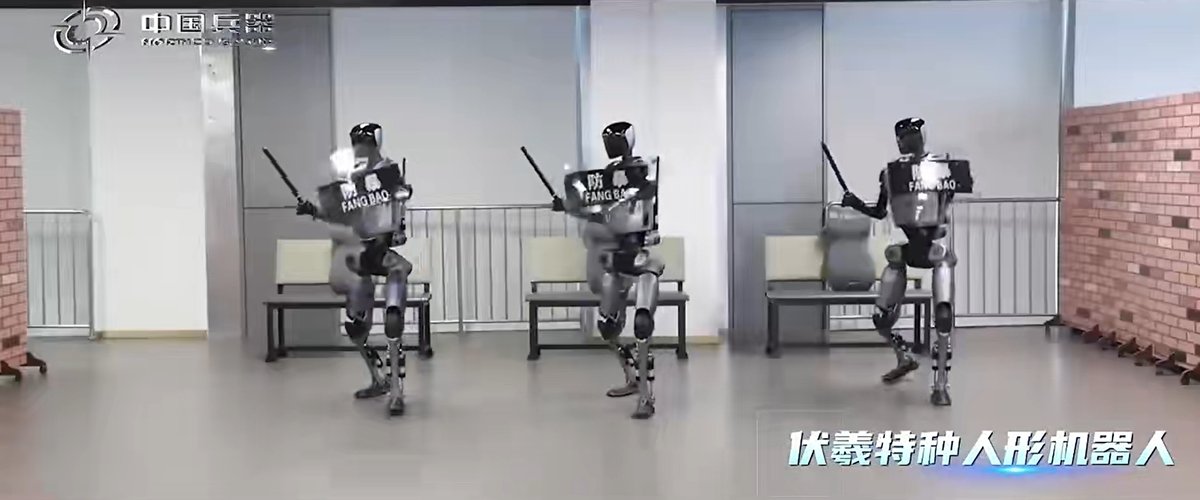
China's humanoid boom has a military branch as well. A new Reuters investigation shows institutions linked to the People's Liberation Army exploring humanoids for reconnaissance, patrol, support and potential battlefield roles. The review draws on more than 100 procurement notices, academic studies, patents, official publications, government records and defense-company materials.
The key conclusion is not that “robot soldiers are already on the battlefield.” Reuters explicitly says it found no evidence of an armed humanoid deployed with an operational PLA unit, while today's robots remain energy-intensive and unreliable outside controlled environments. What is new is the breadth and systematic nature of the interest: academic scenarios, procurement, training data and defense-industry platforms are beginning to connect.
What Reuters found in the documents
Reuters reports that activity accelerated during 2025 and 2026, with work focused on perception, manipulation and training data. The records describe research into reconnaissance, site security, hazardous-area tasks and ways robots could operate alongside troops.
One June 2026 procurement document budgeted roughly $300,000 for a system to collect and label camera, radar and motion data for humanoids, including information about traversable terrain. Reuters also stresses an important uncertainty: for several tenders, it could not determine whether purchases were completed, which suppliers won or which robot models were delivered.
Fuxi shows why teleoperation matters today
A concrete example is Fuxi, a full-size humanoid developed by state-owned defense group NORINCO. A People's Daily Online / Global Times report based on NORINCO material describes all-weather reconnaissance, intelligent patrol and hazardous-area operations among its intended tasks.
Crucially, Fuxi can use a dedicated teleoperation system. Human motion can be remapped to the robot in real time. That distinction is central to evaluating the technology: remote operation can let a machine enter a dangerous location without requiring the robot to solve the much harder problem of autonomous situational understanding.
Teleoperation is not autonomy
In humanoid coverage, the word “AI” can blur a basic line. A robot remotely controlled by a human may still provide substantial value by keeping the operator away from danger. It does not follow that the machine can independently interpret intent, distinguish complex human behavior or make decisions about force.
Reuters highlights the same limitation. Humanoids remain power-hungry and less reliable in uncontrolled environments than in laboratories or demonstrations. Human-like geometry may offer advantages inside buildings, tunnels and other spaces designed around people, but simpler wheeled, tracked or quadruped systems can often be cheaper and more robust for reconnaissance or logistics.
The hardest boundary is decision-making about force
Greater autonomy introduces a legal and ethical challenge that is harder than walking or manipulation. The laws of armed conflict require distinctions between military targets and civilians and appropriate treatment of wounded or surrendering people. Those judgments can depend heavily on context, behavior and intent.
RoboMorrow therefore does not treat every “combat humanoid” demonstration as evidence of an autonomous weapon ready for deployment. The important signal here is that Chinese institutions are building capabilities, datasets and operational concepts, not that the problem of responsible autonomous action in war has been solved.
How this changes the picture of China's humanoid market
Commercial coverage of Chinese humanoids has focused on factories, logistics, services, education, entertainment and data production. RoboMorrow has already mapped that broader commercial field after WRC 2026. The Reuters investigation adds another potential source of demand: defense research can fund perception, resilience, teleoperation and operation in difficult environments.
This does not mean consumer robotics companies automatically supply military-ready systems. It does mean components, models, sensors and control systems can advance in parallel across multiple sectors. Technology can move between civilian and specialist applications, and China's unusually broad robot manufacturing ecosystem creates many platforms on which such ideas can be tested.
What the documents do not prove
A large document set does not mean every program described will reach deployment. Some records are conceptual research, some are procurement requests and others describe capabilities projected years into the future. Reuters itself notes that it could not confirm winners or delivered models for several tenders. That is a crucial line between evidence of institutional interest and evidence of operational capability.
We also do not know how often tested humanoids rely on teleoperation, how resilient their communications are, how long they operate on battery under realistic load or how they recover from failures in unpredictable environments. Those gaps are precisely why the Reuters investigation is valuable as a map of investment direction but not as a battlefield-readiness benchmark.
What would qualify as a material update
RoboMorrow will not create another alert simply because a Chinese outlet publishes another Fuxi video or a new range demonstration. A material update would require a qualitatively different development: a confirmed large-scale contract, official fielding with a unit, a disclosed autonomy architecture with independent verification, or a significant regulatory decision governing these systems. Until then, additional demonstrations belong to the same underlying story.
Why Europe should care
For Europe, there is an industrial dimension and a regulatory one. China's scale in humanoid bodies and components may accelerate development when demand comes from sectors beyond consumer and industrial automation. At the same time, the maturation of Physical AI increases the need for clear accountability rules around autonomous and semi-autonomous systems in high-risk applications.
RoboMorrow view: this is a security and market analysis, not evidence of a deployed humanoid army. A material update would require confirmed operational deployment, a disclosed major contract, a significant new regulatory regime or a demonstrated shift from teleoperation to independently verified autonomy.