Beyond Unitree: 7 Chinese humanoid robots Europe should watch
World Robot Conference 2026 shows that China’s humanoid market is no longer a story about one or two companies. Reuters’ Beijing roundup spans vendors attacking very different niches: Unitree on scale and mindshare, UBTECH on services and industry, Leju on manufacturing, Galbot on warehouses and retail, Fourier on care, LimX on interaction and motion learning, and Robotera on logistics and manufacturing. For Europe, the breadth of this field matters more than another backflip.
WRC is still a trade show and demonstration stage. A robot appearing on a booth, sorting parcels in a video or carrying an “industrial” label is not the same as a paid deployment, multi-shift reliability or positive ROI. That distinction is especially important after Counterpoint’s latest data: global humanoid shipments exceeded 22,000 in H1 2026, yet more than 60% of volume still went to entertainment/performance and data production/research. Read the full Counterpoint breakdown →
Why this WRC matters more than another humanoid stunt
Reuters describes more than 300 exhibitors, over 2,000 exhibits and more than 150 product launches. In a separate report, the agency notes that investors and customers are increasingly asking about productivity, autonomy and return on investment rather than crowd-pleasing demos. That is the correct filter. A robot can look spectacular and still fail a process that requires 99.9% repeatability, safe human interaction, fast failure recovery and maintainable service.
1. Unitree: the benchmark for scale and pace
Unitree remains the most recognisable Chinese humanoid brand. R1 and high-speed “Superman” demonstrations attracted attention at WRC, but market-wise the installed ecosystem around G1/R1 and shipment scale matter more. Counterpoint reports more than 7,000 Unitree humanoids shipped in H1 2026, with a strong position in research and education. That creates something hard to replicate quickly: a large base of devices, users and operating data.
2. UBTECH Walker C1: a service humanoid rather than another factory-only robot
UBTECH positions Walker C1 as a full-size humanoid service robot. Its official page highlights a multimodal intelligence engine, world-model language, an SDK and use cases such as multilingual reception, tour guidance, shopping assistance, events and patrol. Those are manufacturer claims, but the portfolio strategy is notable: UBTECH separates commercial and industrial humanoids instead of pretending one platform is automatically optimal for every task.
3. Leju KUAVO: manufacturing is the credibility test
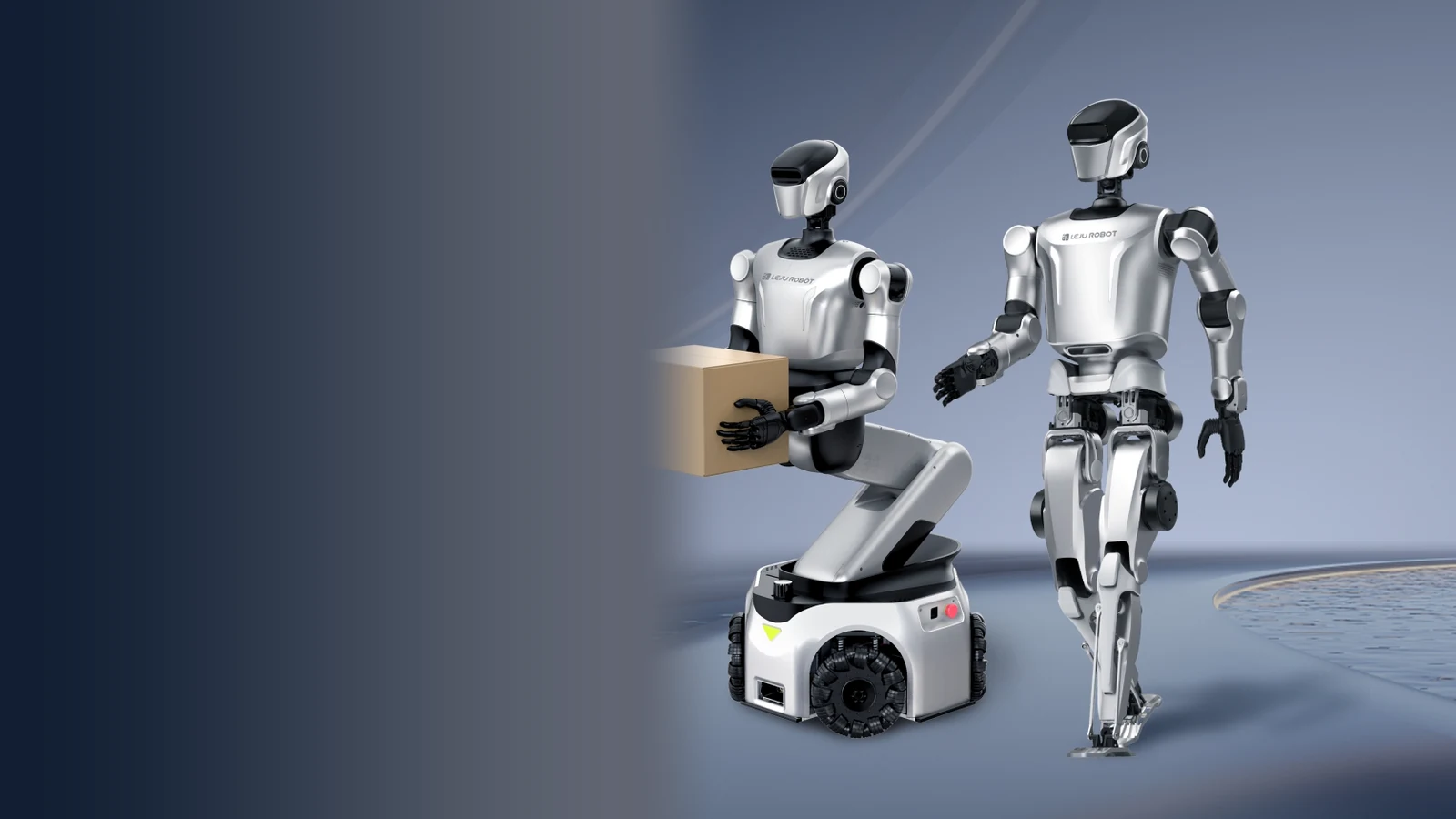
Leju describes KUAVO 5 for industrial manufacturing, patrol, commercial guidance, home services and research. Reuters highlighted KUAVO primarily as a humanoid aimed at industrial applications. That matters for Europe because the nearer-term value of humanoids may be less about a robot in the living room and more about high-mix factories where conventional automation can be hard to justify.
4. Galbot G1: wheels instead of legs, and a pragmatic trade-off
Galbot G1 looks humanoid above the waist but moves on a four-wheel omnidirectional base. Reuters describes it as a warehouse assistant. Official documentation states a 10 kg total payload, 8-hour claimed operating time, NVIDIA AGX Orin at 275 TOPS and a large reach envelope. Wheels reduce terrain flexibility but can improve stability, energy efficiency and simplicity in warehouses and pharmacies. See the Galbot G1 database card →
5. Fourier GR-3: care robotics has a different business equation
Fourier positions GR-3 as a “care-bot”: soft-skin interaction, care and education matter more than moving heavy totes. Official material lists a 165 cm body, 71 kg mass, 55 degrees of freedom and 3 kg single-arm payload. It is another sign that “humanoid” is segmenting into multiple product categories. A care robot will be judged by safety, user acceptance and interaction quality, not the same metrics as a logistics machine.
6. LimX Luna: motion learning and interaction as the product
LimX Luna is a roughly 160 cm full-size interactive humanoid. LimX emphasises multimodal interaction, task editing and video-to-motion capabilities. Reuters also highlighted its ability to learn motions by watching video. That may be directly useful in entertainment, museums and public venues, and indirectly useful as a data pathway for training more productive systems later.
7. Robotera L7: logistics and manufacturing, not humanoid lifestyle
Robotera’s L7 is aimed at logistics and manufacturing in both its own material and the Reuters WRC roundup. The company page lists 55 degrees of freedom and 20 kg combined arm payload. The decisive questions are not maximum payload but whether L7 can repeat a task thousands of times safely, recover from faults and learn a new SKU without an expensive integration project.
What these seven companies have in common
The shared trend is the attempt to turn hardware into a platform: SDKs, VLA/world models, data collection, teleoperation, learning from demonstration and vertical solutions. That makes sense because robot bodies are becoming easier to source and replicate. Competitive advantage will increasingly depend on how quickly a vendor turns a new task into a stable skill and how well it can operate and service a fleet.
The second trend is segmentation. “Humanoid” no longer means one product class. There are bipeds, wheeled humanoid mobile manipulators, soft-skinned care robots and smaller research/entertainment platforms. Comparing all of them with one “who has more DoF” table tells less and less about actual business value.
What Europe should watch
Europe retains deep strengths in industrial automation, machine safety, factory integration, drives and precision components. Chinese companies are demonstrating another advantage: the number of parallel experiments, iteration speed, domestic supply chains and the ability to test many scenarios quickly. If that combines with better model generalisation, hardware may scale faster than European companies can build equivalent full-stack platforms.
The answer is not necessarily for Europe to clone seven Chinese humanoids. A better question is where European companies can control high-value layers: safety, integration, grippers, drives, industrial software, process data, certification and service. Those layers will decide whether an imported body becomes a flashy appliance or a dependable production tool.
The key caveat: demo ≠ deployment
WRC is an excellent map of market direction and a poor benchmark of reliability. Most vendors do not publish comparable MTBF data, intervention rates, hours per shift, service cost or integration time. Without those numbers, it would be misleading to call any of these seven robots “the best.” This article is a map of vendors and strategies, not a performance ranking.
Sources and verification
The primary roundup is Reuters — Chinese companies to watch at WRC 2026, cross-checked with official material from UBTECH, Leju, Galbot, Fourier, LimX and Robotera. Verified 21 August 2026.