Humanoid shipments top 22,000 in six months — but most still are not working in factories
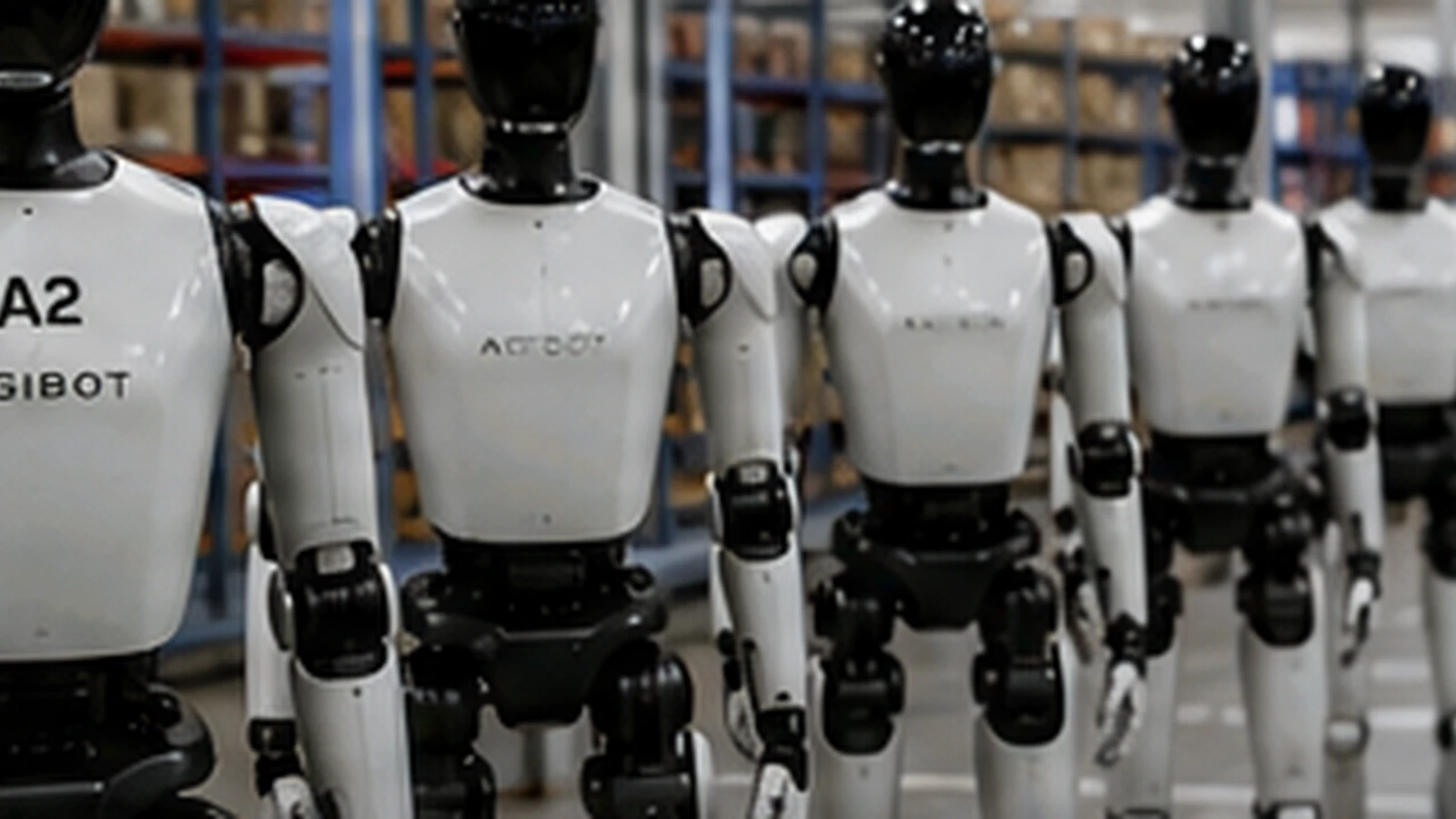
Global humanoid robot shipments exceeded 22,000 units in the first half of 2026, rising nearly 300% year over year, according to Counterpoint Research’s latest public tracker. AGIBOT shipped about 9,700 units for 43.1% share, while Unitree shipped more than 7,000 for 31.1%. Together they represent 74.2% of the market.
At first glance, that looks like a transition to mass commercialization. The application breakdown tells a more complicated story. Entertainment & performance accounts for 33.6% of shipments and data production & research another 27.0%, for a combined 60.6%. Intelligent manufacturing represents 12.8%, warehousing & logistics 4.9%, and service & guidance 19.0%.
22,000 shipped robots do not mean 22,000 robots working a production shift
This is the key caveat. A shipment shows that hardware moved into the market, but it does not reveal whether a robot works autonomously eight hours per day, participates in a pilot, collects training data, performs at events or supports research. Rapid unit growth is strong evidence that hardware and supply chains are scaling, but not yet proof that productive deployments have reached the same level of maturity.
AGIBOT and Unitree control almost three quarters of shipments
Counterpoint ranks AGIBOT first at 43.1% share and around 9,700 shipments. The company develops three main families — A, G and X — with smaller X-series robots widely used in entertainment, services, research and data production. On the industrial side, Counterpoint points to G2 deployments with Longcheer Technology and Joyson Electronics.
Unitree remains number two at 31.1% share and more than 7,000 shipments. The G1 is its primary volume driver and retains a strong position in research and education. That distinction matters: a large number of G1 units sold does not automatically mean the same number of robots are performing productive tasks in factories.
Galbot ranks third at 5.0% with more than 1,100 units, followed by UBTECH at 4.4% and Leju at 2.9%. The top five together account for 86% of global shipments. All five are Chinese companies, which demonstrates supply concentration, but it does not mean that “China has 86% of the market” — the remaining 13.4% is simply grouped as “others”, so the chart does not provide an official country-level share for China.
Where are the humanoids going?
Counterpoint’s application split is more informative than the headline shipment number. Entertainment & performance represents 33.6%, data production & research 27.0%, service & guidance 19.0%, intelligent manufacturing 12.8%, warehousing & logistics 4.9% and other uses 2.7%.
Two processes are happening in parallel. Small humanoids have become real products for performances, education, laboratories and data centers. Manufacturing and logistics are also growing, but they still account for a minority of volume. This explains how the sector can report triple-digit shipment growth while still acknowledging bottlenecks in generalization, reliability and labor economics.
Counterpoint expects more than 50,000 units in 2026
The firm projects global humanoid shipments to exceed 50,000 units for full-year 2026, representing roughly 210% year-over-year growth. Counterpoint also expects service and industrial use cases to replace entertainment and data/research as the main demand engines over the next five years.
That is an analyst forecast, not a guaranteed production plan. Other trackers also show a different market size. Smart Analytics Global estimates H1 at about 19,100 global shipments, while a Committee of 100 report presented at WRC says China alone shipped more than 40,000 humanoids. The gap is too large to treat the figures as mutual confirmation; product scope and shipment definitions remain inconsistent.
Why this matters for Europe
For Europe, the important issue is not simply which vendor tops the ranking. Volume at AGIBOT, Unitree and other Chinese manufacturers accelerates supplier development in drives, gearboxes, batteries, sensors and electronics and allows faster hardware iteration. If that scale continues, European companies will compete not only with finished robots but with an increasingly cost-efficient component and tooling ecosystem.
Counterpoint’s own data also shows why the race is not over. Shipment dominance is not the same as productivity dominance. Europe still has deep capabilities in automation, safety, industrial integration and demanding manufacturing processes. The decisive step will be converting those strengths into deployments where robots work for long periods, repeatably and with measurable ROI.
What to watch instead of shipments alone
- the share of robots operating regularly in production and logistics rather than only in pilots;
- autonomous operating hours and human intervention rates;
- success rates over long-duration tasks rather than short demonstrations;
- MTBF, service cost and recovery time after failures;
- repeat deployments across multiple customers without full retraining and reintegration.
If those metrics start rising together with unit volume, 22,000 will look like the beginning of real economic scale. For now, the new report is best read as evidence that humanoid manufacturing is scaling very quickly while productive deployment is still trying to catch up with the hardware.
Sources and verification
This article is based on Counterpoint Research — Global Humanoid Robot Shipments, H1 2026. For methodology context, we also compared public data from Smart Analytics Global and the Global Times report on the Committee of 100 dataset. Market figures are source estimates, not an independent RoboMorrow audit. Verification: 21 August 2026.