Why Perseverance has different wheels from Curiosity
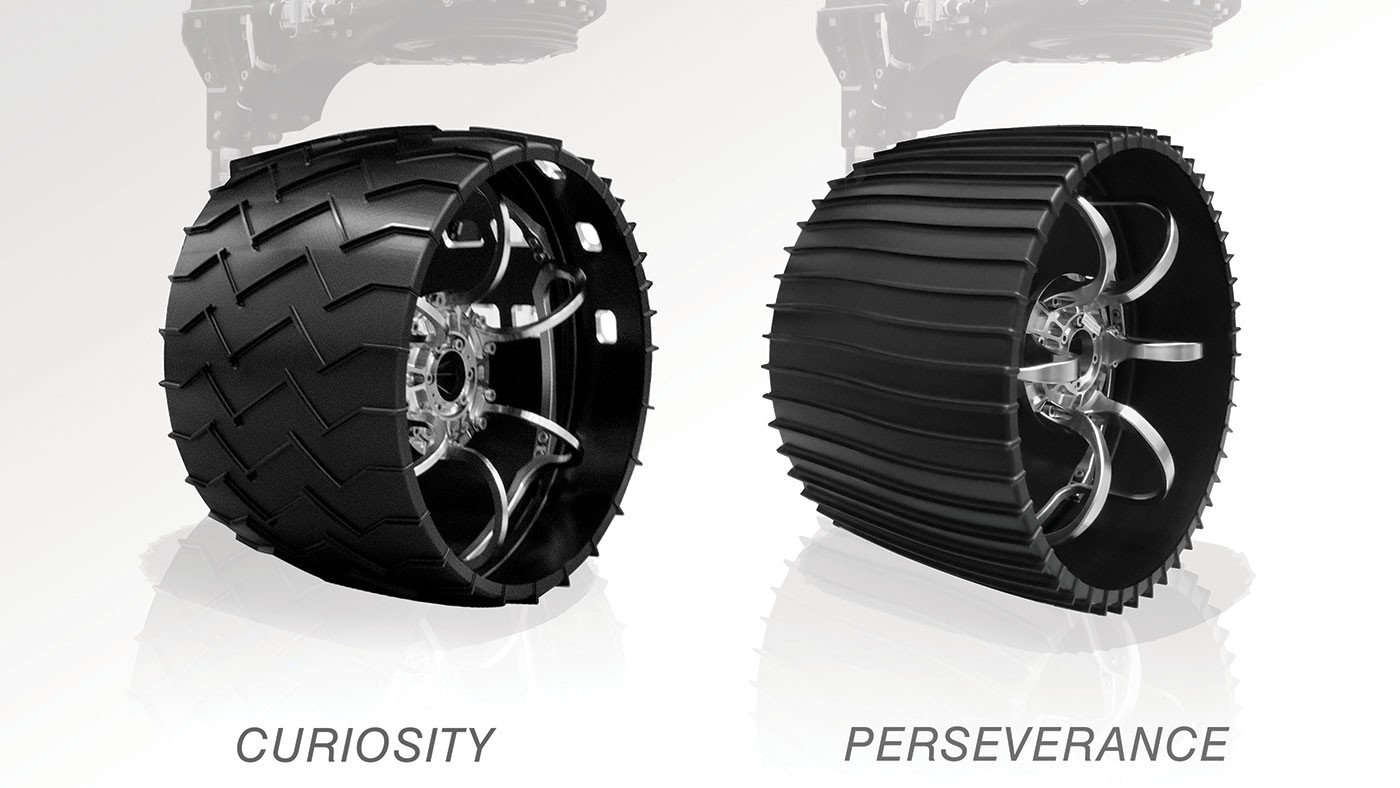
Curiosity wheel at left and Perseverance wheel at right showing their rib patterns. NASA/JPL-Caltech.
Sharp rocks took a toll on Curiosity’s aluminium wheels. For the next rover, engineers could change the size of the wheel, the thickness of its skin and the shape of the raised ribs. NASA’s side-by-side illustration makes some of those changes easy to see. Others only become apparent when you read the engineering description.
Two wheels drawn to the same scale
| Feature | Curiosity | Perseverance |
|---|---|---|
| Diameter | 50.8 cm | 52.6 cm |
| Raised ribs per wheel | 24, in a chevron pattern | 48, with a gentle curve |
| Width and skin | Wider wheel, thinner aluminium | Narrower wheel, thicker aluminium |
Which change is largest?
Diameter increased by 1.8 cm, about 3.5% relative to Curiosity. The rib count doubled. On a quick glance, the new wheel can look like a scaled-up version of the old one. Count the ribs along a similar arc on either wheel and the difference in the surface that meets the ground becomes apparent.
What does each wheel motor do?
Each of Perseverance’s six wheels has its own drive motor. The front and rear pairs also have steering motors. Turning the wheel to face a direction and rolling it along the ground are separate jobs. The rover can follow an arc or change its heading in place. Counting wheels alone tells you little about those manoeuvres.
How to read a field robot specification
Twice as many ribs would be a poor basis for predicting twice the service life. That claim would need comparable distances on similar terrain, along with load and damage records. When comparing mobile robots, record geometry, steering arrangement and observed wear separately.
Related reading
- How RoboMorrow rates robots: availability, autonomy, economics and safety
- A robot dog patrols a warehouse in Poznań. What does it inspect?