Your burger could arrive by robot. Deliveroo plans Coco’s UK launch
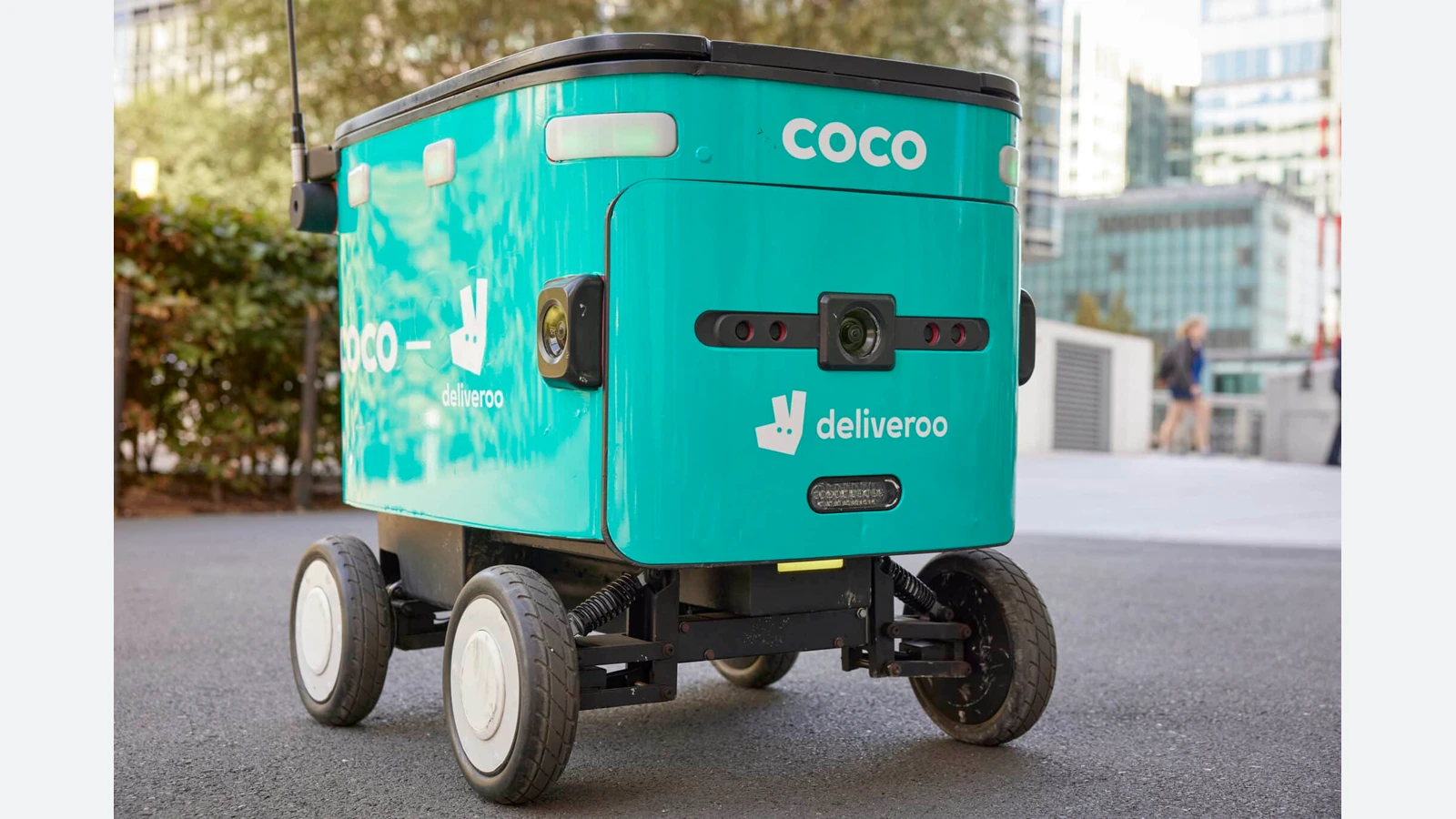
You order a burger, and a wheeled container approaches along the pavement. Deliveroo and Coco Robotics want to bring that experience to the UK: their 5 October announcement names London’s Canary Wharf as the first location, with a start planned for October. This is a concrete service announcement, although it does not yet establish availability at every address.
One part of London first, more cities later
Canary Wharf Group specifies a 12-month trial. Milton Keynes, Leeds, Stockton-on-Tees and Nottingham are also on the expansion list. They are expected to follow over the coming weeks and months; the announcement does not mean five complete networks launched together.
The initial restaurant list includes Patty&Bun, Signorelli and Beam in Wood Wharf. For customers, the practical questions will be which addresses and restaurants are covered. A city’s appearance on an expansion map does not by itself make robot delivery bookable.
What does the robot actually do?
Coco is an electric vehicle for short pavement deliveries. According to Deliveroo, it travels at walking pace, uses cameras, sensors and AI navigation, and processes environmental data on board. The announcement also includes supervising operators. It does not disclose how frequently they intervene.
Coco’s general community page still describes remote pilots. We do not automatically apply that description to every UK journey, but neither do we equate “autonomous” with operating without human involvement. Our explainer on robot teleoperation examines that distinction.
Riders remain central to the service
The partners say human riders will continue to fulfil most orders. Robots are intended for a share of short routes. In Coco’s service workflow, restaurant staff load the order into a lockable compartment and the recipient removes it. Automating the journey still leaves work at both ends.
That matters to restaurant owners. The benefit needs to be measured across the entire order: loading, waiting, travelling and collection. A short drive is less useful if staff wait around with prepared food or customers struggle to retrieve an order.
The real test is fitting into city life
In our assessment, success depends on less photogenic details: yielding to pedestrians, handling a blocked pavement and resolving collection problems. Completed-delivery rates, intervention frequency and actual cost per order would make this deployment assessable. Those results have not yet been published for the new UK rollout.
There is another interesting element: East Midlands CCA describes the BlindSquare partnership, through which obstacle information is intended to help blind and partially sighted pedestrians. That is a project objective; the practical benefit also deserves measurement.
See our Coco robot profile and restaurant robotics guide. The UK plan covers selected local service areas. Service terms and availability need to be confirmed for each location. Customers and businesses should check the local service area before making plans.
Sources and verification
- Deliveroo — 5 October 2026 announcement and navigation notes
- Coco Robotics — UK partnership announcement
- Canary Wharf Group — 12-month trial
- East Midlands CCA — Nottingham pilot plans
- Coco Robotics — delivery-service workflow
- Coco Robotics — operators and community
Verified 7 October 2026; the announcement was published on 5 October. Reporting is based on partner and local-institution materials, not a RoboMorrow delivery test. Photograph: Deliveroo / Coco Robotics, press material published by East Midlands CCA.