Restaurant robots in 2026: waiter, delivery or cleaning — where is the ROI?
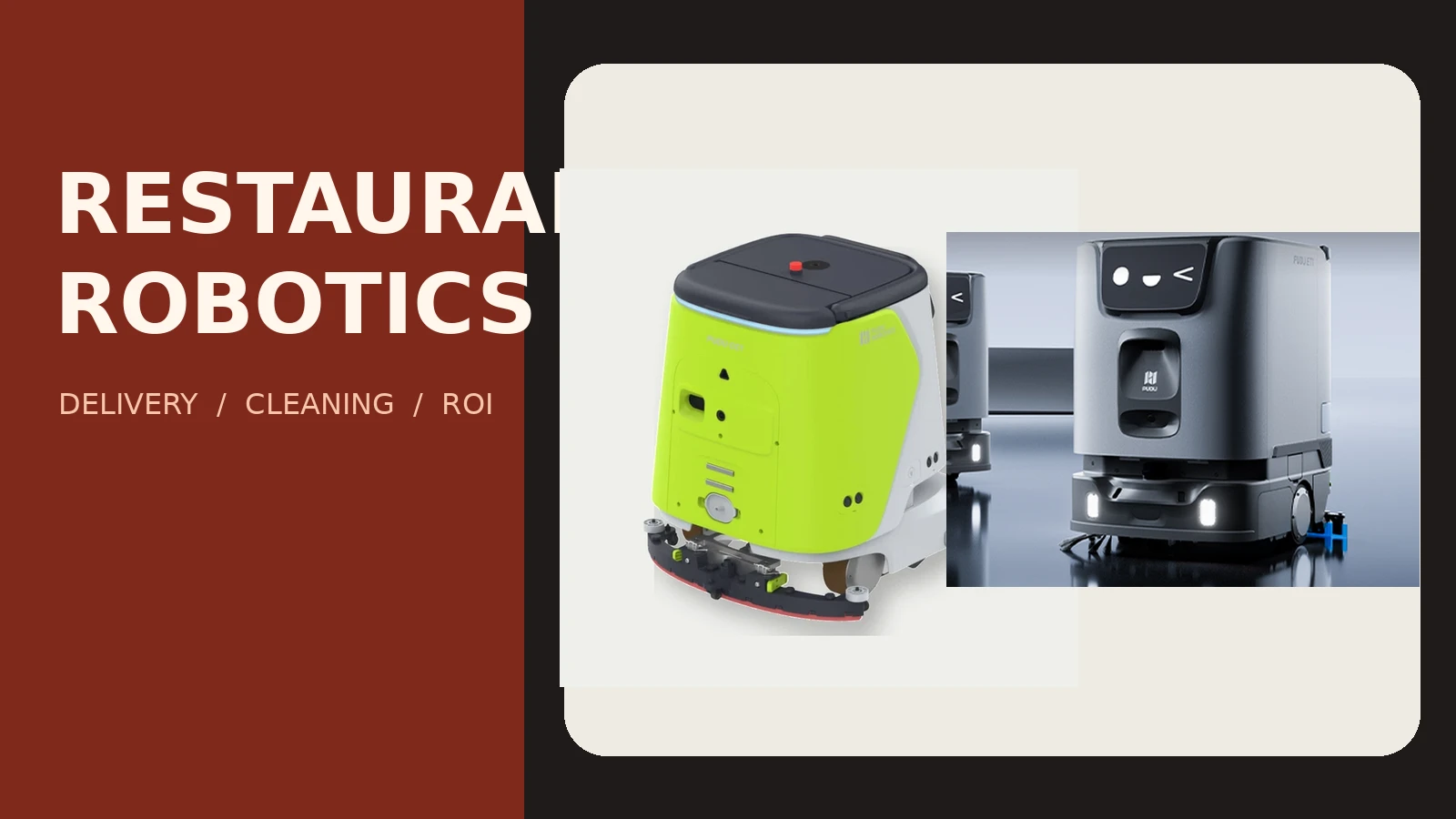
Restaurant robots are most often associated with a “robot waiter” carrying plates between the kitchen and tables. That is only part of the picture. In 2026, restaurants can automate food delivery, dish return, floor cleaning, greeting and some back-of-house logistics. These tasks do not all produce the same return on investment.
Start with the bottleneck
A robot is most valuable when it solves a defined problem: waiters walk too many kilometres, peak periods lack staff for dish return, or floors require regular cleaning between shifts. Buying a robot purely because it attracts customer attention creates short-lived marketing value but a weak automation case.
1. Food delivery: the robot as an autonomous cart
Catering robots can carry multiple trays and travel between kitchen, service station and defined table locations. The strongest operating model is not to remove the waiter but to reduce unproductive walking. People remain responsible for guest interaction, selling, exceptions and service quality.
A pilot should record trips per hour, average distance, waiting time in narrow passages and the number of situations where the robot obstructs staff rather than helping them.
2. Dirty-dish return
Returning plates to the wash area can be even more repetitive than delivering prepared food. A transport robot can serve as a mobile dish-return point and travel back to the kitchen when loaded. In larger venues, this can reduce heavy repetitive walking for staff.
3. Cleaning: easier to measure than a “robot waiter”
Autonomous cleaning robots such as PUDU ET1 and the larger PUDU CC1 have a simpler economic model because results can be measured in square metres, minutes and interventions. ET1 targets smaller, tighter venues; CC1 is designed for larger commercial floor areas.
Restaurants are difficult environments: chairs move, guests walk unpredictably and greasy or wet contamination appears. A robot should therefore be tested during realistic operating conditions, not only on an empty floor before opening.
4. Greeting and marketing
A screen-equipped robot can provide directions, show menus or promotions and support queues. This makes sense mainly when connected to a real process. Novelty fades quickly, and a screen on wheels should not be valued as if it were labour automation.
What does PUDU's approach show?
PUDU's restaurant-automation model combines delivery robots, dish-return solutions and cleaning machines. This is manufacturer material and should be treated as an ecosystem description rather than independent proof of savings. Operationally, however, the logic is sound: restaurants have several different movement flows, so one machine does not need to solve everything.
How do you calculate delivery-robot ROI?
Count staff trips during peak hours and average trip duration. Then measure how many the robot genuinely takes over without assistance. If it saves two hours of walking but needs 1.5 hours of charging, cleaning, repositioning and intervention, the gain is small. If it saves several staff hours and needs only a few minutes of attention, the model becomes much more interesting.
How do you calculate cleaning ROI?
Measure floor area, daily cycles, manual cleaning time and the percentage that remains manual. On restaurant floors, outcome matters as well: whether the surface is dry after a pass, how sticky stains are handled and how often staff must clear obstacles.
Questions to answer before a pilot
- Are aisles wide enough when the restaurant is full?
- Can the robot stop safely for a child, bag or suddenly moved chair?
- How many intervention minutes occur per operating hour?
- Where will the robot charge and be serviced?
- Does the local partner stock wear parts and provide fast service?
- Can the venue run a pilot before committing to purchase?
Which robot should come first?
For many venues, the first robot should not be a robot waiter. If regular cleaning or dish transport is the bigger cost, a specialised machine may deliver a faster and easier-to-measure result. Delivery robots become most attractive in larger restaurants with long kitchen-to-floor routes.
RoboMorrow conclusion
Restaurant robotics makes sense when it removes repetitive transport or repetitive cleaning, not guest interaction. The right metric is not how many customers photograph the robot, but how many staff minutes are recovered per shift while maintaining service quality. The best project starts by measuring the process and only then choosing a model.