Figure 03 walked 348 miles in nine days. The most important detail is the cable
ROBO/MORROW / ENDURANCE TEST / FIGURE / 19 OCTOBER
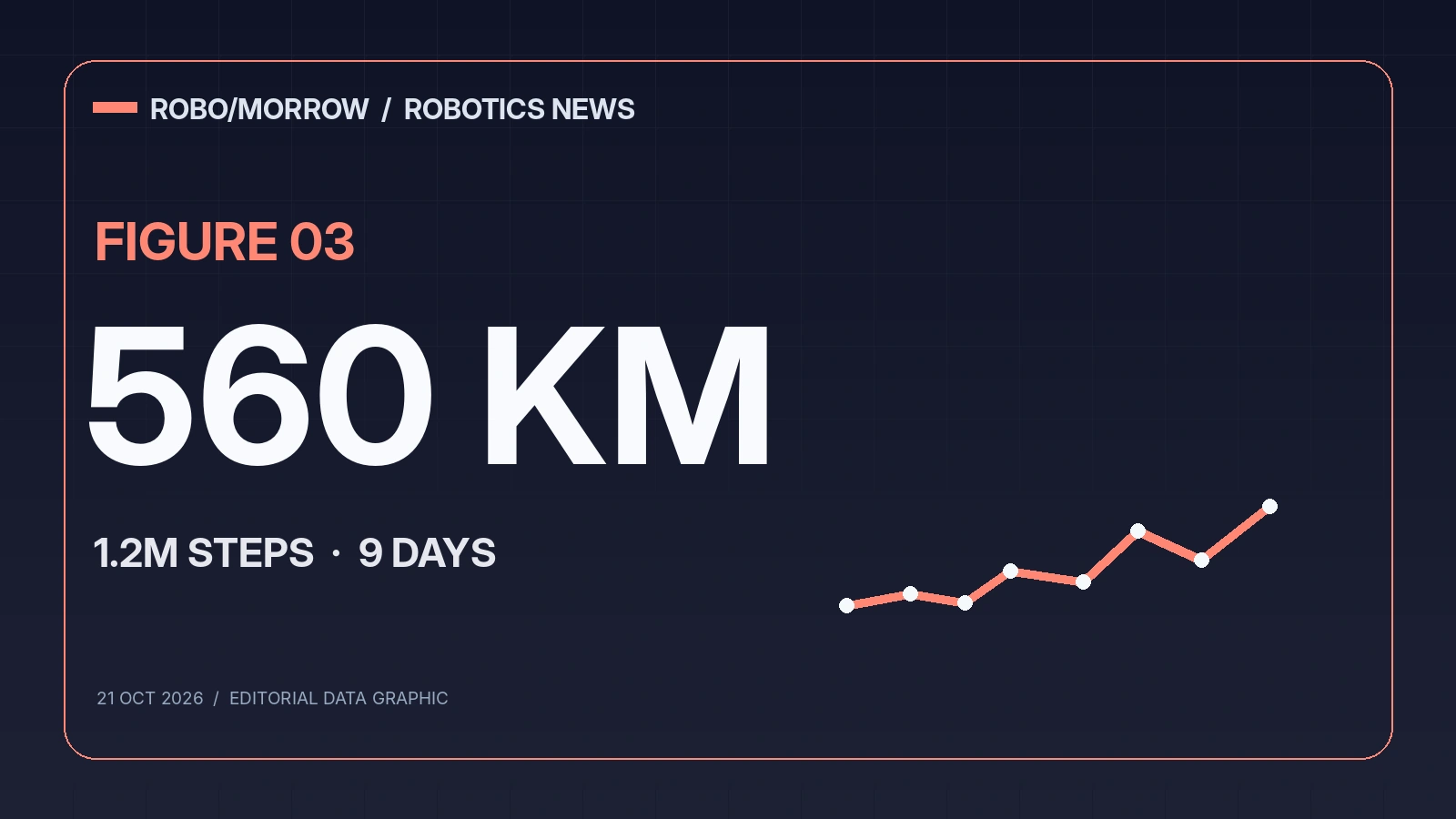
Nine days, 348 miles (roughly 560 kilometres) and 1.2 million steps. Those are the figures shared by Figure AI founder Brett Adcock on 19 October. A Figure 03 humanoid was walking on a treadmill in an extended stress experiment. The result matters for mechanical reliability, but it should never be described as nine days of operation on a single battery charge.
ORIGINAL FIGURE CEO VIDEO
Brett Adcock: Figure 03 — 9 days, 348 miles, 1.2M steps
View the original Figure 03 video on X
X embeds depend on browser privacy settings. The link opens the original post directly.
What exactly happened on the treadmill?
Adcock posted footage of a Figure 03 walking at a steady pace inside a test facility. He said the trial began as a side project intended to stress the robot until possible failures became apparent. As of his update, the company reported nine straight days, 348 miles and 1.2 million steps. These are manufacturer-reported figures, not results from an independently documented laboratory trial.
A treadmill is intentionally unlike a busy factory or public pavement. It enables a highly repetitive gait without stairs, unexpected obstacles or switching between different manipulation tasks. That is the point of a controlled mechanical endurance experiment: push one type of workload far beyond a conventional product demo.
Why 1.2 million steps is meaningful
Extended tests can expose rising motor temperatures, transmission play, bearing wear, connection fatigue and instability in a control loop that short clips will never reveal. A research team can monitor whether the hardware keeps executing the target gait consistently over millions of repeated loading events. Figure has not published the underlying measurements needed for independent assessment of those possible findings.
The public statement does not answer key protocol questions: were parts replaced, were there maintenance interventions, did one unchanged unit complete every step, and were there pauses? Until those are documented, the nine-day milestone should be treated as a strong self-reported engineering signal rather than a standardized reliability benchmark.
The visible cable is a crucial distinction
A power cable can be seen attached to the humanoid. That changes the meaning of the headline: nothing in the video establishes that the robot completed the run using only an onboard battery. The complete power and maintenance configuration is not published, so the appropriate description is a long-duration walking stress test.
Battery runtime, durability, uptime across a shift, charging logistics and successful autonomous task cycles are separate metrics. A robot can walk for a great distance on a treadmill and still encounter unresolved challenges when it needs to pick, carry, recover from an error or navigate a cluttered workspace.
Does it bring humanoids closer to deployment?
Yes, as one part of engineering qualification. Operations leaders need confidence that joints, drivetrains and software can survive thousands of hours before the machines move into production. Controlled testing is also a way to identify failure modes before customers experience them.
But buyers should require data from actual workflows. Other Figure demonstrations have focused on logistics and manipulation; the treadmill experiment measures something different. Useful work must be assessed in completed units per hour, human interventions, service costs, safe operation and recovery performance.
What Figure should publish next
The most useful follow-up would include unit identity, component condition before and after, interruptions, any part replacements, power method and failure logs. A comparable mixed-terrain test and audited workplace uptime figures would make this result far more actionable.
Read the 348-mile claim as a mechanical endurance milestone, not a nine-day autonomy milestone. It is still one of the most instructive humanoid stories of the week, precisely because it shifts the focus from a flashy stunt to a difficult reliability problem.
Frequently asked questions
Did Figure 03 walk nine days on one charge?
No such claim is established; the footage shows a power cable and does not include a full energy protocol.
How far did it walk?
Figure CEO Brett Adcock reported 348 miles, about 560 kilometres, on a treadmill.
Does it prove warehouse readiness?
No. Long-duration walking reliability is different from task autonomy, uptime and manipulation quality in a working facility.
For a different evidence category, our earlier coverage examined the Figure Index training-data platform; it is not proof of this treadmill result. Figure Index analysis.
Sources and verification
- Brett Adcock — oryginalne nagranie i deklaracja
- Figure AI — specyfikacja Figure 03
- Interesting Engineering — opis testu i zasilania
- Benchmark.pl — relacja 20 października
RoboMorrow did not independently test Figure 03. Distance and step totals are attributed to Figure AI’s founder.
By RoboMorrow Editorial · sources checked 21 Oct 2026