Figure and Nscale Commit $3.5B in Compute for Helix, Up to 100,000 GPUs
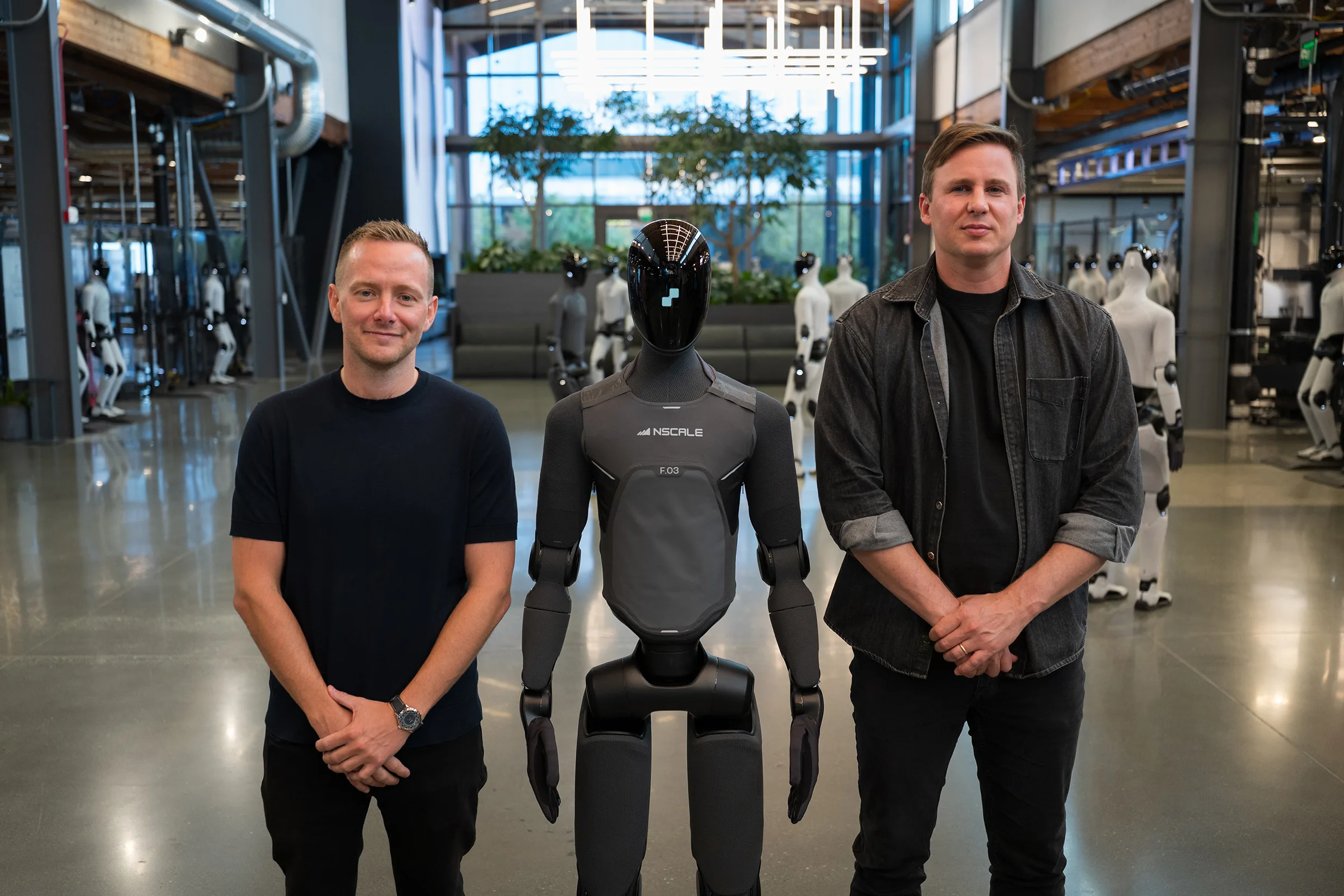
Verified on the evening of 3 September 2026. Figure and UK-based AI infrastructure company Nscale have signed a multi-year partnership that shows how rapidly humanoid economics is expanding beyond robot hardware into data, GPUs and power. The agreement includes an initial $3.5 billion compute commitment, with an intent to scale beyond $6 billion. This is not a $3.5 billion funding round for Figure and should not be described as one.
Up to 100,000 GPUs — not 100,000 GPUs today
The parties describe potential deployment of the NVIDIA Vera Rubin platform for up to 100,000 GPUs. Initial GPUs are targeted to begin deployment in the second half of 2027 in Barstow, Texas. “Up to” matters: Figure does not have that cluster today and the announcement does not say all 100,000 accelerators will arrive in one tranche.
Nscale is set to become Figure's preferred compute provider and is also making a strategic equity investment in the robotics company. The size of that investment was not disclosed. Figure therefore gains both future infrastructure access and a new shareholder, while the hardest public number remains the $3.5 billion initial compute commitment.
Why Figure wants this much compute
Figure directly connects the agreement to training future generations of Helix. The company says it has entered a phase where progress is largely constrained by two resources: data and compute. That fits with Figure Index, announced earlier. Figure says Index is generating around 35 minutes of training data every second. RoboMorrow already covered Index separately; the Nscale agreement is a material new layer of the same strategy rather than a duplicate story.
As with conventional AI, a larger dataset and GPU cluster do not automatically guarantee a better product. Robotics adds demonstration quality, environment diversity, safety, sim-to-real transfer and mechanical reliability. The $3.5 billion commitment is not proof that Helix will reach any specific autonomy level; it is evidence of the scale of resources Figure intends to apply to the problem.
NVIDIA's “physical AI flywheel”
NVIDIA describes the setup as a loop: train Figure models on Vera Rubin through Nscale, validate them in NVIDIA Isaac Sim, then deploy models on NVIDIA GPUs in Figure robots. That is the partners' infrastructure vision, not an independently measured humanoid productivity benchmark.
Training and inference also need to be separated. A huge cluster may accelerate experimentation, world models and reinforcement learning, while a robot in a factory or home still has to operate within limits on energy, latency, bandwidth and safety. Commercial success will depend not only on training cost, but on the cost and reliability of each productive robot hour.
Will Nscale actually deploy humanoids?
The partners say they will explore the potential to scale Nscale's supply chain with humanoids. That is not a signed deployment for a specified number of Figure 03 robots. There is no published site, KPI or rollout schedule. Editorially, “explore the potential” must not become “Nscale will deploy Figure robots.”
Why Europe should care
Although the initial infrastructure is planned for Texas, Nscale is headquartered in the UK and the deal highlights the growing role of European AI-infrastructure operators in the global Physical AI race. For Europe, competitive capacity increasingly means not only robots and components but power, data centres and access to GPUs for training.
The economics are significant too. When one humanoid developer signs compute commitments measured in billions of dollars, the barrier to entry is no longer just building good actuators and a body. Data, infrastructure and long-term compute contracts become part of the moat.
What we watch next
The next meaningful checkpoints are the actual first-tranche GPU count in 2027, Barstow deployment pace, terms of Nscale's equity investment and measurable Helix improvements. If Figure publishes task-success metrics, lower intervention rates or new customer deployments linked to the expanded training stack, those are material updates. A higher headline ceiling without newly deployed infrastructure should not create another standalone story.
RoboMorrow view: publish this as Physical AI infrastructure news. It is not “Figure raised $3.5 billion”; it is a multi-year compute commitment plus an undisclosed-size strategic investment by Nscale.
Compute scale is not robot-fleet scale
There is no simple conversion from “billions of dollars of compute” to a specific number of humanoids. Model training cost is spread across a fleet and multiple software generations, while robot production separately requires factories, actuators, batteries, electronics and service. The Nscale agreement therefore does not tell us how many Figure 03 units will reach customers in 2027 or 2028. It does show that Figure is building infrastructure for more frequent model training and iteration, pushing Physical AI closer to the infrastructure economics of frontier generative-AI labs.
The utilisation of the cluster will matter as much as its headline size. Future disclosure of experiment throughput, training-cycle time, cost per model or measurable reductions in human intervention would make it possible to evaluate the productivity of the investment. Without such metrics, GPU count is evidence of ambition and contracted capacity, not final robot performance.
Sources: Figure — primary announcement, Nscale — primary announcement, RoboMorrow — Figure Index.