Frameless Window Cleaning Robots 2026: Safety & Compatibility Guide
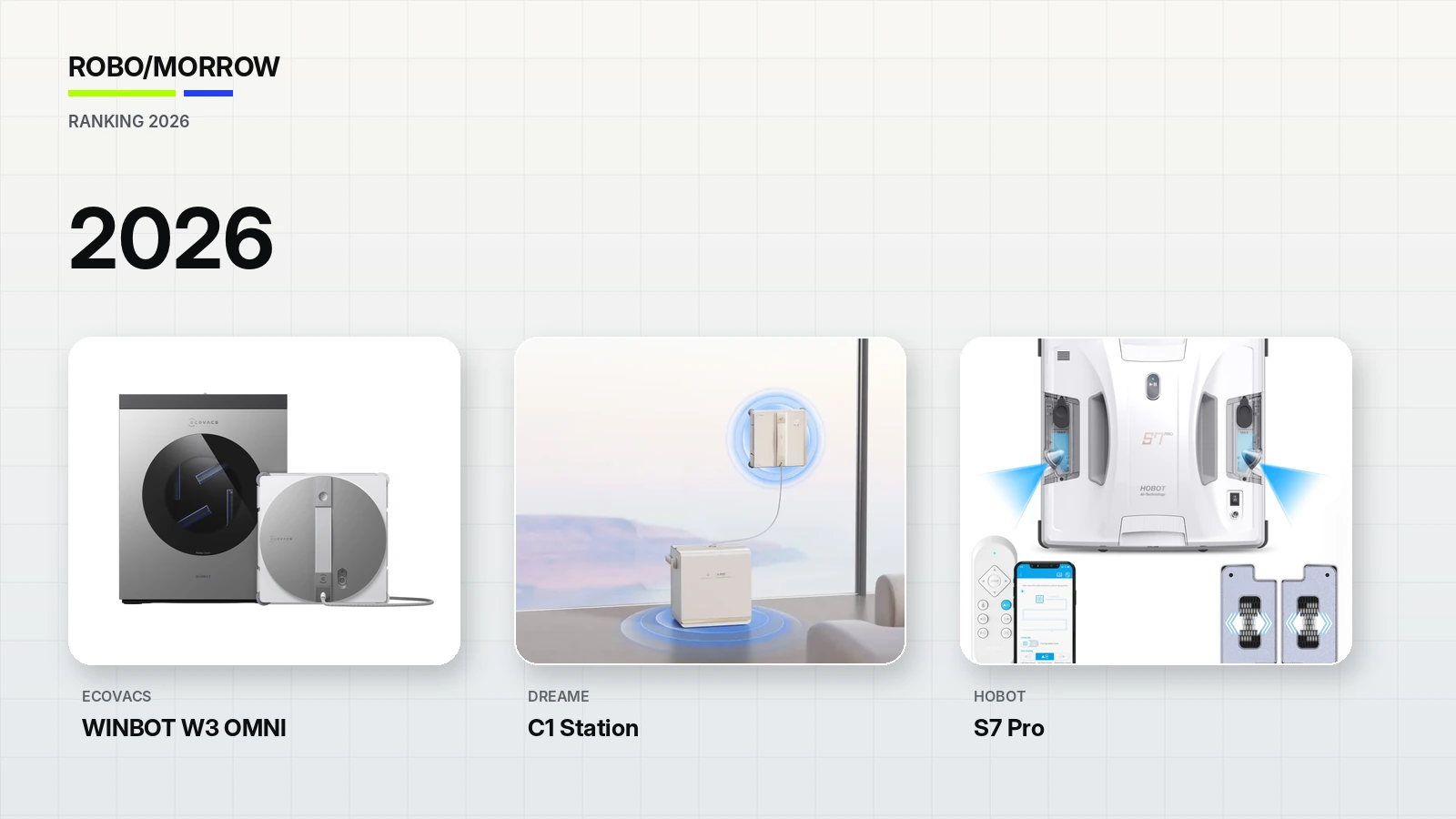
A frameless window-cleaning robot needs a stricter compatibility check than a robot used on a conventional framed window. The missing frame changes the role of edge detection, minimum pane size, the safety tether and the point where the robot can safely finish a path. This guide does not create a universal compatible/incompatible table across every regional SKU. The manual for the exact product takes priority over generic edge-detection marketing.
Short answer
If the manufacturer does not describe frameless operation in the manual, or lists edge restrictions, do not infer compatibility from a video or from operation on framed glass. Safety depends on sensors, braking logic, robot geometry, adhesion, the tether and behaviour after power loss.
1. What “frameless glass” can mean
It may be a balcony balustrade, an internal glass wall, a door without a conventional border or a large architectural pane where one or more edges end in open space. These are different risk cases. A balustrade creates a drop hazard, while an internal wall is more about reliable path termination and transitions between panes.
2. Five checks in the exact manual
- Frameless / edge detection: whether that glass type is explicitly supported.
- Minimum pane size: the robot needs room to manoeuvre, not merely enough space for the body.
- Glass type: coatings, texture, film and moisture can affect stated compatibility.
- Safety tether: where and how it must be anchored on the safe side.
- Power loss: a safety battery or UPS normally maintains adhesion for a limited period; it is not automatically a cordless cleaning mode.
3. W3 OMNI, SP10, S7 Pro and C1 solve different problems
WINBOT W3 OMNI is a dock-based system with automated pad handling. HOBOT SP10 iScraper adds a mechanical squeegee stage, S7 Pro uses moving pads, and Dreame C1 Station handles power and transport differently. None of those architecture choices alone proves compatibility with a specific frameless pane.
4. First-run checklist
- Do not start on the highest or highest-consequence pane.
- Validate on a low pane with similar geometry first.
- Inspect the tether, anchor and cable slack before attaching the robot.
- Follow the manual’s requirement for a dry initial adhesion area where applicable.
- Never operate above people, a vehicle or an area you cannot secure.
- After the first minutes, check pad saturation, adhesion and the amount of liquid left near the edge.
5. One large pane or many small ones?
A large frameless wall can be operationally easier than many small windows because it requires fewer transfers and tether changes. At the same time, the consequence of a failure can be greater. Count panes, anchoring points and setup time rather than only square metres.
6. Does the robot replace manual cleaning?
It can take over much of routine maintenance, but corners, seals, dried deposits, narrow strips and mounting hardware may still need manual finishing. Window robots are strongest as regular-maintenance tools rather than emergency recovery after months of accumulated dirt.
7. Buying framework
| Priority | Look for | Do not assume |
|---|---|---|
| Many large panes | efficient pad/station workflow for long sessions | that the largest station is easy to move repeatedly |
| Streaks and residual water | liquid management and squeegee workflow | that a squeegee removes pad maintenance |
| Distant power outlet | portable station or suitable cable management | that UPS means full cordless cleaning |
| Frameless edges | explicit manufacturer edge-detection procedure | that every camera/sensor makes frameless use acceptable |
8. Related RoboMorrow guides
Start with the Best Window Cleaning Robots 2026 guide and HOBOT SP10 vs WINBOT W3 OMNI. Model profiles link to official sources and, where an exact offer is verified, exact-product Amazon.
Verdict
On frameless glass, the decisive question is not maximum suction but whether the manufacturer supports the geometry, how edge detection behaves and how the robot is tethered. If any of those cannot be confirmed, use another method or obtain written compatibility confirmation from the manufacturer.
9. Coatings, films and textured glass
A robot can detect an edge correctly and still be unsuitable for the surface. Solar film, hydrophobic coatings, frosted or textured glass and heavy contamination can change friction and sensor behaviour. Do not use a chemical that the robot or glass manufacturer does not approve. With interior films, aggressive liquid or mechanical squeegeeing can damage the surface more than the dirt itself.
If the manual does not mention the glass type, validate on a low-risk pane or ask the manufacturer for written confirmation. Commercial buildings should also check whether robotic cleaning affects the façade-system warranty.
10. Exterior glass high above ground
The higher the pane, the less sensible it is to treat the robot like an ordinary appliance. The safety tether needs a real anchor on the safe side and the area below should be controlled. If you cannot secure the system without leaning out or using an unsafe ladder position, the robot has not solved the fundamental access risk.
In high-rise apartments and commercial buildings, some glazing should remain professional work with appropriate access and fall-protection procedures. RoboMorrow does not treat a window robot as a substitute for working-at-height safety.
11. Pad, liquid and streaks
Streaks near a frameless edge are especially visible because there is no frame to hide them. Start with a clean pad, avoid excess liquid and watch whether dirty water is being carried across the pane. On multiple panes, plan pad changes or washing by contamination rather than by area alone — one greasy section can load the pad faster than several metres of light dust.
A pad-washing station is a convenience, not a guarantee of streak-free glass. The tray, tank and pad still need maintenance. On squeegee designs, inspect the rubber edge as well because trapped grit can scratch glass.
12. Quick decision matrix
| Condition | Proceed when… | Stop when… |
|---|---|---|
| Frameless edge | the manual describes edge detection for that geometry | marketing only says “edge sensor” generically |
| Tethering | a solid anchor exists on the safe side | the tether would need improvised or exterior anchoring |
| Surface | glass/coating type is approved | film or coating compatibility is unknown |
| First test | a low-risk pane with similar geometry is available | the only possible first test is immediately over an open drop |
13. After purchase
Keep the manual for the exact regional SKU and photograph the tether setup that works in your home. During the first three sessions, watch every edge and inspect the pad halfway through. If the robot repeatedly stops unpredictably, slips or needs manual pushing, do not normalise that behaviour — adjust the setup or use the applicable return process.
Where to buy models from this article
We show only exact verified Amazon product pages. Before purchase, confirm the variant, seller, warranty and box contents.
Exact Amazon links. Where a verified RoboMorrow marketplace tracking ID is active, the link is an affiliate link and we may earn from qualifying purchases. Price and availability can change after you click.