Best Window Cleaning Robots 2026: Compare by Pane Type
Decision update · 17 October 2026
The best window robot? Start with your smallest glass panel.
A large living-room pane does not describe the whole home. A narrow sash, small area between muntins or unsafe outside access may decide the purchase. Exclude those constraints first, then compare station convenience and pad handling.
RoboMorrow · Decision Lab
Compare what changes the decision
Choose 2–3 models from the same category. Dimensions come from the cited sources; this is not a cleaning-performance test.
| Criterion | ECOVACS WINBOT W3 OMNI | Dreame C1 Station | HOBOT S7 Pro | HOBOT SP10 iScraper |
|---|---|---|---|---|
| Minimum glass panel | ≥ 30 × 40 cm | Unconfirmed | > 50 × 50 cm | Unconfirmed |
| Frameless glass | Yes, subject to manual conditions and securing | Unconfirmed | Yes, subject to manual conditions and securing | Unconfirmed |
| Your work | Autonomous motion on one pane does not mean autonomous transfer between panes. A person provides access and securing. | Autonomous motion on one pane does not mean autonomous transfer between panes. A person provides access and securing. | Autonomous motion on one pane does not mean autonomous transfer between panes. A person provides access and securing. | Autonomous motion on one pane does not mean autonomous transfer between panes. A person provides access and securing. |
| Bundle and variant | OMNI bundle with station and 2-in-1 cable. Check the manual for the regional variant. | C1 Station GCJZ2419 manual, p. 17: maximum 400 cm width and 250 cm height per side; 5.5 m station cable. Minimum for the exact variant is unconfirmed. | The manufacturer specifies >50 × 50 cm, not ≥50 × 50 cm. Prepare the power supply and tether. | The official table specifies width >40 cm. It does not state a minimum height here; we do not turn this into a 40 × 40 cm claim. |
| Price, scope and date | 16 Oct 2026: EUR 599 for W3 OMNI in the German store. Accessory bundles have separate prices. Confirm checkout and delivery. | No verified delivered EUR price for the target market. Request price, tax, shipping and the exact bundle. | No verified delivered EUR price for the target market. Request price, tax, shipping and the exact bundle. | No verified delivered EUR price for the target market. Request price, tax, shipping and the exact bundle. |
| Market evidence | PL: Not confirmed in this passport · no verification date DE: Retail listing in the official store · 2026-10-16 | PL: Not confirmed in this passport · no verification date DE: Not confirmed in this passport · no verification date | PL: Not confirmed in this passport · no verification date DE: Not confirmed in this passport · no verification date | PL: Not confirmed in this passport · no verification date DE: Not confirmed in this passport · no verification date |
| Dimension source and date | Source and variant ↗ · 2026-10-16 | Source and variant ↗ · 2026-10-16 | Source and variant ↗ · 2026-10-16 | Source and variant ↗ · 2026-10-16 |
| A condition that may change the choice | OMNI bundle with station and 2-in-1 cable. Check the manual for the regional variant. | C1 Station GCJZ2419 manual, p. 17: maximum 400 cm width and 250 cm height per side; 5.5 m station cable. Minimum for the exact variant is unconfirmed. | The manufacturer specifies >50 × 50 cm, not ≥50 × 50 cm. Prepare the power supply and tether. | The official table specifies width >40 cm. It does not state a minimum height here; we do not turn this into a 40 × 40 cm claim. |
| Model details | Profile and purchase passport → | Profile and purchase passport → | Profile and purchase passport → | Profile and purchase passport → |
2 models compared
We do not pick a winner from an advertising maximum. Exclude a model that does not fit the working space; compare the rest by upkeep, exact bundle and a quotation for your country.
Three window types, three decisions
For large accessible panes, check cable reach and handling between sides. For many small panels, the verified minimum size and transfer count matter most. For frameless glass, require explicit confirmation in the exact variant’s manual. Edge detection does not replace the required securing arrangement.
What does the table compare?
W3 OMNI, C1 Station and HOBOT models have different evidence coverage. An unconfirmed C1 minimum does not mean it fits any panel. For S7 Pro, the greater-than sign matters: the boundary is not automatically an accepted dimension. Before buying, also check maximum pane width and height and the exact manual variant.
Buy reduced handling, not a promise of full autonomy
Count preparation, securing, panel changes, side changes, pad care and finishing work. A station may simplify some actions, but it does not move the robot between windows. To assess time savings, measure your own work on one safely accessible window. Machine minutes per square metre are not the duration of the complete job.
Check your scenario in the calculator
Detailed guide and earlier evidence
The best window robot must fit the pane and the workflow between panes. Measure clear glass and check frames, handles and the exact model manual first. Then choose between station pad washing, squeegees and manual cloth care.
Redakcja RoboMorrow · advice updated: 8 October 2026. Source dates remain stated alongside the data.
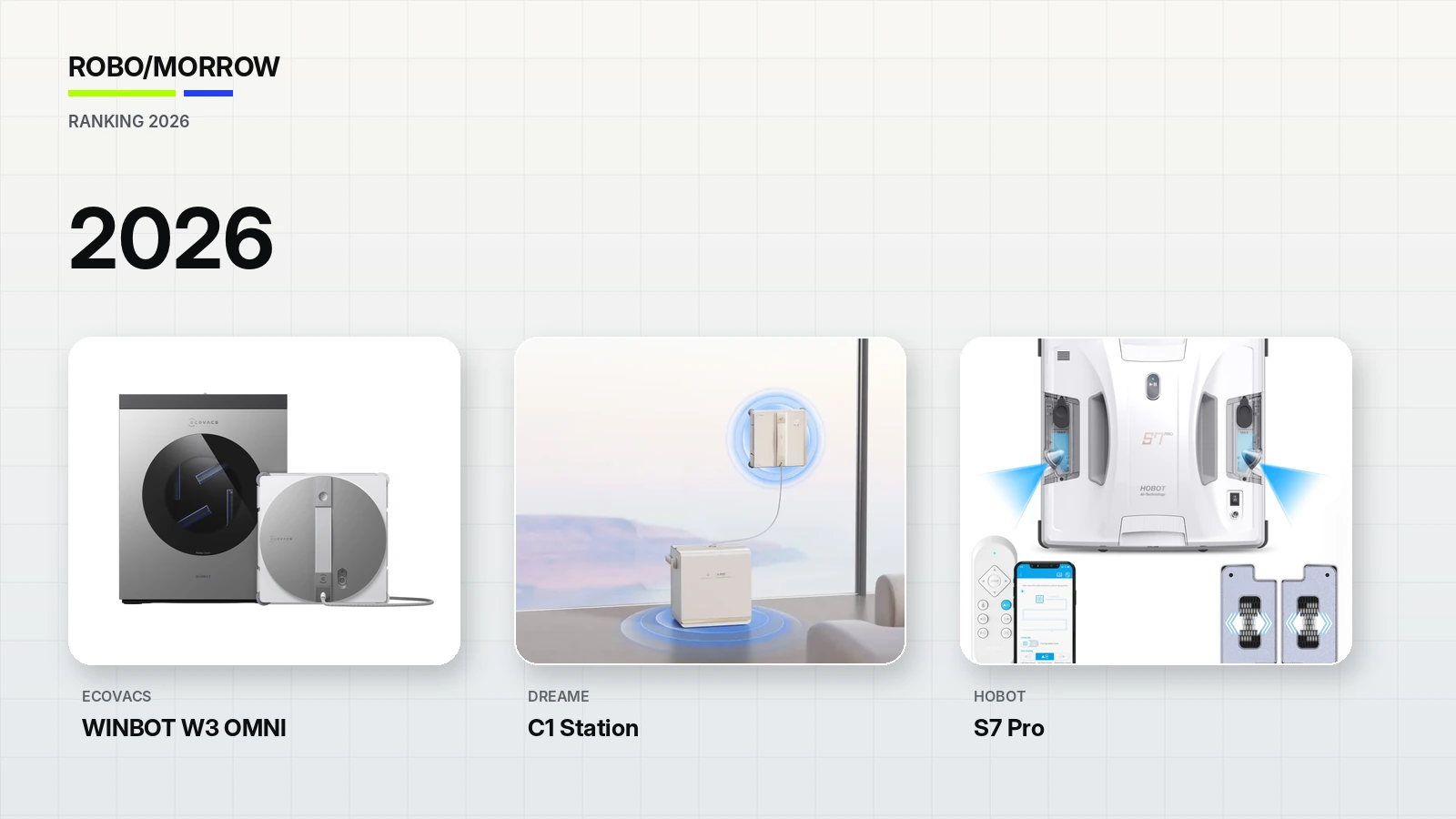
Choose a window robot by pane compatibility and the work between panes. WINBOT W3 OMNI suits a shortlist focused on pad washing at the station; HOBOT SP10 adds mechanical squeegees; S7 Pro uses reciprocating cloths; Dreame C1 Station offers a powered portable station. These are different workflows, not a measured order of cleaning quality.
The shortlist by the problem you want to solve
| Your priority | Consider | Trade-off |
|---|---|---|
| Frequent pad washing | WINBOT W3 OMNI | Station placement, carrying and maintenance |
| Residual water on glass | HOBOT SP10 | Squeegee cleanliness and suitable pane geometry |
| Reciprocating scrubbing | HOBOT S7 Pro | Manual cloth care and >50 × 50 cm pane criterion |
| Portable station power | Dreame C1 Station | Pads still need manual care |
Will it work on your windows? Check this first
| Model | Pane size / surface | Care and constraints |
|---|---|---|
| HOBOT SP10 | HOBOT Polska: >40 × 40 cm. Framed/frameless support; inspect surface and gaps. | Manual cloth and squeegee care; UPS is backup, not cordless cleaning. |
| HOBOT S7 Pro | HOBOT Polska: >50 × 50 cm. Edge-leakage sensors; pane geometry still matters. | Two reciprocating cloths; manual cloth care. Check clearance at handles. |
| WINBOT W3 OMNI | EU manual: glass ≥3 mm, mirrors ≥4 mm; framed glass needs frame ≥5 mm. | Station washes the pad. Manual excludes gaps, raised patterns and certain handle heights. |
| Dreame C1 Station | Dreame DE: min 30 × 40 cm. EU manual: glass ≥3 mm, mirrors ≥4 mm. | Manual pad care; Edge Mode is not for frameless glass. Check frame requirements. |
For W3 OMNI and C1 Station, the reviewed EU manuals exclude a framed pane with a frame smaller than 5 mm. This is not a blanket ban on every frameless pane. They also exclude holes, gaps between adjacent panes, broken or uneven glass and handle heights of 70–105 mm. Check the matching regional manual and the whole path before use. We do not copy another WINBOT model’s minimum pane size into the W3 row.
The HOBOT dimensions are from the Polish distributor’s comparison, not a universal approval for every national bundle. The SP10 English manual separately states a working width above 40 cm. Measure the clear glass between obstructions, not the complete window frame. A pane only just at a published limit is a reason to obtain a model-specific answer before ordering.
Films, coatings and exterior glass
A machine adhering to ordinary glass does not establish that its pad, detergent or squeegee is approved for your film. Identify the exposed layer and its cleaning instructions. For exterior work, the W3 and C1 EU manuals require calm conditions without rain or snow, secure restraint and supervision. Their station and plug stay indoors. A battery-powered station does not change those restrictions.
Count panes, not just square metres
A robot must be repositioned for each separate pane and side. Twenty small panes can demand more attention than four large ones with the same total area. Time attachment, tethering, transfers, pad care and removal marks. Automatic pad washing helps one part of that routine; it does not move the robot or clean window frames for you.
Buying from the US or another market
Choose the intended delivery country in the availability section and open the exact model offer. Compare the supplied plug, station, cloths, solution, warranty territory and returns route. An EU manual explains the reviewed European unit; verify the manual supplied with a US or other regional unit before relying on its electrical or operating limits. Do not select the country solely from the page language.
When a robot may not be a good purchase
For a few easy-to-reach panes, setting up and maintaining the machine can outweigh the work it removes. Inaccessible anchoring, unsuitable glass or a surface the manufacturer has not cleared are stronger reasons to stop the shortlist than a discount is to continue it. Compare the full session with your current method on a representative pane.
Next step
- HOBOT SP10 vs S7 Pro: differences and buying guide
- WINBOT W3 OMNI vs Dreame C1 Station: what does the station do?
- Window-cleaning robots on film and coated glass: checks first
- How long does a window robot take? Count the whole job
- Window-cleaning robot outdoors: when to stop or postpone
- Window-cleaning robot leaves streaks: pad, solution and timing
Sources and method
Checked on 5 October 2026. Manufacturer specifications and seller offers; this is editorial analysis, not a RoboMorrow hands-on test.
Check the correct bundle and current offer
Affiliate links / advertising: we may earn a commission. Confirm the exact model, bundle, seller and delivery terms before buying. We do not quote an unverified current price.
Check the offer for WINBOT W3 OMNI
Author: Redakcja RoboMorrow. Advice and use-case selection are editorial analysis. Manufacturer claims are not RoboMorrow test results. The image illustrates a model or comparison; it does not document an editorial test.
Continue with the exact decision
Source scope: the decision block was checked on 12 October 2026. Earlier dated source statements retain their dates. Seller listings establish an enquiry route, not live stock or a delivery promise. No new affiliate offer has been verified or added.
Image: manufacturer material already published by RoboMorrow; illustrative, not evidence of an editorial hands-on test.
Redakcja RoboMorrow · new decision section and comparison: 17 Oct 2026. Specifications and offers retain their own dates. Source analysis, not an in-house hardware test.
Before buying: variants, offers and further comparisons
- Measure your smallest pane, frame width and access to a safe tether anchor.
- Check the exact model manual for frameless glass, minimum pane size and permitted working orientation.
- Allow for moving the robot between panes, washing pads and finishing edges. A station does not remove every manual task.
Check availability on Amazon
As an Amazon Associate, RoboMorrow earns from qualifying purchases. Check the seller, bundle, delivery and availability on the store page.
- HOBOT SP10 iScraper · Amazon — international availability — check availability
- ECOVACS WINBOT W3 OMNI · Amazon Poland — check availability
Amazon may redirect you to a local store. If the identical product is unavailable, you may see search results. Check the model, bundle, power supply, delivery and warranty before buying.
Check offers for these models
As an Amazon Associate, RoboMorrow earns from qualifying purchases. Marketplace availability, seller and bundle contents may vary.
Related guides and model profiles
Check your measurements — open calculator
RoboMorrow · Decision Lab
How much work will your windows still need?
Count separate glass panels, check their size and see the manual moves required. The robot does not transfer itself to another pane or the other side.
Enter measurements. You can browse the source data below before calculating.
ECOVACS WINBOT W3 OMNI
OMNI bundle with station and 2-in-1 cable. Check the manual for the regional variant.
Open model profile →HOBOT S7 Pro
The manufacturer specifies >50 × 50 cm, not ≥50 × 50 cm. Prepare the power supply and tether.
Open model profile →Dreame C1 Station
C1 Station GCJZ2419 manual, p. 17: maximum 400 cm width and 250 cm height per side; 5.5 m station cable. Minimum for the exact variant is unconfirmed.
Open model profile →HOBOT SP10 iScraper
The official table specifies width >40 cm. It does not state a minimum height here; we do not turn this into a 40 × 40 cm claim.
Open model profile →How to read the result?
Fits dimensionally means the entered measurements match, not that the product was tested. Conditional requires a further check. Rejected identifies a mismatch or unsafe setup. Missing data is not a pass. A two-step claim never becomes a single-edge limit.
Redakcja RoboMorrow · release 17 Oct 2026. Source dates are listed separately. Measurements and results stay in your browser; saving downloads a file to your device.