HOBOT SP10 vs S7 Pro: Pane Size, Squeegees & Daily Care
BUYING IN YOUR MARKET
Availability in your country
Sales, delivery and support can differ by country and exact model. Choose your market to see the evidence we have checked.
HOBOT SP10 iScraper
Poland
Local store offer — check checkout availability
- Seller / sales channel
- HOBOT Polska
- Price
- See the local offer for the current price and exact bundle
- Delivery
- Confirm stock and the delivery date for your address with the seller
- Warranty and service
- Confirm written warranty terms, parts and service coverage for your address
HOBOT Polska lists this exact model for this market. A listing is evidence of a buying route, not a delivery commitment.
Evidence checked: · Not a live stock feed
HOBOT Polska: check local offer ↗No verified local offer in this dataset
No country-specific offer for this exact model has been established in our current sources. This is a gap in our research, not a statement that the robot cannot be bought here. Use the manufacturer’s sales contact to request a supplier serving your address; confirm configuration, imports, warranty and service.
- Price
- No verified local price in this dataset
- Delivery
- No confirmed date for your address
- Warranty and service
- Local coverage not verified
HOBOT S7 Pro
Poland
Local listing — shown out of stock when checked
- Seller / sales channel
- HOBOT Polska / Robosfera
- Price
- PLN 1,699 including VAT displayed; verify the current price on the linked listing
- Delivery
- No immediate delivery claim; ask the seller for restock timing
- Warranty and service
- Confirm warranty and return terms with the seller
The exact-model product page states Brak w magazynie. A product listing and a current purchase-ready stock position are different facts.
Evidence checked: · Not a live stock feed
HOBOT Polska: S7 Pro product and stock status ↗No verified local offer in this dataset
A current local sales offer, exact regional variant, delivery date and service coverage have not been verified for this country in the regional dataset. This does not mean that the robot is unavailable.
- Price
- No verified local price in this dataset
- Delivery
- No confirmed date for your address
- Warranty and service
- Local coverage not verified
“Listed” confirms a product page or sales route, not stock, delivery to every address or local service. “Pre-order” is not immediate availability. Unverified means we lack evidence; it does not mean unavailable. Prices belong to the named market and currency. Confirm the exact version, tax, shipping and support before ordering.
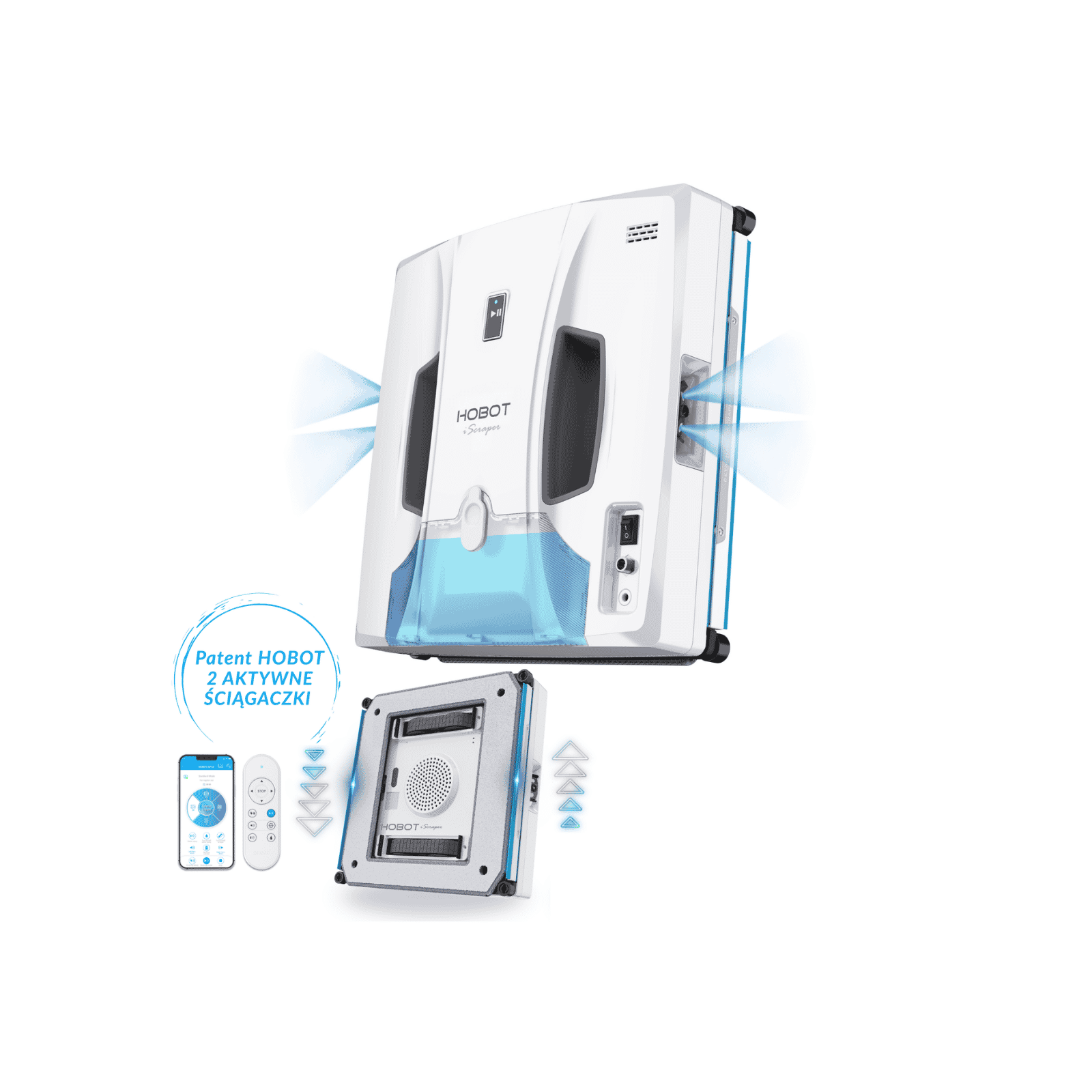
Choose between SP10 and S7 Pro by the cleaning mechanism and your smallest pane. SP10 adds two mechanical squeegees to its wiping sequence. S7 Pro works with two reciprocating cloths and ultrasonic spray. Neither design alone establishes which will leave fewer marks on your own glass.
| Item | HOBOT SP10 | HOBOT S7 Pro |
|---|---|---|
| Dimensions | 245 × 245 × 75 mm | 262 × 264 × 89 mm |
| Working pane: HOBOT PL | >40 × 40 cm | >50 × 50 cm |
| Tank | 120 ml | 2 × 26 ml |
| Declared pass time | 3 min/m² | 2.6 min/m² |
| UPS backup | 20 min | 20 min |
The manufacturer’s current S7 Pro specification gives 262 × 264 × 89 mm and 1,650 g. This conflicts with the older Polish comparison’s 69-mm height and 1,400-g weight. We use the manufacturer’s dimensions; confirm the delivered variant rather than choosing S7 for an assumed lower profile. The SP10 manual gives 1,450 g. Pane criteria are strictly greater than 40 × 40 cm (SP10) or 50 × 50 cm (S7), not “at least” those sizes.
Squeegees or moving cloths: what changes in your routine?
With SP10, inspect both the cloth and squeegee contact edges when diagnosing streaks. A dirty contact surface can transfer contamination to later panes. With S7 Pro, inspect the two cloths and their attachment. Compare finish only after both machines have been prepared according to their own instructions, using compatible consumables.
Measure the whole route before comparing body height
Using the current specifications, SP10 is 75 mm high and S7 Pro is 89 mm. Measure the space around handles, recesses and any projecting fittings before treating that as a buying advantage. The robot also needs room to turn and maintain contact. A body fitting through an opening is not proof that its automatic cleaning path can complete there.
Power, frameless glass and coatings
The UPS specification describes emergency holding backup after power loss; it is not a normal cordless cleaning runtime. HOBOT describes edge-leakage sensing for frameless work. That does not approve cracked glass, every gap or an unknown applied film. SP10’s manual identifies stickers or window film as possible contributors to movement problems; obtain surface-specific guidance rather than assuming every film is forbidden or approved.
How to compare a demonstration
- Use similar accessible panes with a known surface and a fresh, correctly prepared cloth.
- Record the automatic pass separately from setup, removal, finishing and washing.
- Inspect under the same light immediately before and after removal.
- Compare local bundle price and replacement cloth/squeegee availability.
Next step
- Best Window Cleaning Robots 2026: Picks by Use Case, Not Hype
- How long does a window robot take? Count the whole job
- Window-cleaning robot leaves streaks: pad, solution and timing
- Window-cleaning robots on film and coated glass: checks first
Sources and method
Checked on 5 October 2026. Manufacturer specifications and seller offers; this is editorial analysis, not a RoboMorrow hands-on test.
Continue the decision
Specifications narrow a shortlist but do not replace a trial on your glass. Check the manual, tether attachment and return terms before ordering.