How long does a window robot take? Total and hands-on time
Decision update · 17 October 2026
Window-cleaning time is more than the robot’s travel time.
Separate three measurements: total job duration, machine-running time and your active handling minutes. They need not be equal. We do not infer time savings from glass area or an advertised productivity figure alone.
RoboMorrow · Decision Lab
Compare what changes the decision
Choose 2–3 models from the same category. Dimensions come from the cited sources; this is not a cleaning-performance test.
| Criterion | ECOVACS WINBOT W3 OMNI | Dreame C1 Station | HOBOT S7 Pro | HOBOT SP10 iScraper |
|---|---|---|---|---|
| Minimum glass panel | ≥ 30 × 40 cm | Unconfirmed | > 50 × 50 cm | Unconfirmed |
| Frameless glass | Yes, subject to manual conditions and securing | Unconfirmed | Yes, subject to manual conditions and securing | Unconfirmed |
| Your work | Autonomous motion on one pane does not mean autonomous transfer between panes. A person provides access and securing. | Autonomous motion on one pane does not mean autonomous transfer between panes. A person provides access and securing. | Autonomous motion on one pane does not mean autonomous transfer between panes. A person provides access and securing. | Autonomous motion on one pane does not mean autonomous transfer between panes. A person provides access and securing. |
| Bundle and variant | OMNI bundle with station and 2-in-1 cable. Check the manual for the regional variant. | C1 Station GCJZ2419 manual, p. 17: maximum 400 cm width and 250 cm height per side; 5.5 m station cable. Minimum for the exact variant is unconfirmed. | The manufacturer specifies >50 × 50 cm, not ≥50 × 50 cm. Prepare the power supply and tether. | The official table specifies width >40 cm. It does not state a minimum height here; we do not turn this into a 40 × 40 cm claim. |
| Price, scope and date | 16 Oct 2026: EUR 599 for W3 OMNI in the German store. Accessory bundles have separate prices. Confirm checkout and delivery. | No verified delivered EUR price for the target market. Request price, tax, shipping and the exact bundle. | No verified delivered EUR price for the target market. Request price, tax, shipping and the exact bundle. | No verified delivered EUR price for the target market. Request price, tax, shipping and the exact bundle. |
| Market evidence | PL: Not confirmed in this passport · no verification date DE: Retail listing in the official store · 2026-10-16 | PL: Not confirmed in this passport · no verification date DE: Not confirmed in this passport · no verification date | PL: Not confirmed in this passport · no verification date DE: Not confirmed in this passport · no verification date | PL: Not confirmed in this passport · no verification date DE: Not confirmed in this passport · no verification date |
| Dimension source and date | Source and variant ↗ · 2026-10-16 | Source and variant ↗ · 2026-10-16 | Source and variant ↗ · 2026-10-16 | Source and variant ↗ · 2026-10-16 |
| A condition that may change the choice | OMNI bundle with station and 2-in-1 cable. Check the manual for the regional variant. | C1 Station GCJZ2419 manual, p. 17: maximum 400 cm width and 250 cm height per side; 5.5 m station cable. Minimum for the exact variant is unconfirmed. | The manufacturer specifies >50 × 50 cm, not ≥50 × 50 cm. Prepare the power supply and tether. | The official table specifies width >40 cm. It does not state a minimum height here; we do not turn this into a 40 × 40 cm claim. |
| Model details | Profile and purchase passport → | Profile and purchase passport → | Profile and purchase passport → | Profile and purchase passport → |
2 models compared
We do not pick a winner from an advertising maximum. Exclude a model that does not fit the working space; compare the rest by upkeep, exact bundle and a quotation for your country.
Example: eight panels cleaned on both sides
Eight panels multiplied by two sides means 16 placements. Between successive surfaces there are at least 15 moves; initial placement and final removal are separate actions. Restarts, extra passes and touch-ups add work. This is task geometry, not a prediction of duration.
Record five stages instead of one number
Measure setup, securing and starting, work across panels, pad handling and final cleanup. Record your active time at each stage. If you do something else during a cycle, do not automatically count that as unrestricted free time: the manual’s supervision and safety conditions still apply.
When is a manual-cleaning comparison fair?
Compare similarly dirty windows, the same sides and the same accepted result. Include corners and touch-ups. Record cycle count and consumable use. The calculator can count area and transfers, but it does not know your experience, dirt level or access conditions. Your own trial establishes whether this workflow is more convenient.
Check your scenario in the calculator
Detailed guide and earlier evidence
Two clocks produce a fairer comparison
Elapsed time starts when you prepare the system and ends after putting it away. Hands-on time counts only the minutes spent actively handling it. Do not simply add overlapping activities twice. Any supervision required by the manual still applies even when your hands are free.
| Editorial example | Time | How to count it |
|---|---|---|
| Preparation | 5 min | Elapsed and hands-on time |
| Robot travel across panes | 30 min | Elapsed time; record interventions separately |
| Transfers between panes | 8 min | Elapsed and hands-on time |
| Pads, corrections and cleanup | 7 min | Elapsed and hands-on time |
If the stages do not overlap, this example gives a 50-minute session and 20 hands-on minutes. These are fictional numbers illustrating the method, not a test result or savings promise. A comparison with manual cleaning needs the same panes, sides and acceptance standard. If the robot cannot cover some areas, include finishing them by hand. Square metres alone do not capture the number of transfers.
Detailed procedure
Measure two things: how long the session lasts and how many minutes you actively work. Published minutes per square metre describe only part of window cleaning. Transfers, restraint, pad care, frames and removal marks can determine whether a robot saves effort in your home.
Count pane-sides, not window units
One opening with two separate panes cleaned on both sides creates four pane-sides. Measure each clear area and record whether the exterior side is safely accessible. Exclude incompatible panes before calculating a total; advertised coverage cannot make an unsafe or undersized pane usable.
Worked example: 12 pane-sides, 18 m²
These are illustrative inputs, not model test results. Assume no overlap between steps. Use your own measured pass rate; here it is 3 minutes/m².
| Step | Calculation | Minutes |
|---|---|---|
| Setup | fixed | 8 |
| Automatic passes | 18 × 3 | 54 |
| Attach / remove / secure | 12 × 2 | 24 |
| Pad care | 3 × 3 | 9 |
| Frames / finishing | fixed | 12 |
| Clean up / store | fixed | 7 |
| Elapsed, no overlap | 8 + 54 + 24 + 9 + 12 + 7 | 114 |
| Hands-on total | 8 + 24 + 9 + 12 + 7 | 60 |
The 60-minute figure excludes watching the automatic pass. If safe supervision occupies the whole interval, your committed time may still be 114 minutes. Do not describe the difference as free time unless your manual permits the actual concurrent activity and the setup remains supervised.
Sensitivity: one extra minute per pane-side
With 12 pane-sides, one extra handling minute adds 12 minutes to both the non-overlapping session and active work. Reducing the assumed pass rate from 3 to 2.6 minutes/m² saves 7.2 machine minutes across 18 m². In this example, handling changes matter more than that pass-rate difference. This is arithmetic, not a speed verdict between HOBOT models.
What each design can change
- W3 OMNI: station pad washing can change pad-care work, but include water handling and station cleanup.
- SP10: mechanical squeegees change the finishing mechanism; record your actual touch-up time.
- C1 Station: portable station power changes placement and cable workflow; pads still need washing.
Make the result comparable
Use the same pane set and agreed cleanliness threshold for the robot and your existing method. Record elapsed time with one clock to avoid double-counting overlapping tasks. Add hands-on minutes separately and mark supervision time. Repeat on a normal level of dirt rather than relying on the clean demonstration pane.
Continue with your next question
- HOBOT SP10 vs WINBOT W3 OMNI: scrapers or wash station?
- WINBOT W3 OMNI vs Dreame C1 Station: which fits?
- WINBOT W3 vs W2 PRO OMNI: is upgrading worth it?
Availability and sources
Check the exact regional model, compatible consumables, delivery to your address and local support before ordering. A product listing is not stock confirmation. This article adds no affiliate offers.
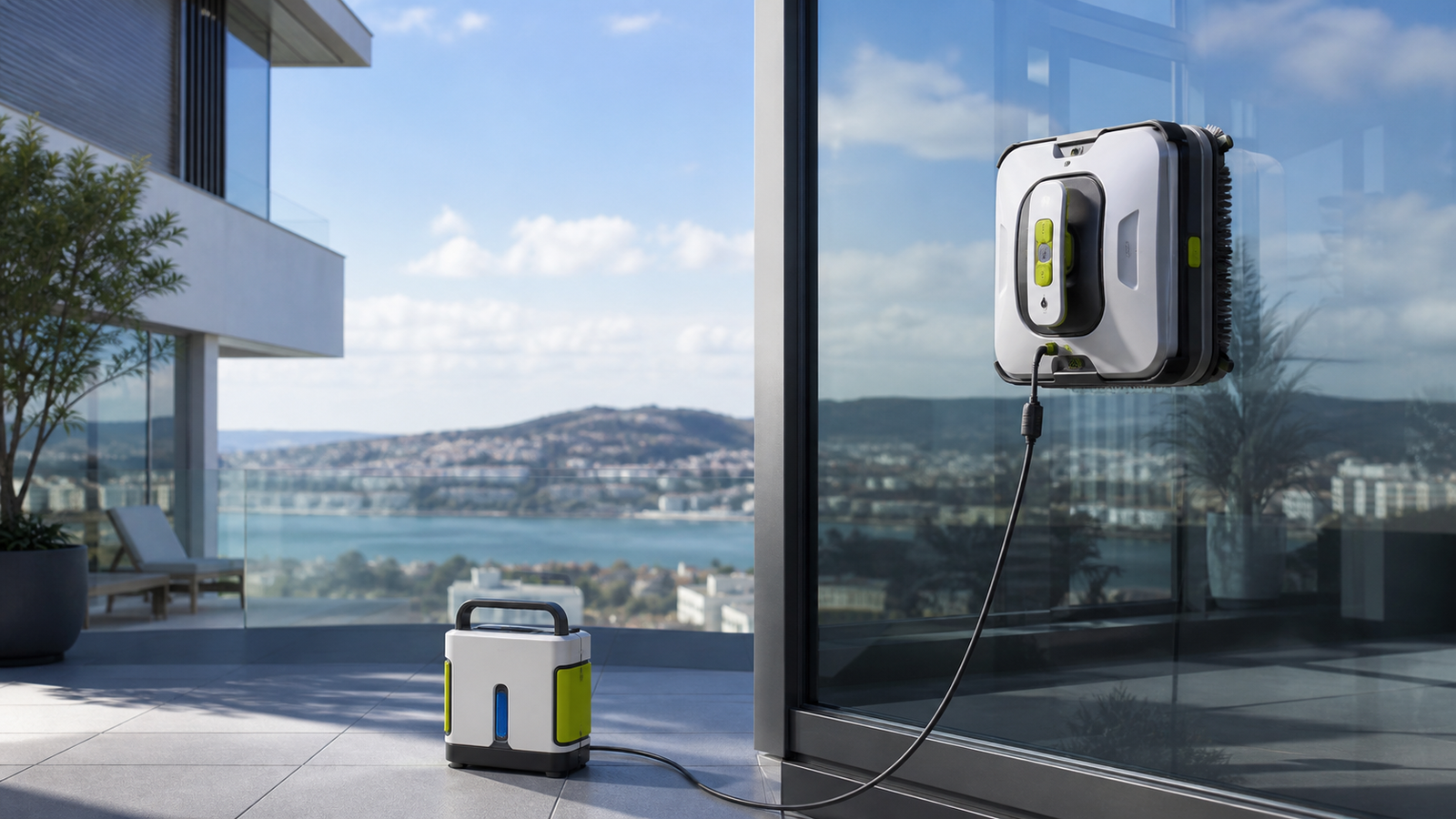
Redakcja RoboMorrow · updated 12 October 2026. Manufacturer statements are attributed above; practical checklists and fictional examples are editorial analysis, not hands-on test results. Product images are existing RoboMorrow manufacturer materials and illustrate the model, not an editorial test.
Where to buy models from this article
We show only exact verified Amazon product pages. Before purchase, confirm the variant, seller, warranty and box contents.
Exact Amazon links. Where a verified RoboMorrow marketplace tracking ID is active, the link is an affiliate link and we may earn from qualifying purchases. Price and availability can change after you click.
Redakcja RoboMorrow · new decision section and comparison: 17 Oct 2026. Specifications and offers retain their own dates. Source analysis, not an in-house hardware test.
Where to buy models from this article
We show only exact verified Amazon product pages. Before purchase, confirm the variant, seller, warranty and box contents.
Exact Amazon links. Where a verified RoboMorrow marketplace tracking ID is active, the link is an affiliate link and we may earn from qualifying purchases. Price and availability can change after you click.
Check your measurements — open calculator
RoboMorrow · Decision Lab
How much work will your windows still need?
Count separate glass panels, check their size and see the manual moves required. The robot does not transfer itself to another pane or the other side.
Enter measurements. You can browse the source data below before calculating.
ECOVACS WINBOT W3 OMNI
OMNI bundle with station and 2-in-1 cable. Check the manual for the regional variant.
Open model profile →HOBOT S7 Pro
The manufacturer specifies >50 × 50 cm, not ≥50 × 50 cm. Prepare the power supply and tether.
Open model profile →Dreame C1 Station
C1 Station GCJZ2419 manual, p. 17: maximum 400 cm width and 250 cm height per side; 5.5 m station cable. Minimum for the exact variant is unconfirmed.
Open model profile →HOBOT SP10 iScraper
The official table specifies width >40 cm. It does not state a minimum height here; we do not turn this into a 40 × 40 cm claim.
Open model profile →How to read the result?
Fits dimensionally means the entered measurements match, not that the product was tested. Conditional requires a further check. Rejected identifies a mismatch or unsafe setup. Missing data is not a pass. A two-step claim never becomes a single-edge limit.
Redakcja RoboMorrow · release 17 Oct 2026. Source dates are listed separately. Measurements and results stay in your browser; saving downloads a file to your device.