WINBOT W3 vs W2 PRO OMNI: is upgrading worth it?
BUYING IN YOUR MARKET
Availability in your country
Sales, delivery and support can differ by country and exact model. Choose your market to see the evidence we have checked.
ECOVACS WINBOT W3 OMNI: price, Vortex Wash and specs
Germany
Local store offer — check checkout availability
- Seller / sales channel
- ECOVACS Germany
- Price
- See the local offer for the current price and exact bundle
- Delivery
- Confirm stock and the delivery date for your address with the seller
- Warranty and service
- Confirm written warranty terms, parts and service coverage for your address
ECOVACS Germany lists this exact model for this market. A listing is evidence of a buying route, not a delivery commitment.
Evidence checked: · Not a live stock feed
ECOVACS Germany: check local offer ↗United States
Official regional store listing — check current offer
- Seller / sales channel
- ECOVACS US
- Price
- See the official regional store for the current local bundle price
- Delivery
- Request the current lead time for the exact model and delivery address
- Warranty and service
- Confirm warranty territory, parts and the named local service provider in writing
Official regional store lists this exact model. Select the local bundle and check checkout eligibility, current stock, tax and delivery terms.
Evidence checked: · Not a live stock feed
ECOVACS US: exact-model sales route ↗Canada
Official regional store listing — check current offer
- Seller / sales channel
- ECOVACS CA
- Price
- See the official regional store for the current local bundle price
- Delivery
- Request the current lead time for the exact model and delivery address
- Warranty and service
- Confirm warranty territory, parts and the named local service provider in writing
Official regional store lists this exact model. Select the local bundle and check checkout eligibility, current stock, tax and delivery terms.
Evidence checked: · Not a live stock feed
ECOVACS CA: exact-model sales route ↗France
Official regional store listing — check current offer
- Seller / sales channel
- ECOVACS FR
- Price
- See the official regional store for the current local bundle price
- Delivery
- Request the current lead time for the exact model and delivery address
- Warranty and service
- Confirm warranty territory, parts and the named local service provider in writing
Official regional store lists this exact model. Select the local bundle and check checkout eligibility, current stock, tax and delivery terms.
Evidence checked: · Not a live stock feed
ECOVACS FR: exact-model sales route ↗Austria
Official regional store listing — check current offer
- Seller / sales channel
- ECOVACS AT
- Price
- See the official regional store for the current local bundle price
- Delivery
- Request the current lead time for the exact model and delivery address
- Warranty and service
- Confirm warranty territory, parts and the named local service provider in writing
Official regional store lists this exact model. Select the local bundle and check checkout eligibility, current stock, tax and delivery terms.
Evidence checked: · Not a live stock feed
ECOVACS AT: exact-model sales route ↗Belgium
Official regional store listing — check current offer
- Seller / sales channel
- ECOVACS BE
- Price
- See the official regional store for the current local bundle price
- Delivery
- Request the current lead time for the exact model and delivery address
- Warranty and service
- Confirm warranty territory, parts and the named local service provider in writing
Official regional store lists this exact model. Select the local bundle and check checkout eligibility, current stock, tax and delivery terms.
Evidence checked: · Not a live stock feed
ECOVACS BE: exact-model sales route ↗No verified local offer in this dataset
No country-specific offer for this exact model has been established in our current sources. This is a gap in our research, not a statement that the robot cannot be bought here. Use the manufacturer’s sales contact to request a supplier serving your address; confirm configuration, imports, warranty and service.
- Price
- No verified local price in this dataset
- Delivery
- No confirmed date for your address
- Warranty and service
- Local coverage not verified
“Listed” confirms a product page or sales route, not stock, delivery to every address or local service. “Pre-order” is not immediate availability. Unverified means we lack evidence; it does not mean unavailable. Prices belong to the named market and currency. Confirm the exact version, tax, shipping and support before ordering.
Upgrade to remove a specific task
First identify what bothers you about W2 PRO OMNI. If it is manual pad washing, W3's Vortex Wash addresses that stage. If the problem is incompatible glass or moving the robot across many small panes, a newer model alone does not provide the answer.
| Reason to consider upgrading | What to verify first |
|---|---|
| Frequent hand washing of pads | The complete W3 pad and station routine |
| Streaks on glass | Cloth condition, solution and the current model's procedure |
| Many small panes | Compatibility and the number of manual transfers |
| Limited space | Storage for the complete replacement system |
Compare the new system's cost with servicing the existing one, without assuming an unconfirmed resale price. W2 consumables may not fit W3: verify compatibility by part number. A useful criterion is consistently lower hands-on time on the same approved panes. A newer model number or a difference in claimed runtime does not replace that comparison.
Detailed procedure
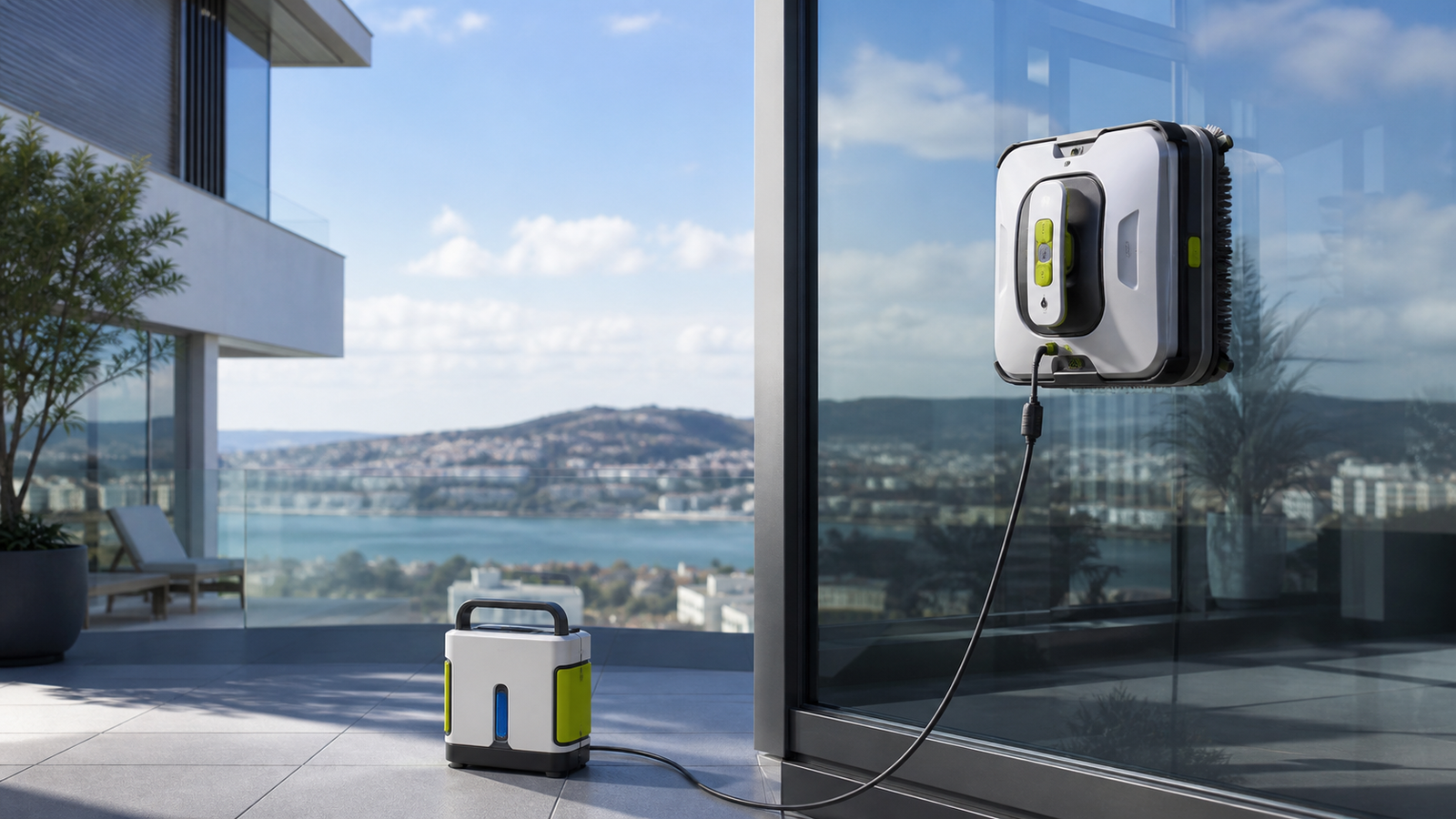
The decision to move from WINBOT W2 PRO OMNI to W3 OMNI should start with pad and station handling. Both have a portable battery station, and the robot remains connected to it by a cable. W3 does not turn this into a machine that travels freely across glass without a station connection.
The key difference happens between panes
ECOVACS describes automatic pad washing in the W3 OMNI station. W2 PRO OMNI provides power, controls, storage and cable handling, but its product page does not list an equivalent pad-washing function. How often you manually handle a dirty pad is therefore a useful starting point.
| Area | W2 PRO OMNI | W3 OMNI |
|---|---|---|
| Portable power | Battery station and plugged-in operation | Battery station and plugged-in operation |
| Robot-to-station connection | Combined cable | Combined cable |
| Pad care | Manual care according to instructions | Station pad washing described by manufacturer |
| Route planning | WIN-SLAM 4.0 | WIN-SLAM 5.0 |
| Results on your windows | Need checking; a version number is not a shared test result | |
When paying more could make sense
The strongest use case is a large number of panes with frequent dirty-pad handling. If most of your effort happens between runs, automating that step could matter more than a small change in travel time on one pane. You still need to move the robot, check its attachment and inspect the finish.
For a few accessible windows that W2 already cleans satisfactorily, a newer name is a weak replacement argument. First check pad condition and preparation, and whether your complaint concerns frames or corners beyond the machine’s practical reach.
How to compare them fairly
- Use comparable panes with similar dirt. Do not let the second machine benefit from glass already cleaned by the first.
- Prepare pads and solution according to each model’s instructions. Record the chosen mode.
- Separate robot time from active handling: setup, transfers, pad care, touch-ups and equipment cleaning.
- Inspect centres, edges and corners under comparable light after drying.
- Repeat across further panes where safe. A clean first pane does not reveal the workload of a whole home.
Do not mix measurements from different tasks
Battery runtime, coverage from a fluid tank and fast-mode time per pane describe different limits. None alone is the time needed to clean a house. Product claims also have manufacturer test conditions, while the number of separate panes can strongly affect handling.
Distinguish W2 PRO OMNI from W2S PRO OMNI. Also avoid assuming that US and European offers are identical. This comparison concerns the functions on the cited pages for the two named models; it does not establish a local price or current availability in every country.
Before ordering, check the exact bundle. Consumables, support arrangements and replacement pads are part of the ownership decision. A useful quotation identifies the model and included accessories, rather than offering an unspecified “Winbot Omni”.
If your W2 PRO OMNI still works well
For an upgrade, the relevant cost is the changeover cost, not just the new model’s price. Record the actual extra outlay after deciding what happens to the existing system. Then identify the particular task W3 should reduce. If W2 already delivers satisfactory glass cleaning, easier pad care must be valuable enough to justify the purchase.
W3 adds automatic pad washing, along with station components that handle water and collected dirt. Assess the full process: preparing tanks, running the wash cycle, emptying and end-of-session care. The Vortex Wash description does not mean the user has no equipment maintenance after the final pane.
Calculate the value of easier pad care
Assume, purely for illustration, 12 complete sessions a year. If the new station reduced active work by ten minutes each time, that would recover 120 minutes a year. At 24 sessions it would recover 240 minutes. These are not measured W3 savings; the example shows why cleaning frequency changes the value of the same feature.
If servicing the new station leaves little net time saved, reduced contact with a dirty pad may still be worthwhile. Describe that benefit as convenience. An upgrade does not have to claim a financial payback to be a reasonable personal choice.
Battery runtime is not whole-home cleaning time
The US product pages state up to 110 minutes for W2 PRO OMNI and up to 130 minutes for W3 OMNI. Those are manufacturer runtime claims under their stated conditions. Both systems also describe operation while plugged in. Where sockets are readily accessible, the runtime difference may matter less than the system’s size, cloth supply and ease of carrying.
| Your situation | First action | What supports choosing W3 |
|---|---|---|
| W2 cleans a few windows satisfactorily | Check consumable condition | A clear need for more convenient pad care |
| Long sessions with many panes | Measure hands-on work between panes | A demonstrated reduction in that work |
| First purchase | Compare complete local bundles | Pad washing that fits your routine |
Buying decision
W3 is a candidate for someone who wants less manual pad handling during a larger cleaning session. W2 remains a candidate when its glass-cleaning workflow already meets the need and cloth care is not a significant burden. Record the minutes you actually spend on that step before comparing the benefit with the current upgrade price in your market.
Continue with your next question
- Window robot leaves streaks: what to check first
- Window robot for small panes and muntins: sizing guide
- How long does a window robot take? Total and hands-on time
Availability and sources
Check the exact regional model, compatible consumables, delivery to your address and local support before ordering. A product listing is not stock confirmation. This article adds no affiliate offers.
Redakcja RoboMorrow · updated 12 October 2026. Manufacturer statements are attributed above; practical checklists and fictional examples are editorial analysis, not hands-on test results. Product images are existing RoboMorrow manufacturer materials and illustrate the model, not an editorial test.
Before buying: variants, offers and further comparisons
Check availability on Amazon
As an Amazon Associate, RoboMorrow earns from qualifying purchases. Check the seller, bundle, delivery and availability on the store page.