Before this robot touches the bin, Google lets it practise
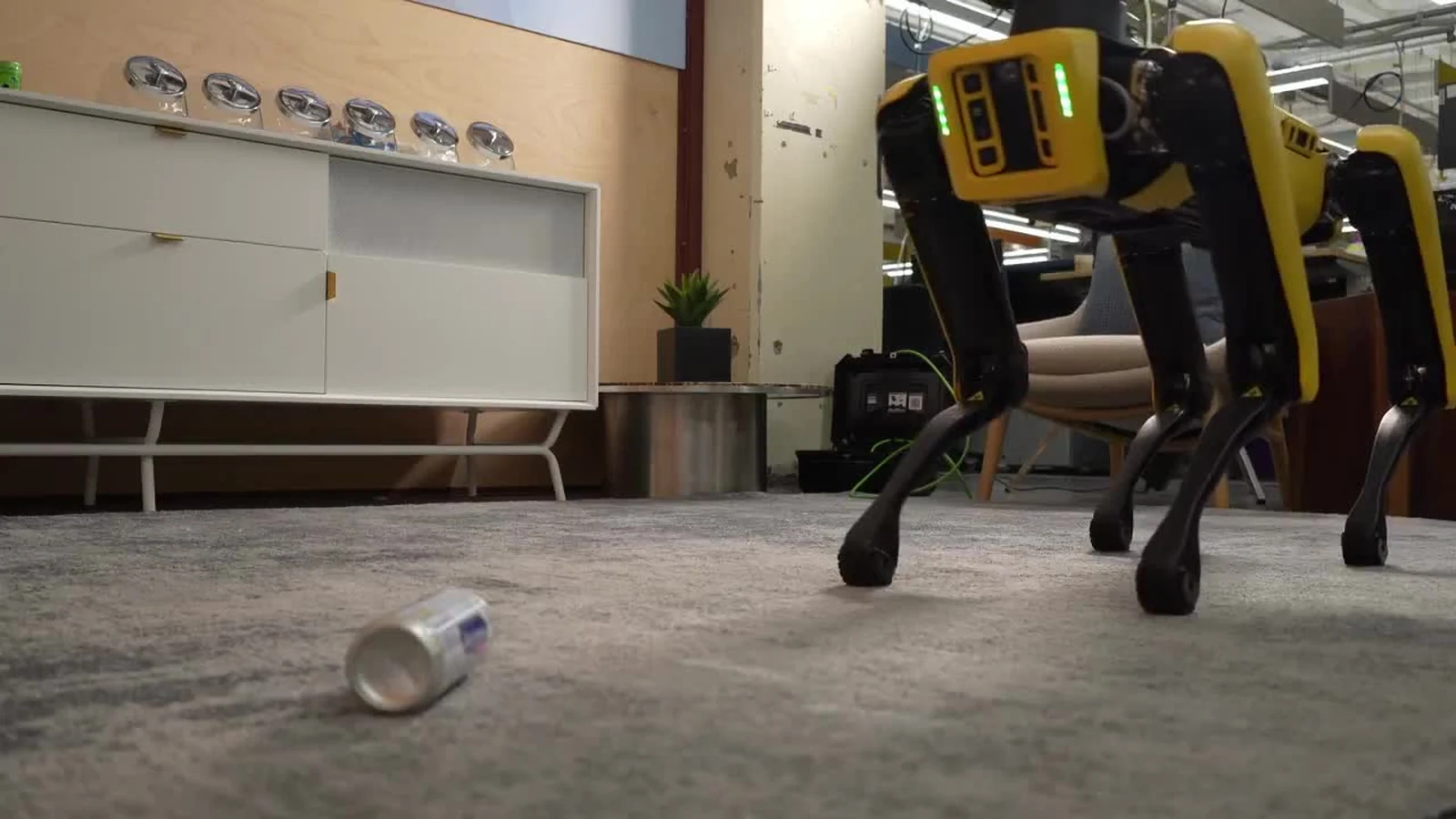
A robot picks up a can and needs to put it in a pedal bin. Before doing so, it practises the movement in a computer simulation. Google uses Spot to demonstrate Gemini 4 Argon, connecting understanding a scene, writing code and preparing an action in the physical world.
The 13 October publication describes a specific sequence: a MuJoCo model of the bin, practice balancing and pressing the pedal, and execution on hardware. It demonstrates an approach to learning and control. It is not the launch of a ready-made household cleaning robot.
A pedal bin is a more demanding task than it looks
The can does not merely need to end up above a container. The robot has to remain stable, position a foot, open the lid and avoid releasing its load too early. A mistake in one part can undo correct execution of the others. That makes an ordinary chore a readable example of a robotics problem.
The hardware is Boston Dynamics’ Spot with an arm. It is an existing platform developed for uses including inspection, data collection and object manipulation. The new story concerns the use of Google’s model, rather than a new quadruped robot.
The interesting work begins before the movement
MuJoCo is a physics simulator used in robotics research. It allows movements and contacts to be examined in a modelled environment. A virtual attempt avoids wearing real equipment and makes failures easier to analyse. Its usefulness depends on whether the model captures the relevant properties of the task.
For a bin, dimensions are only part of that description. Hinge position, pedal response, friction and base stability may matter. If a simulated lid allows an easy movement that the physical lid will not permit, the robot learns the wrong solution. Transferring practice to hardware therefore needs its own verification.
In our assessment, the interesting possibility is reducing the effort required to prepare that trial. Instead of separately building a scene, describing the task and interpreting successive images, a team could try to connect those activities through one AI-assisted process. This remains engineering work, but some of the manual coordination between tools might become easier.
The film contains two different kinds of evidence
Google’s video combines physical Spot footage with computer simulation. They serve different purposes: one shows the preparation of an action, the other its execution on a machine. A scene containing a robot is not automatically footage of a physical robot doing the task.
Likewise, a model’s result on questions about the world is not the success rate of a complete robotic system. ERQA, referenced by Google, assesses reasoning through tasks and images. That can inform model selection, but it cannot replace repeated attempts at operating a bin under changed conditions.
The instruction still does meaningful work
The demonstration includes a detailed instruction and extra checks of positioning before releasing the can. The practical implication is that the task description and the conditions for completion form part of the system. Saying that a robot uses a large model does not explain how much preparation makes its behaviour possible.
This helps distinguish the story from our earlier coverage of Gemini Robotics 2. Different demonstrations address different parts of the robotics stack: planning, movement generation, perception or data preparation. A result for one component should not be assigned to every machine associated with the Gemini name.
What could businesses use this approach for?
The most convincing direction is easier preparation of new tasks for existing hardware. A company may not need a robot that throws cans away. It might need to adapt a grasp, examine a simple mechanism or prepare a test scene before changing a workstation.
The useful test would show what happens when an object moves, a grasp fails or the surroundings change. Preparation time and human interventions also matter. Without those observations, it is hard to tell whether the model makes deployment faster or shifts effort into a different tool.
Another practical use of this platform appears in our article on Spot, Orbit and responding to events in an industrial facility. That story starts with inspection; this one starts with learning a physical action. Both are easier to assess by identifying the specific process than by debating a robot’s general intelligence.
Availability: a model and a deployment are separate purchases
Google describes developer access to Argon. It does not present a complete “Spot with this task” package with a Polish price and deployment date. Robot hardware, model access and the work needed to build and maintain an application remain separate considerations.
The video is useful because it lets viewers follow the route from planning to contact with a real object. Our explanation of the operator’s role in robotics provides another lens for watching it. The promising development here is the preparation of a new skill; repeated execution outside the demonstration’s conditions will determine how far that progress travels.
Image: Google’s still of the physical Spot from its official video. The film also includes simulation. This is an analysis of published sources; RoboMorrow has not independently tested the model or robot.