GENISOM AI Raises Several Hundred Million RMB After Claiming 15,000 Robots Produced
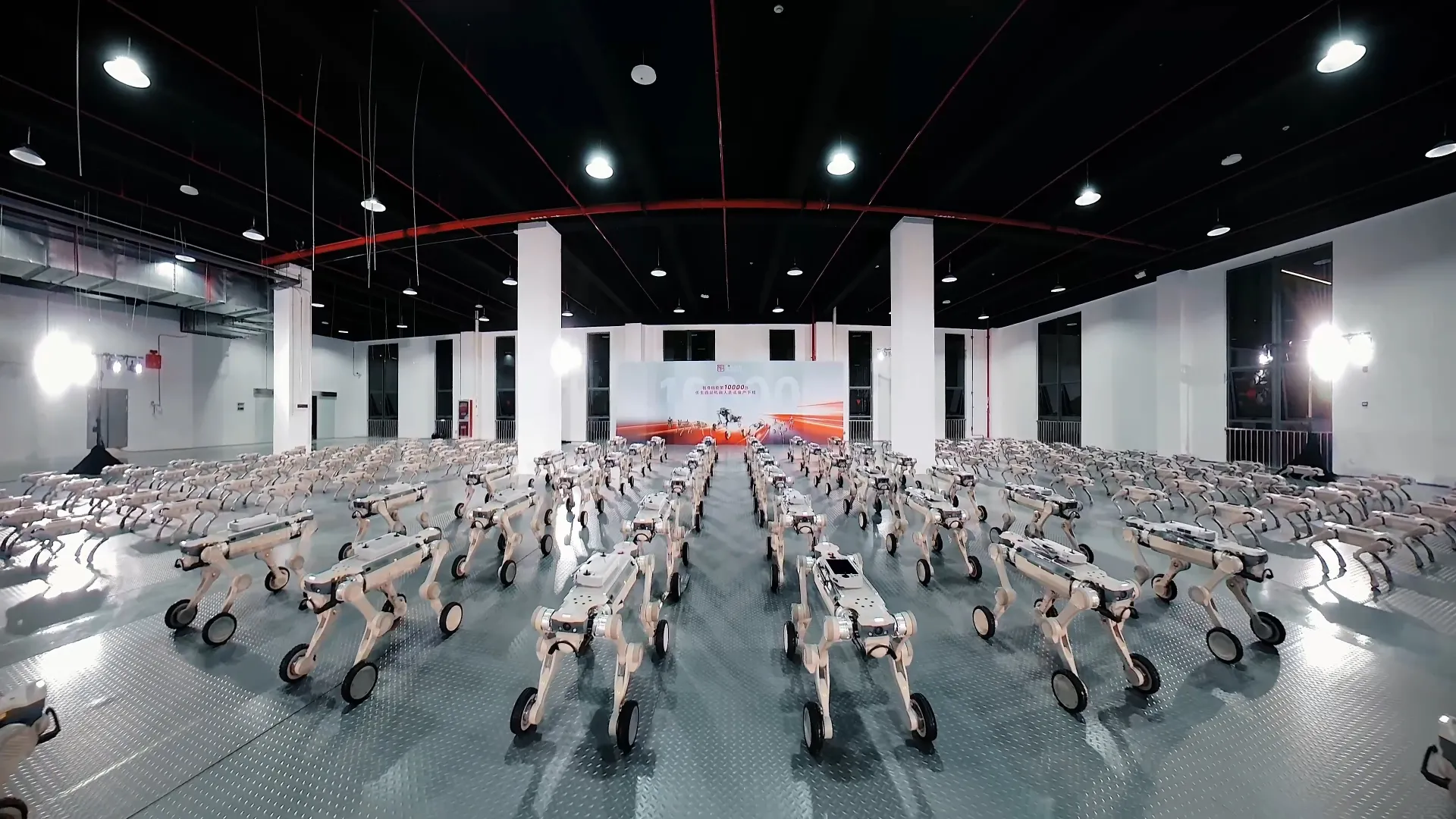
GENISOM AI (智身科技) announced on September 20 that it had completed a Series B round described as “several hundred million RMB.” UAE-based Stone Venture led the round, with a mix of financial and industrial investors participating. The exact amount and post-money valuation were not disclosed. The more important RoboMorrow context is the company’s scale claim: GENISOM says it had mass-produced more than 15,000 embodied-AI robots by June 2026. That is a manufacturer claim and it does not mean 15,000 humanoids. Source: GENISOM AI.
The funding targets hardware, intelligence and task execution
GENISOM says the new capital will support robot bodies, control and intelligence layers, and the ability to execute useful tasks in real environments. The company also highlights continued work on GSD autonomous navigation and four intelligence directions: motion, spatial, interaction and collective intelligence. This is the central physical-AI problem: building a mobile platform is not enough if the system cannot consistently reach the workplace, understand the situation and complete a task without frequent intervention.
The investor list combines financial capital with industrial participants. Alongside Stone Venture, GENISOM names Hongshan Capital, Guangdong Technology Finance and industrial investors including Neusoft, Highpower Technology and Riyee Electronics. Strategic capital does not prove technical superiority, but it suggests that the round is designed to support product and supply-chain scaling rather than research alone.
The 15,000-robot claim needs the right label
On its official website and in a World Robot Conference update, GENISOM says it had mass-produced more than 15,000 embodied-AI robots by June 2026 and had monthly production capacity above 5,000 units. These are company figures, not independently audited numbers. The portfolio includes legged robots and mobile platforms for demanding environments, so the 15,000 figure should not be re-labelled as humanoid production.
That distinction matters in light of RoboMorrow’s analysis of conflicting humanoid market statistics. Robotics reporting often mixes produced, shipped, sold and deployed units. GENISOM’s public wording describes broad embodied-AI robot production. We do not have a model-by-model split, customer count, geographic split or the number of units remaining in regular productive operation.
GENISOM is targeting difficult real-world environments
The company positions its robots for power infrastructure, industrial inspection, security and emergency-response scenarios. These environments are very different from a consumer home: ruggedness, terrain capability, communications, operation outside carefully prepared facilities and integration with an operator’s existing systems matter. GENISOM describes deployment as a data loop in which field experience feeds training and product improvement.
That logic is credible, but the quality of the loop can only be judged through operating metrics. Useful evidence would include hours in service, mission success rate, interventions, failures, teleoperation share and repeat orders. Production scale demonstrates a capability to build hardware; it does not demonstrate that the autonomy problem has been solved.
Why a UAE lead investor is notable
Stone Venture is identified as the UAE-based lead investor. That establishes the origin of the lead capital, not a new overseas sale. The announcement does not name a new Middle Eastern deployment customer. Possible access to partners should therefore not be presented as an executed commercial contract.
If the company later names customers and publishes hard KPIs outside China, that will be a stronger signal than the financing itself. Physical AI is rapidly moving from “can the robot do it?” toward “how many hours can it do it, at what cost, and who is paying?” The Series B gives GENISOM resources to answer those questions, but it is not an answer by itself.
Why Europe should watch
For a European buyer, GENISOM’s funding round is not an announcement of local product availability. A quotation, support arrangement and reference deployment would provide more directly useful evidence. Manufacturing scale can be relevant to supply capacity, but it does not establish the price or suitability of a complete application at a particular site.
EU commercialization would still require product compliance, safety documentation, cybersecurity and clear responsibility for autonomous behavior. The next meaningful proof point is therefore not another impressive demo but a transparent customer deployment with measurable results. RoboMorrow treats the financing as a significant scale signal while keeping the production numbers clearly attributed to the company.
What would separate scaling from a scaling narrative
Over the next few months, the useful signals will be named customers, repeat orders, the share of revenue outside research projects, reliability and service data, and the geographic mix of deliveries. GENISOM can already point to hardware and manufacturing capacity, which gives it a stronger story than a pure prototype startup. The market will care much more about whether that factory scale becomes fleets that remain in operation for thousands of hours. That is the evidence needed to compare the company with vendors that disclose deployments at identifiable customer sites.
Factory scale has to be matched by support capacity
Manufacturing a fleet and keeping it useful are different organizational tasks. A factory can assemble a large batch of similar machines, while customers operate those machines on different routes, with different sensors and under different connectivity conditions. GENISOM therefore deserves questions not only about assembly throughput but also software updates, fault diagnosis and replacement of worn components. The public production total does not answer any of those questions.
For an illustrative inspection task, a robot returning to its starting point is not necessarily a successful outcome. The operator needs a complete set of usable observations from the required locations and a clear record of anything missed. An incomplete mission may still require sending an employee, even when navigation worked for most of the route. Cost analysis should therefore include repeat attempts, mission preparation and manual verification rather than counting every completed journey as a completed service.
A second question is how well experience transfers between sites. Does a configuration that works for one customer need extensive retraining and integration at the next? How does the supplier detect performance regression after an update? These are evaluation criteria for a scalable product, not allegations about GENISOM. A related distinction between demonstrations and the actual boundaries of independent operation appears in our coverage of Spirit AI and robot-autonomy claims. It is useful whenever a polished demonstration is presented alongside an ambitious commercial narrative.
A buyer’s first project should have a limited scope, explicit acceptance conditions and an agreed expansion path. Responsibility for interpreting suspect readings, future spare-parts availability and dependence on the manufacturer’s engineering team all belong in that discussion. Our business robotics resources provide a starting point for organizing those questions. Funding can help a supplier build support infrastructure, but only an operating support model shows whether a customer can use the robot without continuously involving its original developers. That is the commercial bridge between a factory-output claim and a sustainable installed base.
Sources and verification
Funding coverage uses the company announcement and Yicai reporting. Production scale remains a GENISOM claim. Fleet-support criteria are editorial analysis.