This robot unloads boxes in Germany. What does the operator do?
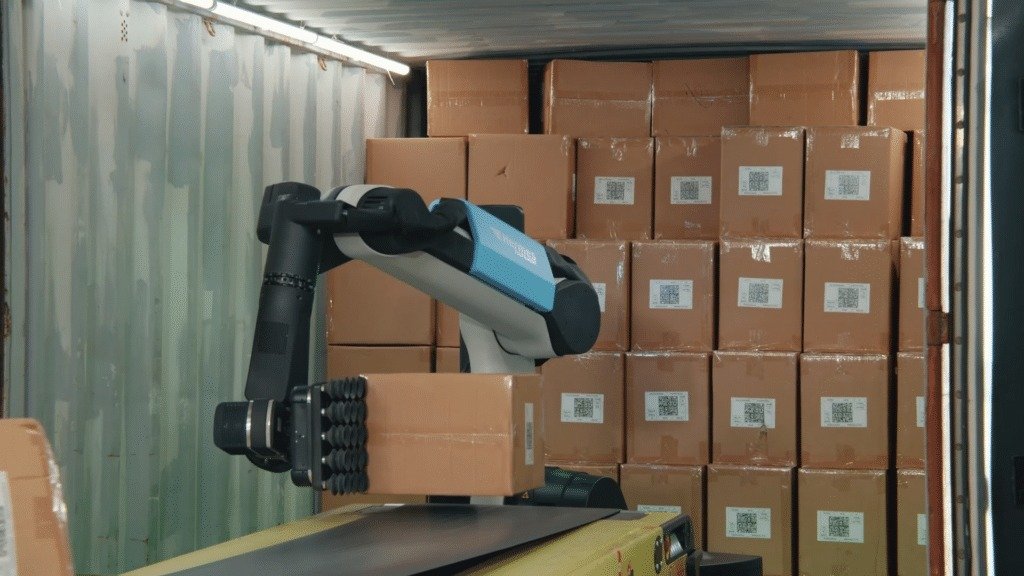
The interesting part of this deployment does not end when a box is lifted. It must move into the next process, and the operator must know when work can safely begin. Those handovers reveal more about automation than an impressive arm movement alone.
What the source supports
Boston Dynamics describes Stretch unloading boxes at Hermes Fulfilment in Haldensleben. An operator positions the robot and performs a safety check. Stretch coordinates with a telescopic conveyor, while label orientation matters for downstream scanning. An announced plan for more than 20 group facilities is not confirmation that the entire rollout was completed.
A robot task needs a beginning and an end
When assessing a similar system, define when a box becomes the robot’s responsibility and where the next stage accepts it. Automated unloading does not mean automated handling of every delivery, resolution of every exception or completion of the warehouse operation. A precise boundary makes quotations easier to compare fairly.
A lifted box is not yet a completed task
For your trial, add successful conveyor handover and label reading to the acceptance conditions. A lift counter alone may hide corrective work at the next station. Measure boxes correctly processed from start to finish and interventions per defined number of units. Distinguish a failed pick, a line stoppage and an exception requiring a human decision.
What would remain for your operator?
Ask the supplier to list actions before startup, during exceptions and after a trailer is finished. Include questions about moving to another work area, damaged cartons and restarting after a stop. This is a proposed deployment discussion, not an assumption that every site organises work exactly like Hermes.
A trial that reveals more than a video
Use a representative load with a range of sizes, weights, positions and packaging conditions permitted for the system. Agree on stopping and acceptance conditions with the site team. Record preparation and exception handling, not only the best part of a cycle. Then assess the effect on throughput and human workload.
What remains unconfirmed
We do not provide an unverified cost, payback period or current fleet size. The supplier’s case supports the described application; it is not our site audit or confirmation of the entire fleet’s present status.
View this location in the deployment atlas
Source and method
Boston Dynamics — Hermes Fulfilment
Redakcja RoboMorrow · source reviewed 17 Oct 2026. The reported facts come from the supplier’s case; deployment questions and acceptance methods are editorial analysis. We have not conducted an on-site test.
Stretch grips a carton beside a conveyor in the Hermes Fulfilment case study. Photograph: Boston Dynamics.