HONOR Lightning Runs 100m in 9.32s, Faster Than Bolt's Record
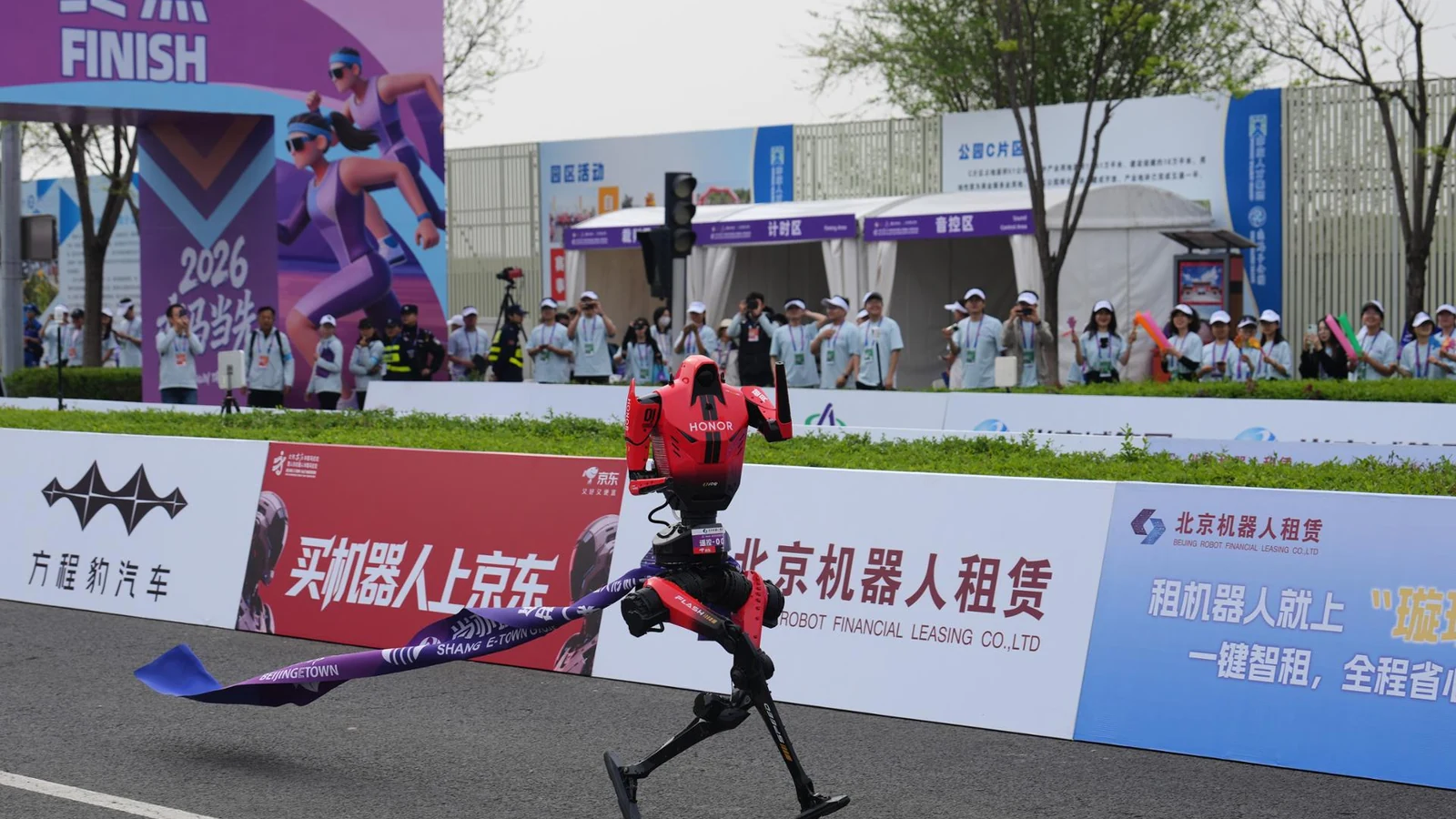
HONOR's Lightning humanoid ran 100 metres in 9.32 seconds during a test ahead of the second World Humanoid Robot Games in Beijing. That is 0.26 seconds faster than Usain Bolt's 9.58-second men's world record. The crucial caveat is that this is not an athletics record certified under World Athletics rules. China's state broadcaster reported the test, and Reuters published the result on August 22.
According to CCTV, the robot reached a peak speed of 14.5 m/s, or about 52.2 km/h. A 9.32-second 100 m time corresponds to an average speed of roughly 10.73 m/s. The Bolt comparison is therefore striking and easy to understand, but technically it is a comparison between a machine's test time and the human record, not a new world record in athletics.
9.32 seconds is remarkable, but the methodology matters
Reuters attributes the result to Chinese state television and does not present an independently measured timing result. Public reporting also does not provide a complete methodology equivalent to an athletics competition: starting procedure, track certification, timing system, test conditions and independent ratification are not documented. RoboMorrow therefore does not label 9.32 seconds an “official humanoid world record”.
The exact autonomy level during the sprint is also unclear. That distinction matters because fast locomotion, autonomous navigation and autonomous task execution are separate robotics problems. A machine can have exceptional motion control and mechanics while still using external control, a prepared trajectory or test infrastructure. Until HONOR or the event organizer publishes more detail, autonomy during this particular run should remain unconfirmed.
Lightning had already demonstrated unusual endurance
Today's sprint is not an isolated demonstration. On April 19, Lightning won Beijing's humanoid half-marathon with a net time of 50 minutes 26 seconds. Xinhua described the 169 cm HONOR robot as a machine built for speed and explosive power. IEEE Spectrum later highlighted liquid cooling, gearing, weight optimization and large leg motors as important parts of the engineering behind the performance.
The hardware was modified ahead of the August competition. CCTV, as quoted by Reuters, says the robot's legs were lengthened from about 95 cm to 105 cm. This is a clear example of optimizing hardware for a specific benchmark: longer legs can increase stride length and speed potential, but that does not mean the same configuration is optimal for factory walking, table-side manipulation or safe movement around people.
What does a humanoid this fast actually demonstrate?
The most interesting story is not the viral “robot beats Bolt” framing. It is the set of engineering problems that must be solved to keep a biped stable at this level of dynamics. The controller has to manage foot contact, centre-of-mass motion, joint torque and transitions between stance and flight phases at very short time intervals. Mechanical loads, thermal management and power delivery also become much more demanding.
That is where Lightning's result may matter beyond a sports demonstration. Improvements in actuator durability, thermal efficiency and dynamic control can eventually transfer into logistics, industrial or emergency-response robots. IEEE Spectrum nevertheless points to an important trade-off: a robot optimized for running does not automatically become the most efficient platform for ordinary walking or general-purpose work.
Speed is not the same thing as usefulness
RoboMorrow separates four layers: locomotion, manipulation, autonomy and real-world usefulness. A sprint mainly measures the first. A factory buyer may care more about task success rate, human interventions, cycle time, MTBF, safety and cost per operating hour. A home robot adds privacy, reliability and the ability to handle an unpredictable environment.
That distinction is especially relevant at this year's World Humanoid Robot Games, where dexterous-hand tests and work scenarios sit alongside spectacular sports events. In our analysis of the 2026 Games, we explain why teleoperation and full autonomy should be reported separately. Lightning is an impressive mobility benchmark, but it does not tell us whether the robot can independently complete useful work.
Why this result matters for the humanoid market
Only a few years ago, many biped demonstrations were impressive simply because the robot remained upright. In 2026, specialized platforms are increasingly pushing individual performance metrics beyond human ranges. That signals rapid progress in actuators, mechanics and control, while also warning against judging the entire humanoid industry by one spectacular clip.
HONOR is particularly interesting because the company comes from consumer electronics and is now developing its own humanoids. The transfer of expertise in batteries, cooling, electronics and AI into Physical AI illustrates how broad China's robotics ecosystem is becoming. For Europe, the more important question is not who wins a sprint, but who can turn similar hardware progress into reliable deployments.
What do the sources confirm, and what remains open?
Reuters reports that the 9.32-second time and 14.5 m/s peak speed come from China Central Television. The agency describes the run as a preparatory test event for the second World Humanoid Robot Games, which opened in Beijing on August 22. That is strong confirmation that the test was publicly reported, but it is not the same thing as independent ratification. The published report does not provide a complete timing-system specification or a procedure equivalent to World Athletics competition standards.
HONOR's official robotics event page describes the D1 half-marathon platform as using autonomous perception and navigation together with an in-house high-dynamic motion system. Xinhua separately reported that the winning 50:26 half-marathon performance was completed in autonomous-navigation mode. That fact cannot simply be carried over to today's sprint: Reuters does not specify how Lightning was controlled during the 100 m test. RoboMorrow therefore keeps the autonomy status of the 9.32-second run explicitly unconfirmed.
14.5 m/s is not an average speed of 52 km/h
Two figures that can easily become blurred in headlines should also be kept separate. CCTV's 14.5 m/s figure, about 52.2 km/h, is a peak speed. A 9.32-second time over 100 m corresponds to an average of roughly 10.73 m/s, or 38.6 km/h. Both figures can be true at the same time: the robot accelerates, reaches a higher instantaneous speed and completes the distance at a lower average. Future comparisons between humanoids should therefore look beyond peak numbers to repeatability, stability and a clearly documented test method.
Sources and photography: full transparency
RoboMorrow bases this report on fresh Reuters/CCTV reporting, official HONOR material and Xinhua's earlier coverage of the half-marathon. The featured image is an authentic photograph of Lightning at the Beijing half-marathon on April 19, 2026, published by The Korea Times with an AP-Yonhap credit. It is not a photograph of today's 100 m test and is used only to identify the robot. We state that distinction deliberately so the visual does not imply documentary coverage of the 9.32-second run.
RoboMorrow verdict
9.32 seconds is a powerful demonstration result and one of the clearest symbols yet of how quickly humanoid locomotion is improving. There is still no basis for presenting it as an official world record in the sporting sense. A complete assessment requires timing methodology, autonomy details and independent validation so that different platforms can be compared on equal terms.
The best way to read the news is simple: Lightning did not “take Usain Bolt's record”. It demonstrated that a specialized humanoid can now cover 100 metres in less time than the human world-record mark. That is already a substantial enough change to deserve attention.